« March 2007 | Main | May 2007 »
Monthly Archives: April 2007
Supreme Court Decision Update - Microsoft Corp. v. AT&T Corp.
 Today’s second patent decision from the Supremes comes in Microsoft Corp. v. AT&T Corp. (PDF of the opinion) and is about the shipment of software overseas. AT&T sued Microsoft over copies of Windows it ships oversees for installation on foreign computers, because the Windows code includes bits that are patented by AT&T. In a 7-1 decision, the Supremes fall back on “the general rule under United States patent law that no infringement occurs when a patented product is made and sold in another country.”
The focus here was on an exception to this rule when someone sells a component necessary to make the patented invention. AT&T tried to argue that the Windows software, along with AT&T’s patented bits, was a “component” of the foreign computers being sold with Windows pre-installed, thereby pulling Microsoft within this exception. So there are two questions in this case - when does software qualify as a “component,” and whether the “components” in this case were supplied by Microsoft from the US.
As to the first question, Justice Ginsburg’s majority opinion held that software is considered a component when it’s made into something more than intangible information - when it’s made physical in a way that computers can read it, such as when it’s put onto a CD. But Microsoft sends out master copies of Windows, either on a master disk or electronically, which are in machine-readable object code and akin to information in a blueprint - it’s a roadmap, rather than an actual component. Only when there’s the “extra strep” of making copies of the software which machines can interact with is there a component, says Ginsburg.
And that, she adds, answers the second question - Microsoft isn’t making the “components” in this case. It’s the foreign companies that make the components when they make copies from Microsoft’s master. So Microsoft supplies from the United States, but it’s not actually supplying a component. Which means AT&T is S.O.L. in this situation (not to mention, says Ginsburg, there’s a “presumption against extraterritoriality” which weighs against AT&T if there was any doubt here).
Now the majority opinion was only joined in full by the Scalia and Justices Kennedy and Souter. Justice Alito wrote a concurring opinion, joined by Justices Thomas and Breyer - while Alito agrees that there were no “components” supplied by Microsoft from the US, he gets there in a different way. In his mind, “no physical object originating in the United States was combined with these [foreign] computers,” since no physical part of the software disk sent out by Microsoft becomes a physical part of the final foreign computer. So that is why he says Microsoft is okay here.
As an aside, Alito concurs with all but one footnote of Ginsburg’s opinion. In footnote 14, she said: “Microsoft suggests that even a disk shipped from the United States, and used to install Windows directly on a foreign computer, would not give rise to liability…if the disk were removed after installation…. We need not and do not reach that issue here.” But Alito doesn’t concur with this one point because “the physical incarnation of code on the Windows CD-ROM supplied from the United States is not a “component,” [which means] it logically follows that a copy of such a CD-ROM also is not a component.”
Finally, there is a lone dissent filed by Justice Stevens (yes, Chief Justice Johnny is missing - he wasn’t involved in this case). He thinks that finding Microsoft liable is more in check with what Congress intended when it created the “component” exception: “if a disk with software inscribed on it is a ‘component,’ I find it difficult to understand why the most important ingredient of that component is not also a component.”
Supreme Court Decision Update - KSR International Co. v. Teleflex Inc.
 The first of today’s two patent cases is KSR International Co. v. Teleflex Inc. (PDF of the opinion), and it’s about the obviousness requirement. As Dennis Crouch succinctly explains, the unanimous opinion authored by Justice Kennedy “appears to simply refine the particulars of how prior-art can be combined and when a ‘combination patent’ will be seen as obvious.” This, Crouch says, means that “patents will be more difficult to enforce and easier to invalidate.”
The facts behind this case are quite involved, delving into several patents relating to adjustable car pedals. The important thing to know to understand this case is that Teleflex got a patent for one such adjustable accelerator pedal which arguably did little more than combine technologies and aspects covered by earlier patents (so-called “prior art”). Teleflex then sued KSR for infringement of this patent, which is how this got in front of the courts.
Now the patent laws say that you can’t get a patent when the covered technology would be obvious to one skilled in the art, and KSR argued that Teleflex’s patent was obvious, meaning it should be invalidated. Both the District Court and the Court of Appeals for the Federal Circuit disagreed, ruling that Teleflex’s patent wasn’t obvious and was therefore valid.
When the Federal Circuit looks at the question of a patent’s obviousness, it applies “the teaching, suggestion or motivation’ test (TSM test), under which a patent claim is only proved obvious if ‘some motivation or suggestion to combine the prior art teachings’ can be found in the prior art, the nature of the problem, or the knowledge of a person having ordinary skill in the art.” KSR says this test is no good, and the Supremes basically agree.
In a unanimous opinion, Kennedy says that the Federal Circuit’s test is too narrow. He points out several flaws in the way the Federal Circuit analyses patent obviousness, and wraps things up with this little bit about how we need to basically balance the need for restrictive patents with the need for allowing room for growth and invention of new things:
We build and create by bringing to the tangible and palpable reality around us new works based on instinct, simple logic, ordinary inferences, extraordinary ideas, and sometimes even genius. These advances, once part of our shared knowledge, define a new threshold from which innovation starts once more. And as progress beginning from higher levels of achievement is expected in the normal course, the results of ordinary innovation are not the subject of exclusive rights under the patent laws. Were it otherwise patents might stifle, rather than promote, the progress of useful arts. See U.S. Const., Art. I, § 8, cl. 8. These premises led to the bar on patents claiming obvious subject matter established in Hotchkiss and codified in § 103 [of the Patent Act]. Application of the bar must not be confined within a test or formulation too constrained to serve its purpose.
Supreme Court Decision Update - Scott v. Harris
 This may be the best Supreme Court decision ever because on the Supreme website, you don’t just find the written opinion, but a downloadable video (Real Player format) of a high-speed car chase. Who doesn’t love high-speed car chases? Nobody, that’s who.
So back in 2001, a local deputy busted a car for speeding. He tried to pull the driver over, and this turned into a high-speed chase, which Deputy Timothy Scott joined. The chase ended when Scott used his car to push the fleeing car off the road. The car crashed and the fleeing driver wound up a quadriplegic. He then filed a civil rights lawsuit, claiming that Scott had used excessive force resulting in an unreasonable seizure under the Fourth Amendment. Scott tried to have the case thrown out on the basis of “qualified immunity,” but the District Court and Eleventh Circuit said that Scott’s actions might be considered “deadly force,” and that the use of deadly force in this particularly situation may have been a constitutional violation.
In an 8-1 decision, the Supremes reversed, finding that the driver initiated the chase and, as such, he had caused a serious risk to others which authorized Scott to use possibly deadly force to get the car chase off the road. This 8-1 majority opinion was written by the Scalia, and joined by everyone but Justice Stevens. Stevens filed a dissenting opinion, and there were also two concurring opinions from Justices Ginsburg and Justice Breyer.
As I mentioned, there is a video of the car chase. The Scalia says that this video quite clearly shows events which contradict the plaintiff’s version of how things went down (the plaintiff claims that there was no risk to others, that he didn’t run any cars off the road, etc.), and that no reasonable jury could believe his story. As such, the lower courts were wrong to adopt his version of facts in considering Scott’s summary judgment motion (as you may know, when a party moves for summary judgment, the court will generally accept the other side’s alleged facts as true for the purpose of resolving that motion). And in light of the facts as shown on the video, says the Scalia, it’s clear that there was no Constitutional violation. This is because the question is, regardless of whether or not Scott’s actions were “deadly force,” were they reasonable.
And the Scalia says this was a reasonable seizure in light of the high likelihood of injury to others (which justified the intrusion made by Scott ending the chase). And Scalia is not willing to make a rule requiring cops to stop their chases, as that rewards drivers who drive so recklessly that they create these dangerous high-speed situations:
A police officer’s attempt to terminate a dangerous high-speed car chase that threatens the lives of innocent bystanders does not violate the Fourth Amendment, even when it places the fleeing motorist at risk of serious injury or death.
Justice Ginsburg filed a one-page concurrence, just to say that she doesn’t think the majority opinion articulates “a mechanical, per se rule.” So there may be a situation where an attempt to end a high-speed chase results in a Constitutional violation, she doesn’t think this was such a case. Justice Breyer, meanwhile, filed a concurring opinion for a couple of reasons. He agrees with Ginsburg’s point, and says so. He also suggests “that the interested reader take advantage” of the Court’s publication of the chase video “and watch it.” Right on, Breyer! Finally, Breyer notes that while some precedent was overturned by the majority, he thinks that “stare decisis concerns are at their weakest here” because there has been “little reliance” on those earlier cases.
Lastly, Justice Stevens filed a dissent because he thinks there not only should not be a hard-line “per se rule” (like Ginsburg and Breyer said), but he thinks that there is room for different interpretations of the video in this instance. He says the majority actually makes an “unprecedented departure from our well-settled standard of review of factual determinations made by a district court and affirmed by a court of appeals,” and he’s having none of it.
American Idiot
 That “American Idol” television program is a crazy PR machine. Three days before season two near-finalist, Olivia Mojica, is set to release the first ever “AI”-related sex tape, “Hardcore Idol” (which is “very explicit” and has over 40 minutes of “hot sex,” and is in stores Thursday!), an actual finalist from the 2005 season is focusing even more attention to the show, because being number one and number two in the Nielson ratings every single week just isn’t enough.
Jessica Sierra, who papers are reporting is best remembered for her remake of “Total Eclipse of the Heart” (completely untrue — she’s not remembered at all), was arrested early Sunday morning out in Tampa, Florida. She was booked on a charge of “assault with a deadly weapon” after slamming a drinking glass over a man’s head, inflicting a cut over his eye. She was also charged with possession of cocaine after officers found some of the good stuff on her while performing a search of her person. During the arrest, police had to threaten to shackle her legs because she attempted to kick out the window of the police cruiser.
While posing for her mug shot, Sierra reportedly kept holding up eight fingers, indicating which contestant viewers should vote for. Police also rebuffed Coca-Cola’s efforts to have Sierra hold up one of their products while taking the photo.
Supreme Court Decision Update - EC Term of Years Trust v. United States
 The Supremes ushered out five opinions today, and we’re gonna’ talk about EC Term of Years Trust v. United States (PDF of the opinion) first, because it’s nice and short. In a unanimous opinion written by Justice Souter, the Supremes were looking at a very specific situation involving a third party challenging the IRS when it levies upon that third party’s property to collect taxes owed by another.
If that doesn’t make much sense to you, I don’t blame you. Here’s the deal. The IRS may sometimes levy upon some property to collect on taxes someone else owes. In this case, a couple had formed the EC Term of Years Trust back in 1991. This couple owed the IRS some money, and the IRS took a tax lien against the Trust, assuming the couple had illegally transferred money to it. The Trust denied any tax obligation on the couple’s behalf, but to avoid further financial issues, it put money in a bank account which the IRS then levied, eventually getting a $3 million check from the bank. A year later, the Trust sued the IRS, claiming a wrongful levy. However, the Internal Revenue Code says that you have nine months (from the date of the levy) to challenge a levy you think was wrongful. So the case was thrown out for being filed too late.
The Trust tried to claim that it was allowed to sue the IRS under the auspices of seeking a tax refund, but the Court was unpersuaded. And today, the Supremes agreed that this argument is no good. When your property is wrongfully levied by the IRS, your only remedy is to sue them under that 9-month provision of the Internal Revenue Code. And since the Trust didn’t sue within nine months, the IRS just made a cool $3 million which it might not otherwise be entitled to keep. Government at work, baby!
It should be noted that this decision was also yet another Supreme slap in the Ninth Circuit’s face, as it has previously ruled that this 9-month provision “is not the exclusive remedy for third parties challenging a levy.”
Wat a minute. Where’s your long-winded analysis, with all the questions like this one? Well, QuizLaw is changing these Supreme Court Decision Updates up a little. Quite frankly, it’s just too much for us to do the in-depth breakdowns on every case, while also holding down day jobs, trying to maintain semblances of a life, personal relationships, etc. I mean, the Supremes issued five opinions today, coming in at over 140 pages. That’s a lot, and our long-winded breakdowns take time. If some wealthy, VC-type QuizLaw reader wants to talk to us about underwriting the Updates, we’d be happy to listen. But as that’s rather unlikely to occur, we’re all going to have to settle for shorter, quick and dirty updates (although we’ll try our best to give more in-depth looks at really “big and important” decisions, but no promises).
S’all right?
S’all right.
Only in America The Rest of the World is Full of Dumbasses, too!
 We generally stick to domestic legal stories, but I thought I’d introduce tales of a couple of international cases just to demonstrate to our seven readers that the jury system is just as screwed in other countries as it is here in the States.
Take, for instance, a Canadian man who stole over $100 worth of razor blades at a supermarket. Employees at the supermarket discovered that he’d stolen them and, during the course of their arrest, handled him a little too roughly, i.e., he lost a tooth and now he has difficulty speaking. He’s been awarded $12,000 Canadian dollars (a.k.a. funny money) in damages. And given the price of razors today (I used to lift the occasional pack during my poorer law school days; the prices are freakin’ outrageous — I grew a beard over the winter and saved enough money to put a down payment on a house), he ought to be able to buy at least a couple new packages of razor blades, though I do understand that Canadian money is only good for games of Monopoly.
Elsewhere, in Australia, a judge has found in favor of a mentally retarded apprentice hairdresser and awarded her upwards of $500,000 after the woman lost her leg in a railroad accident. The 26-year-old woman, Leigh Ann Russell (who reads at an 8th grade level) saw a group of young men painting graffiti near the train; one of the boys then jumped up onto the ladder attached to the train.
Ms. Russell told the court the boy made it look “like he was a star athlete at it”.“Because he made it look so easy I go, ‘I could do this too,’ ” she said, agreeing that she copied him because she wanted to look “cool.
But she realized she was in trouble as the train sped up.
She let go of the ladder and was dragged over rocks beside the track, injuring her right leg so badly it had to be amputated below the knee.
Now, if you really want to look “cool,” Ms. Russell, you ought to get yourself one of those Grindhouse legs.
The Daily Memo - 4/30/07
 New York’s governor, Eli Spitzer, has proposed a bill legalizing gay marriage, although he expects the state legislature to reject the legislation. (Yahoo! News)
The new “Internet Radio Equality Act” looks to save internet radio by, among other things, getting rid of the new royalty rate hike - but since that hike takes effect on May 15, don’t hold your breath on this getting through in time. (Download Squad
If you are a California convict, you can hook yourself up with a posh cell for just $75 to $127 a day. (Houston Chronicle)
A man has been charged with theft for spending $80,000 that had been accidentally deposited into his bank account. (CBS News)
The Feds are trying to figure out who’s responsible for leaving over 700 pounds of cocaine on a flight from Mexico that landed at Chicago’s O’Hare on Friday. (Chicago Tribune)
Hand out over 1,000 fliers with naughty pictures of your ex-wives and you, too, can have a face-to-face meeting with the police. (Wave 3)
Tennessee’s Senate has passed a bill approving the sale of booze in the state’s zoos. (CBS46)
Yet another shining example of lawyers at their best
 Cynthia D. Garris is a defense lawyer in Virginia who has now been publicly reprimanded by the state bar. Last summer, she was in court for a case and told the judge that she needed to postpone the proceedings because of a conflicting commitment in another court. The judge gave Garris her postponement, only to later learn that she had used this new free time to go shopping. He smacked her with a contempt ruling and a $250 fine, and she of course apologized for her actions, saying it was “immature, selfish and inexcusable.”
“But,” she allegedly added in a statement to the state bar, “just look at how my new shoes match my new briefcase. This kind of fabulous pairing doesn’t just happen by itself. It takes work, your honor.” But it would seem that the Virginia State Bar just doesn’t care about good fashion.
Can we just start calling him “former Senator” now?
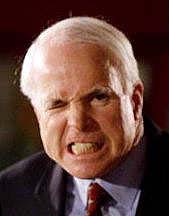 You know, one of the pieces of legislation John McCain is best known for is one which happens to bare his name - the McCain-Feingold Act, a 2002 bill which enacted campaign finance reform. Maybe McCain needs to revisit campaign reform, and pass some sort of limits on how much a politician’s current job he or she can skip out on while campaigning for reelection or a new public job.
Of course, McCain would suffer more than most under such a regime, since he’s now been deemed the “most absent Senator in [the] 110th Congress.”. Technically, he’s actually second on that list, but Senator Tim Johnson gets a pass since his absences are due to his unfortunate brain hemorrhage last December.
Meanwhile, McCain has missed over 40 percent of the Senate’s role-call votes to date, a fact which he happily ignores while hypocritically attacking other candidates for their own voting:
While McCain did not have time to vote against the [Iraq] withdrawal plan [on Friday], he did find time to release a harsh statement attacking the Senators who did not vote to begin redeployment. “We need to send a bill to the President that he can sign, and we need to do it as soon as possible,” he said.
He added: “…well, as soon as possible, so long as it doesn’t interfere with kissing babies. I mean, priorities people! Why try to help our soldiers and run our country and all these things when there are palms to be pressed?”
…and the public perception of lawyers falls another dozen notches
 Roy Pearson, a Washington DC lawyer, took his pants to the dry cleaners, and now he’s trying to take the dry cleaners to the dry cleaners (that bad joke’s free, but the next one is gonna’ cost you!). A couple of years ago, Custom Cleaners lost some pants Pearson had brought in for a $10.50 alteration. So he did what lawyers do best, and he filed a lawsuit.
The case is set for a June trial, and it should be interesting to see this scumbag in action.
“But Seth,” you say, “he filed a lawsuit because they lost his pants - why does that make him a scumbag?” Well reader, I say, he’s not a scumbag because he’s suing them, per se. He’s a scumbag because he wants … $65 million!
He says he deserves millions for the damages he suffered by not getting his pants back, for his litigation costs, for “mental suffering, inconvenience and discomfort,” for the value of the time he has spent on the lawsuit, for leasing a car every weekend for 10 years and for a replacement suit.
Oh yeah, and he’s not just a scumbag lawyer. This wonderful human being is also a judge!
Go read the story and be amazed at the sheer lunacy.
“How come all my food tastes like motor oil?”
 Roger Bean of West Palm Beach, Florida (…where else?) has been hit with charges of running a dental office out of his garage. An illegal dentist’s office, as he is unlicensed – the 60-year-old has allegedly been making false teeth and dentures, charging $200 for what usually costs over two grand.
And not only was the work itself illegal, but there were serious health risks, as his garage has been described as “filthy.”
Personally, I love the fact that his clients “praised Bean for saving them thousands of dollars.” I mean, I understand that some elderly folks may not have the money to afford proper dentures. But can they really be all that happy about the potential disease and infestation they’re putting into their mouth each and every day? I mean, is the Plague really worth it?
Oh, that’s right. These folks are all Floridians too. They probably actively seek out the Plague. …I love Florida.
The Daily Memo - 4/27/07
A judge has ruled that the University of Wisconsin-Madison has to give the RIAA the names and contact info for 53 students. (Wisconsin State Journal)
A big anti-spam lawsuit is being filed in Virginia seeking the identity of some of the folks who help spammers harvest e-mail addresses. (Slashdot)
Turns out popular belief is wrong, as a law professor has compiled evidence suggesting that malpractice juries actually tend to side more with doctors rather than with plaintiffs. (Law.com)
A Chicago-area student was arrested after writing an essay which got his teacher and school administrators worried about a potential Virginia Tech-type situation. (Chicago Tribune)
Is there a criminal legal doctrine based on “thrusting?”
 Twenty-nine-year-old Tiffany Weaver has pleaded guilty to identity theft and using someone else’s government ID. She was charged with posing as a lawyer so that she could get into a Baltimore City prison to have sex with one of the inmates. While she confesses to using the fake ID, she says there was never any prison sex, despite prison officials saying that they saw the sex.
Her attorney denied the sex charges as well, putting it thusly: “There was never any sexual intercourse. There was no thrusting whatsoever.” No. Thrusting Whatsoever.
…Are we sure this guy isn’t impersonating a lawyer as well?
Who’s got bigger balls?
 On Wednesday, the House Oversight and Government Reform Committee subponead Condoleezza Rice to come give testimony about the original justifications of the Iraq invasion. The subpoena came after the Committee voted in favor of it in a 21-10 vote which fell along party lines. The subpoena “directs her to answer questions from the panel next month about the administration’s claim — later proven false — that Iraq had sought uranium from Niger for nuclear arms.”
But she and the administration are planning to fight the subpoena, more or less, as Rice has said she’ll only reply with a letter. “I’m way to important to actually come talk to y’all,” she is alleged to have said. (Allegation comes solely from QuizLaw.) So study up on executive privilege, as it sounds like the doctrine will be coming up yet again next month, as this whole mess plays out.
(And if you’re curious, Slate explains “why Congress has the power to make arrests.”)
Mmmmm…pie
From the always brilliant Indexed comes this very simple breakdown of a fundamental civics lesson:

Church vs. State: Two Case Studies
 Well, the church vs. state argument is still alive and well, as demonstrated by these two cases.
First, in Connecticut, a federal judge has ordered that post offices run by churches and other religious organizations cannot promote religion within the confines of the post office.
The religious displays “put the church’s beliefs front and center, out for the public to see, endorsing the church’s form of Christianity and seeking outsiders to join the church in its mission,” U.S. District Court Judge Dominic J. Squatrito wrote in a decision handed down last week. The displays “violate the Establishment Clause of the First Amendment.”
The case was brought by a Jewish war veteran and the Connecticut ACLU, who complained that the local post office — run by Sincerely Yours Inc., which is part of the Full Gospel Interdenominational Church — violated the vet’s First Amendment rights because the post office was full of Christian messages and symbols.
But, in another case in Ohio, a man who was arrested for trying to use a stolen credit card at a drugstore was freed. When Eric Hine appeared in court, his lawyer told the judge that his bond should be set low because Hine was an avid churchgoer. The judge, skeptical of Hines’ religiosity, asked him to recite the 23rd Psalm. He did: all six verses.
The courtroom broke into applause and Hine was released on a $10,000 appearance bond (meaning he only has to pay it if he doesn’t show up).
The Case of the Overbilling Dickhead
 Florida. Overtime Case. Dickheads. Here we go:
Two weeks ago, Chief Judge William Zloch denied attorney Peter Mavrick’s request for attorney fees of around $150,000, giving him instead $4,900 and barring him from receiving any further funds from his client’s settlement. In the case, Mavrick and his opposing counsel, Jeffrey Norkin, worked over three years, made 276 filings, and racked up hundreds of thousands in legal fees.
But the irony here is that the case was a simple, straightforward overtime dispute, where the employee sought only $11,000 from her employer for back wages, and the employer actually settled the case for that amount.
So, what the hell? Well, apparently, the two lawyers didn’t get along very well and the personal dispute between the two led to this unnecessarily protracted litigation of a case that the judge said should’ve taken about 19 hours, instead of the 455 billed by one attorney at $300 an hour. At various times during the course of the case, the lawyers were not on speaking terms, complaints were filed against the Florida bar, the plaintiff was called “a bitch” by opposing counsel, a door was shut on a court reporter, knocking the elderly woman out of her chair, and best of all was this:
After the overtime pay suit was filed, the relationship between Mavrick and Norkin quickly deteriorated. Norkin claimed that when Mavrick called him to schedule a deposition, Mavrick started the conversation by saying, “Dickhead, when can we do this deposition?”“I went around the office, stunned, telling everyone, this guy just called me a dickhead,” Norkin said. But Mavrick claimed that Norkin called him a dickhead, and put the accusation in court papers.
What the lawyers should’ve done, however, was to simply explain to the judge that, according to the Urban Dictionary, “dickhead” is a synonym for lawyer. So, the two were just referring to each other by their more informal titles.
Supreme Court Decision Update - Smith v. Texas
 In yesterday’s Smith v. Texas (PDF of the opinion) decision, the Supremes took a second look at a case about Texas death sentence jury instructions (the same type of instructions they looked at in yesterday’s other two cases). The Supremes ruled that the Texas appeals court botched the issue, as there were procedural problems with the instructions, meaning that Smith’s constitutional rights were violated.
QuizLaw Analysis: This case came up to the Supremes in 2004. Now, the Supremes basically tell the Texas court that it got everything all wrong, and it should’ve just done things right after that 2004 opinion, i.e., “these instructions were bad and you have to rule that Smith’s death sentence gets tossed, and we’ll keep telling you this until its gets through your fat collective head.”
So this is Smith’s second time in front of the Supremes? Yessir. A while back, LaRoyce Lathair Smith was convicted of brutal first-degree murder in Texas, and a jury hit him with the death sentence. In imposing the death sentence, the jury had to look at some special issues, which is what this case is all about.
What are special issues? Ok, so we’re talking about Texas law here. Now when we look at a jury verdict form in Texas, there are several so-called special issue questions, which are intended to help the jury figure out if the death penalty should be imposed in a particular situation. At the time Smith was on trial for murder, Texas law looked at three special issues: whether the murder was deliberate, whether there was future danger, and whether the murder was an unreasonable response to any provocation by the victim. That third issue didn’t come into play in Smith’s case, so the jury just looked at the questions of deliberateness and future danger and, because they answered “yes” to both questions, they imposed the death penalty.
But what about mitigating factors? Good question, grasshopper. The Supremes actually looked at these two special instructions in another case, Penry v. Lynaugh (which we call Penry I). The Supremes ruled that the instructions weren’t broad enough to allow the jury to consider mitigating evidence, which creates a constitutional problem: “We refer to the inadequacy of the special issue instructions as “Penry error.”
So why were these special issue questions used in Smith’s case? After Penry I, for a time, the Texas courts tried to cure the Penry error with a so-called nullification charge. The judge in Smith’s case used such a charge:
In Smith’s case the trial court instructed that if a juror was convinced the correct answer to each special-issue question was “yes,” but nevertheless concluded the defendant did not deserve death in light of all the mitigating evidence, the juror must answer one special-issue question “no.” The charge was not incorporated into the verdict form. In essence the jury was instructed to misrepresent its answer to one of the two special issues when necessary to take account of the mitigating evidence.
Well that doesn’t sound right. Correct - it isn’t. In Penry v. Johnson (Penry II), the Supremes ruled that a nullification charge “created an ethical and logical dilemma” preventing juries from really allowing mitigating evidence to factor into the sentencing decision. “In other words, Penry II held that the nullification charge did not cure the Penry error.”
Anything else we need to know? Yup. Before trial, Smith filed several challenges to the jury instructions in his case, arguing that the special issue questions were unconstitutional. He had several arguments for this, one of which was that they the nullification charge needed to actually be on the jury verdict form. The trial count denied all of the challenges and as to the last one, the judge gave Smith a copy of the nullification charge and told him that he should offer any suggestions if he wanted it worded differently. Smith declined to offer any such suggestions, so the charge was given to the jury as originally written (although it still wasn’t on the verdict form). The jury answered “yes” to both of the special issues, and Smith was smacked with the death sentence.
After the trial, Smith filed a whole bunch of appeals and habeas petitions. This case largely turns on what issues, exactly, Smith raised during these appeals and the petitions. The majority’s opinion spends quite a few pages looking at it all, but it basically boils down to this - the majority says that Smith was always contending, primarily, that the special issue questions suffered from a Penry error (and not, as Texas argued, that the real problem here was jury confusion caused by the nullification charge).
So who is the majority here? Same as in yesterday’s other two cases, although this one was penned by Justice Kennedy (and joined by Justices Stevens, Souter, Ginsburg and Breyer).
Wait – didn’t you say Smith was already in front of the Supremes? That’s right. The Supremes issued an opinion in 2004 where they ruled that the Texas Court of Criminal Appeals was wrong in denying Smith relief, because there was definitely a Penry error. And even though the nullification charge given in Smith’s case was different from the one considered in Penry II, those differences were “constitutionally insignificant,” meaning the nullification charge didn’t fix the Penry error and was inadequate underPenry II.
So how did we end up back with the Supremes? The case went back down to the Texas Court of Criminal Appeals, which again denied relief to Smith. This time, the court said that Smith had not preserved the right to make a Penry II challenge because at trial he wasn’t actually challenging the jury charge, but was really challenging the state statute authorizing the special issue questions. This, the court said, was a procedural error which it could only consider if there was egregious harm, not just some harm. And the court said there wasn’t any egregious harm, so relief denied.
Can we finally to get to the meat and potatoes of this decision? Kennedy being by reiterating that the special issue questions used in Smith’s trial suffered from a Penry error which was not cured by the nullification charge. That’s what Smith I was all about. Kennedy clarifies that the basis of the Court’s ruling in Smith I had to do with the error arising from the defecting special issue questions, not any error specifically caused by the nullification charge.
So the appeals court botched this on remand when it interpreted Smith I as granting relief in light of an error with the nullification charge. And, says Kennedy, if you look at all of Smith’s post-trial arguments, as well as the resulting state court judgments, it’s quite clear that Smith was always attacking the special issue questions (specifically the jury charge, not really the Texas statute), and that his argument never changed.
And so it all just boils down to this - the appeals court was all confused, misunderstanding how Penry I and Penry II work together, “and it mistook which of Smith’s claims furnished the basis for this Court’s opinion in Smith I.”
And what’s the right standard of review? The Texas court said that Smith’s claim wasn’t properly preserved, and thus Smith had to show egregious error. But Kennedy just said the objection was properly preserved, so the Texas court was wrong on this. Thus, if there’s “‘a reasonable likelihood the jury believed it was not permitted to consider’ some mitigating evidence,” the appropriate error standard is met. And the state court is “required to defer to our finding of Penry error, which is to say our finding that Smith has shown there was a reasonable likelihood of that the jury interpreted the special issues to foreclose adequate consideration of his mitigating evidence.” Which means it appears that Smith is entitled to relief.
And what of the dissent? Actually, we have a concurring opinion first.
Ok - so what of the concurrence? Well Justice Souter wrote a quick little thing, and I’ll just quote it, as it would take me longer to summarize it:
I join the Court’s opinion. In some later case, we may be required to consider whether harmless error review is ever appropriate in a case with error as described in Penry v. Lynaugh, 492 U.S. 302 (1989). We do not and need not address that question here.
That’s the extent of his concurrence.
Once again then, what of the dissent? The dissent here was written by Justice Alito, and joined by Chief Justice Johnny, Thomas and the Scalia. Alito says this is all less complicated than Kennedy suggests. Smith’s attorney never objected to the actual text of the special issue questions, says Alito, nor did he take up the judge’s offer to provide new language for the nullification charge. Alito says the Texas appeals court was right to therefore say an objection had not been properly preserved, and that the “egregious error” should apply. And thus, he says this is now a state law issue, which this court doesn’t even have jurisdiction over: “According, I would dismiss for want of jurisdiction.” He then explains this all in much more depth over a dozen-or-so pages, but I’ll leave the details for you to explore on your own.
Supreme Court Decision Update - Brewer v. Quarterman
 Brewer v. Quarterman (PDF of the opinion) is a companion case to Abdul-Kabir and given that the same questions are presented, the only reason I can conclude as to why the two cases were not consolidated was because the Supreme Court hates me and wants me to have to do extra work.
QuizLaw Analysis: This is another mitigating evidence case, and well, Stevens pretty much says the same thing he did in Abdul-Kabir, only now he’s got the extra weight of Abdul-Kabir as precedent. So now, when he says “clearly established law,” he can cite from the law he just clearly established with the case he wrote right before this one. Ahoy! Fortunately, both Roberts’ and Scalia’s dissent were consolidated for both cases.
Well the facts are at least different, right? Yeah. Brewer committed murder during a robbery (as did Abdul-Kabir), but Brewer introduced different types of mitigating evidence, not justabout a terrible childhood, but also about bouts of depression, hospitalization, drug abuse, and father abuse. Unlike Abdul-Kabir, however, he didn’t introduce any expert testimony.
In this case, the exact same jury instructions were given as in Abdul-Kabir, (did he deliberately murder the victim and is he a future threat of violence?) only this time, the prosecutor not only said that the sentencing jury could only consider the facts, but specifically said “[y]ou don’t have the power to say whether [Brewer] lives or dies. You answer the questions according to the evidence, mu[ch] like you did at the guilt or innocences [sic]. That’s all.”
The jury answered in the affirmative and Brewer was sentenced to death.
But, really — what is the difference between this case and Abdul-Kabir? Honestly, the only relevant difference is that Abdul-Kabir, in addition to testimony from his family, also introduced expert testimony. Brewer did not. However, while repeating his line of reasoning in Abdul-Kabir, Stevens also adds here that “the question of whether mitigation evidence could have been considered by the jury is [not] a matter of quantity, degree, or immutability.”
In other words, Stevens is saying that it doesn’t matter how much mitigating evidence you have, the amount must be given full effect and the jury still must have a “vehicle for expressing its ‘reasoned moral response’ to” mitigating evidence. Here, as in Abdul-Kabir, the jury instructions did not allow the jury to make a decision in a “reasoned, moral way.”
The Daily Memo - 4/26/07
Sigh … another dumbass gets arrested for a DUI on the way to a DUI hearing…. (Centre Daily)
North Dakota has joined Mississippi by passing a conditional abortion law which is set to outlaw abortion in the state the moment if/when the Supremes overturn Roe v. Wade. (Above the Law)
The New Jersey Supremes have ruled that public policy doesn’t support the state not rehiring a toll collector who got in trouble for shooting off a paintball gun at a car. (Law.com)
Hahahahahahaaaaa … Perez Hilton has been sued by five more paparazzi agencies for copyright infringement because of unauthorized use of their photos. Suck it, Perez. (The Hollywood Reporter, Esq.)
A Cleveland man’s last words before being put to death for the 1994 murder of his wife was that he would be helping the Browns win the Super Bowl from the afterlife. (Deadspin)
A Department of Homeland Security officer has confessed to helping run a massage parlor which (allegedly) gave happy endings. (The Buffalo News)
Supreme Court Decision Update - Abdul-Kabir v. Quarterman
 Abdul-Kabir v. Quarterman (PDF of the opinion), the first of three death penalty cases handed down by the Supremes yesterday, involves jury instructions. Specifically, it looks at whether a judge allowed constitutionally adequate consideration of mitigating evidence to be considered by a jury which wound up imposing the death penalty.
QuizLaw Analysis: Like the other two death penalty cases handed down today, this one was decided 5-4 in favor of the defendant. The Court reasonably concluded that a sentencing jury ought to be given the opportunity to consider constitutionally relevant mitigating evidence. The big hullabaloo in this case, however, is about what precedents should’ve controlled. And although Justice Stephens’ opinion gained the five-vote majority, Chief Justice Johnny’s dissent won the sarcasm award, hands down.
So, what’d this dude do? Back in 1987, Jalil Abdul-Kabir (formerly Ted Cole) decided — along with his stepbrother and his stepbrother’s wife — to rob the stepbrother’s wife’s grandfather, Raymond Richardson. Two days later, they did the deed, strangling Richardson with a dog leash and coming away with $20 dollars, which they used to buy beer and food. I hope that was some tasty beer, because it led to this capital case, in which Abdul-Kabir was convicted and sentenced to death.
Okay, and what’s the deal with the jury instructions? During the sentencing phase, the jury was given only two questions, which they were required to give a yes or no answer to: (1) did Abdul-Kabir deliberately kill Richardson; and (2) Is Kabdul-Abdir a continuing threat to society? During the sentencing hearing, Abdul-Kabir introduced family members who testified that he had a difficult childhood full of violence and neglect, as well as expert witnesses who testified that his difficult childhood and some neurological damage had a bearing on Adbul-Kabir’s violent tendencies (he had also been convicted of an earlier murder, for which he served out his sentence). However, that evidence had no relationship to the yes or no questions, according to the prosecutor, who told the jury to simply answer the questions based on the facts, disregarding other views as to what might constitute appropriate punishment. The judge also denied the defendant’s request that the jury be able to consider mitigating evidence that would have authorized “no” answers to those questions. Based on the facts alone, the jury responded in the affirmative to both questions and Abdul-Kabir was sentenced to death.
Bummer. So, what’s the issue? The issue is whether the jury instructions allowed the jury to consider and give full effect to his mitigation evidence.
All right, then. What’s the majority say? Justice Stevens, writing for the majority, devotes a large section of his opinion to the judicial history of this particular issue, discussing (cherry-picking?) at length the majority, concurrence, and dissenting opinions to something like 47,342 cases, before ultimately concluding that Penry I governs the facts of this case. And basically, Penry I says that, even if you do answer yes to the above questions (did he commit the murder deliberately and is he a future threat to society), you still have to provide the jury “with a vehicle for expressing its ‘reasoned moral response’ to” mitigating evidence.
While the dissent and some precedent established that mitigating evidence should only be used where there is a nexus between that evidence and the crime (e.g., where mental retardation was a contributing factor in a defendant’s decision to murder someone), the majority concludes that a jury should also be able to factor in mitigating evidence when deciding “whether death is an appropriate punishment for that individual in light of his personal history and characteristics and the circumstances of the offense.” In this case, the two yes-or-no questions given by the judge did not offer an outlet for the jury to express its “reasoned moral response.” Therefore, Stevens (joined by Justices Kennedy, Souter, Ginsburg, and Breyer) overturned the lower courts’ rulings.
So, what’s up Chief Justice Robert’s ass? Well Roberts doesn’t seem to be nearly as upset with the actual decision than with how the majority arrived at that decision. He complains that the majority basically looked at five different cases that could’ve controlled here, picked Penry I, and “anoint[ed] that case as the one embodying ‘clearly established Federal law.’” He argues that “it should not take the Court more than a dozen pages of close analysis of plurality, concurring, and even dissenting opinions to explain what the ‘clearly established law’ is.” (We agree on at least one thing, Justice Roberts! I could’ve done without those 12 pages myself.) He further suggested that the lower courts didn’t have a “clearly established law” to work from — they only had a “dog’s breakfast” of divided, conflicting, and ever-changing analysis (hey, welcome to the Supreme Court, buddy). Chief Justice Johnny then chides the majority for, in turn, chiding the lower courts for not knowing what the controlling law is, when there was no way for the lower courts to make sense of the existing mess of law at the Supreme Court level.
Roberts then draws his conclusion by picking the cases that he wants to control and rule the day.
And surely the Scalia has something to say about this. Doesn’t he always. Well, Scalia — while agreeing with Chief Justice Johnny — also goes on to say, “hey, wait a minute, buster. There was clearly established law, and it wasn’t in the majority’s favor.” He says that Johnson v. Texas should control here, because it came after the Penry I case, so today’s majority ruling basically overturns Johnson. And, for the record, Johnson stated that a sentencing jury need only “be able to consider in some manner all of the defendant’s relevant mitigating evidence and not, as Penry I, suggested, in “every conceivable manner.”
When old people attack!
 Earlier this week, up in Canada, 81-year-old John Driscoll faced charges of second-degree murder. Driscoll has been living at the Bethany Care Center for the last two months and, according to the cops, he got into fight with his 77-hear-old roommate. The fight apparently escalated and got physical, and Driscoll ended up attacking the hell out of his roommate (neither the cops nor the nursing home have said how the attack occurred, and whether it was by hand, foot, knife, chair, etc.). The roommate was taken to a hospital after his injuries were discovered, but he eventually succumbed to them.
Both Driscoll and his roommate were being treated for Alzheimer’s and/or dementia, so they were obviously in rough mental shape, and it’s certainly quite possible that Driscoll has no idea/recollection of what happened.
This sounds right out of last Sunday’s episode of “The Sopranos,” where Uncle Junior, who also suffers from bad mental break downs, kicked the living crap out of a Rutgers professor in his nursing home. I wonder when we’re going to have Congressional hearings about this incident being TV’s fault.
Oh that’s right, this was in Canada, and their politicians don’t blame stupid shit on the media. My media.
I hope he washed his gavel afterwards
 Out in Colorado, a local judge and a lady prosecutor who … uhm … frequently appeared in his courtroom have gotten themselves into a little trouble. Judge Grafton M. Biddle (who’s 57) and prosecutor Laurie A. Steinman (who’s almost three decades his junior, at 29) have admitted to having sexual romps in the judge’s chambers, as well as in the women’s showers at the courthouse.
This confession comes in connection with a complaint filed with the Attorney Regulation Council, and the pending investigation could lead to both of them getting disbarred. Biddle has already resigned from being a judge - he did so back in December, in fact, when these rumors first started circulating. And four days later, Steinman was fired by her district attorney.
The real question here is: Am I really going to end this post with the following terrible pun?
Well this gives a whole new meaning to “counselor, please come into chambers and show me your legal briefs.”
You bet I am! Smell ya’ later…
O Supreme Court Updates, Supreme Court Updates - QuizLaw, wherefore art thou Supreme Court Updates?
 The Supremes issued three opinions today and we’re a bit backed up here at QuizLaw, so we haven’t gotten around to our usual same-day updates (it’s happened before, and it’ll surely happen again – such is life). But we’ll get to them, and they should all be up sometime tomorrow - promise.
In the meantime, if you’re just dying to know the what-what, all three cases involved the Supremes overturning death row convictions in Texas. The opinions were each 5-4, and since the majority ruled in favor of overturning the convictions, it’ll come as no surprise that the dissenters to each of the opinions where Chief Justice Johnny, the Scalia, and Justices Alito and Thomas.
If this isn’t enough to hold you over, and you simply must know more right now, SCOTUSblog has a quick little write-up on the cases.
(And that image from the Boboli Gardens in Florence has nothing to do with this post - I just think it’s a cool image and thought I’d share it with y’all, as a way of apologizing.)
The Ass Crack Award Goes to …
 In the further misadventures of legislators having entirely too much goddamn time on their hands, a state senator in Florida has proposed the “Pull Up Your Britches” bill.
Under the proposed law, a student could be suspended for up to 10 days for showing his or her underwear. 10 Days! That’s two weeks. Not for fighting. Not for drug use. Not for excessive tardiness. Not even for failing grades. But for wearing low-rise jeans.
I hate to see what this law will do to those vo-tech high schools where students can specialize in a particular profession, like plumbing. There won’t be enough students to teach.
Idiot
 Jazrahel King, a Bridgeport, Connecticut man, stole a Jeep Liberty last month. And after toiling away in it for four weeks or so, King decided he wanted a better, bigger car. So, King did what any self-respecting dumbass with a hard-on for prison would do. He returned to the same used car lot that he stole that Jeep from and tried to trade it in.
Unfortunately for King, the manager recognized that the keys had the dealer’s key ring on them and that the Jeep still had the dealer-provided temporary license plate.
King was arrested. I hope when they put him in jail, the put a dunce cap on his head and stick him in the corner.
Imus Ruins America
 F’in hell! I knew this would happen. Don Imus makes some stupid insensitive remarks, and now the watchdog groups have been emboldened. I swear to God - they are determined to get every goddamn offensive person in American off the radio airwaves. Insensitive assholes are the new Communist, I suppose.
Anyway, the story here concerns a NYC radio station owned by CBS (the same broadcasting company that owned Imus’ show) and their mid-morning show, “The Dog House with JV and Elvis.” Apparently, the day after Imus made his stupid remark, JV and Elvis made a six-minute prank call to a Chinese restaurant, in which several ethnic and sexual slurs were used. In the skit, the DJs called the employees of a Chinese restaurant and berated them, telling one women he wanted to come to the restaurant to see her in the buff, specifically the part of her body referred to as “hot, Asian spicy.” The caller also repeatedly cursed at the employees and tried to order, “flied lice.”
Naturally, the show was re-aired last Saturday. And naturally, the advocacy group the Organization of Chinese Americans took umbrage and — taking a page out of the Al Sharpton book — made it their end goal to get the DJs fired. The DJs have since been suspended, but the advocacy group has promised not to let up until the hosts and their producer are fired. Said the president of the NYC chapter:
I just see plain ignorance in the CBS management — of the community, of who we are, of what we’re all about. If they don’t fire the D.J.’s, it will be a double standard.
And this, folks, is what were inevitably going to have to deal with for the next few years as advocacy groups begin extending their assault onto other media and, in all likelihood, stand-up comedians. I’m sure some goddamn Caucasian advocacy group is already preparing itself to go after Chris Rock; the gay rights groups are ramping up a campaign against Larry the Cable Guy; and everybody else is getting ready to take down Sarah Silverman.
Damnit.
Can’t we just let the goddamn markets dictate this? Do we really need social lobbyists to do our bidding for us? Imus was a racist douchebag — so, I don’t watch him. These DJs are racist douchebags, so I don’t watch them, either. But, it’s nice to have a choice in the matter. And you know what? I hate all of those redneck comedians who belittle educated people and glorify Wal-Mart and flatulence, but I’m not forming an organization to combat them. Jim Belushi offends my sense of humor. “American Idol” offends my sense of well-being. Tom Brady offends my need to have the Colts win every game they play against the Patriots. But I don’t work up to a fever-pitch and develop a bloodthirst for rolling heads every goddamn time I’m offended.
And lookit: I understand it’s not the same thing, at least not yet. But, it may be someday soon. The PC assholes are mounting their horses, ready to take aim at everyone and everything. The country’s skin is growing increasingly thin. That stupid, insensitive racist “flied lice” bit was in a huge blockbuster film not 7 years ago (Lethal Weapon IV, I believe) and, while I flinched, no one else raised a fuss. It’s not a First Amendment issue today, but pretty soon it will be. The airwaves, cable and satellite television, and even the Internet will be completely sanitized and deprived of anything that might ever offend anyone ever again. In 10 years time, USA Today will be the most subversive thing on the planet and the First Amendment will be completely useless.
Does anyone really want that? Is this a fair exchange for getting a few racist pricks off the air?
Lenny Bruce is turning over and hurling an arsenal of obscenities from his grave. (Though, soon enough, advocacy groups will probably dig him up and cremate him, just so he won’t be allowed to offend our delicate sensibilities from the great beyond).
Update: Hip hop music officially the latest casualty of Imusgate.
The Daily Memo - 4/25/07
Ladies and gentleman, Mr. Kenneth Heller, Esquire - the most obnoxious lawyer in New York! (The Legal Reader)
New York City’s city council has banned metal bats from high schools, overriding a mayoral veto in the process. (Fox Sports)
Apple has been sued for patent infringement over tabs used in its OS X Tiger operating system. (Slashdot)
A Texas state judge has put over 1,000 personal injury lawsuits over the drug Vioxx on hold until an appellate court rules on the court’s decision that Vioxx manufacturer Merck gave adequate warnings. (Law.com)
There are going to be some online debates between the presidential hopefuls on both the Republican and Democrat side, which sounds like a pretty terrible idea to me. (Download Squad)
The RIAA “disingenuous?” Get outta here! (Slashdot)
Perhaps unsurprisingly, Google is deemed the most “powerful” brand in the world. (The Trademark Blog)
Does that belt come in snakeskin?
 I mean, at some point, doesn’t Florida become a parody of itself?
Benjamin Hodges, of Tampa, has been arrested and charged with killing or possessing an alligator. He faces a possible fine of up to $500, along with up to 60 days in the clink. The first line of this CBS4 story really tells you all you need to know:
A Tampa man arrested for butchering an alligator on his front lawn said he only wanted a new belt.
I mean, do I even need to add any further comment here?
… I thought not.
Our current favorite politician - Representative Dana Rohrabacher
 Representative Rohrabacher is a Republican California district, and he also has the pleasure of sitting on a House Foreign Affairs subcommittee. Last week, said subcommittee was having a hearing on the Bush administration’s policy of secreting terror suspects off to Egypt and Syria to be tortured.
Rohrabacher apparently likes this policy, as he defended it throughout the hearing, going after witnesses testifying that this rendition policy actually hurts our ability to prosecute terrorists. The highlight of his attack came after audience members groaned in response to his statement that it was okay if we wind up wrongly torturing an innocent person if it means getting 50 terrorists who might kill 20,000 people. He responded to the groans by saying:
Well, I hope it’s your families, I hope it’s your families that suffer the consequences.
Think Progress has the video of this exchange, as well as the subsequent protest, and Rohrabacher comes off looking like a real champ (although my favorite part of the video is actually watching the aides sitting behind Rohrabacher, who have some of the deadest eyes I’ve ever seen). This is why he’s our current favorite politician.
A QuizLaw story update
 Remember yesterday’s fantastic story about
 Doctor Captain America and the case of the mysterious trouser burrito? Well, I don’t really have a substantive update to the story - no new info any such. However, The Smoking Gun gives us some booking photos of the good Doctor. That fellow on the right would be the charming fellow.
Better yet, Defamer gives us this entirely awesome photo of the Captain in the police station, which I just love to pieces:

That picture is actually a screen-capture from a video of the booking, showing the poor Captain being forced to start taking off his crime-fighting uniform.
… It’s a sad time for the future of American superheroes.
Fun-Bags, No-Pants, Nic-Rage, and Cinderella
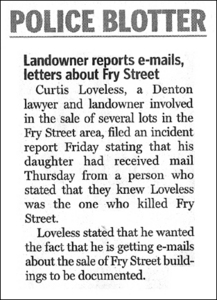 In the Tuesday afternoon police blotter, we’ve got a number of unusual stories for you.
A 40-year-old woman in Florida (can we just get an autokey for Florida, Seth?) was arrested over the weekend. The crime: She stood in front of her neighbor’s yard and flashed her goodies to a 5-year-old. Apparently, she lifted her shirt (nothing was underneath it) and jumped around. She must have been demonstrating gravity and centrifugal force.
In North Carolina, a man was arrested for going through a dry cleaners drive-thru while not wearing pants. He was charged with indecent exposure. Now, that’s just dumb. Cut the guy a freakin’ break — he was there to get his pants. You don’t arrest a guy for going into a restaurant hungry, so Kenneth Lee Wollen ought not be arrested for going to dry cleaners pantless.
In Idaho, Eric. D. Marienau was arrested for aggravated assault and driving while intoxicated after ramming his vehicle into his estranged wife’s home at a high-rate of speed. He had a good reason, though. He asked her for a cigarette, and she didn’t bring it to him. That’ll teach her.
And finally, again in Florida, John Glen Aquista had himself a Cinderella moment, only 100 miles from Disney World. Aquista allegedly rammed his van into the bathroom of a house in the city of Holiday. The residents then watched as the van’s driver fled across their front lawn — leaving a shoe behind.
The Florida Highway Patrol was investigating the crash about an hour later when 43-year-old John Glen Aquista of Holiday walked up to the scene. The Pasco County man was bloody, wearing boxer shorts and, most importantly, shoeless. His injuries looked a lot like he smashed his face into a steering wheel, investigators said. Aquista “denied any involvement in the traffic crash,” a Florida Highway Patrol report said. The van wasn’t his, but it was registered to the address where he lived, the FHP said. When a trooper asked him to slip on the wayward shoe, “it was a perfect fit,” the FHP said.
Let’s Kill em’ All
 For critics of the death penalty, there are a couple of new developments that bolster the argument against the practice. First, Jerry Miller — a man who served 25 years in prison for a rape he did not commit — became the 200th person exonerated by DNA evidence this week. In fact, Miller had already been paroled when his case was tossed (woops!). It took 13 years to reach the first 100 DNA exonerations, but the last 100 has only taken the last five, all of which demonstrates that the jury system is not foolproof, and perhaps 12 people who were not smart enough to figure out how to get out of duty ought not be weighing the credibility of witnesses and deciding the fate of those facing death.
If that’s not enough to convince you (and I realize, if you are pro death penalty, nothing will convince you), a medical study (via TalkLeft) was released this week that suggests that lethal injection does not kill its victims the way that we thought it did.
Our findings suggest that current lethal injection protocols may not reliably effect death through the mechanisms intended, indicating a failure of design and implementation. If thiopental and potassium chloride fail to cause anesthesia and cardiac arrest, potentially aware inmates could die through pancuronium-induced asphyxiation. Thus the conventional view of lethal injection leading to an invariably peaceful and painless death is questionable.
Asphyxiation! That’s a helluva way to go. I’m sure death penalty advocates would argue it doesn’t really matter how the guy goes out — An eye for an eye painful suffocation (to a guy who may not have done it), right? It says so right there in the Bible.
The Daily Memo - 4/24/07
XM is being sued for false advertising for claiming its stations are “commercial free” despite having “promotional and advertisement segments.” (Engadget)
Patently-O gives some preliminary notes and comments on the Patent Reform Act of 2007. (Patently-O)
SCOTUSblog rounds up some of the reviews of the new book Supreme Discomfort: The Divided Soul of Clarence Thomas. (SCOTUSblog)
The South Carolina guy charged with the dungeon rapes has received a not guilty verdict. (CNN)
Going to drycleaners + no pants = charge of indecent expose. (WRAL)
A despicable San Francisco woman (if the charges are true, of course) has been arrested for giving birth on a sidewalk and then walking away like nothing happened, leaving the baby kicking around on the sidewalk. (CBS5)
Local drivers are thumbing their noses at judges, pleading guilty to DUIs, driving with a suspended license, etc., and then leaving the courthouse, hopping in their cars, and driving off. (Chicago Sun-Times)
A second mistrial has been declared in the Georgia trial of three men accused with an August courthouse shooting of a deputy in an attempted inmate escape. (Lawinfo)
So wait, you want me to pay for my porn?
 In the wee hours of Sunday morning, two men were arrested in a Boston hotel after fighting over a $600 bill for porn videos ordered to their hotel room over the course of one night! The Boston Herald refers to this as “a smut-film bender,” which sounds about right. Both men were arrested - one for “defrauding the innkeeper,” and the other for an outstanding warrant.
The police report doesn’t indicate how many movies the men actually purchased. But you figure that, on the high-end, movies can’t be more than $20 a pop (pun sort of intended), which means they got a minimum of 30 flicks over the course of one night!
I would love to hear their explanation for this because I just don’t get it.
Is that a burrito in your pocket or are you just trying to save the world?
 Oh Florida, Florida, how many ways do I love thee? Today, my Florida love is directed specifically towards the city of Melbourne, as that’s where Dr. Raymond Adamcik got himself arrested, giving us this amusing story. See, the 54-year-old family physician was spending his Saturday night taking part in a pub crawl along with a bunch of other doctors. At one of the bars, a place called On Tap, Dr. Adamcik got himself into some trouble when he was harassing women with a burrito that he had sticking out of his tights.
Yes, I said burrito. And yes, I said tights.
See, this pub crawl was apparently some type of costume party, and our good doctor was dressed as Captain America. And for some reason, Dr. America had a burrito in his tights, sticking out of the top. At the On Tap bar, he was asking women if they wanted to touch it. When one lady said “no thanks,” he allegedly started to grope her. She called the cops, who showed up a short while later. That gives us my favorite part of the story, one of the officer’s notes in his written report:
There were so many cartoon characters inside the bar at the time, all Captain America’s were asked to go outside for a possible identification.
The lady then identified Dr. America, and they found the burrito stashed in his boot. He was then arrested and taken to a holding cell, where he got in further trouble for trying to flush a joint that was also stashed in his tights. He now faces charges for battery, disorderly conduct, drug possession and trying to destroy evidence. All of which are, of course, decidedly un-Captain-America-like.

I Was Going to Touch Myself for Dr. Betty Dodson!
 Freakin’ Arkansan podunks. Out in Bentonville, Arkansas (that’s the home-office of Wal-Mart, where the only thing larger than SuperCenters are the Baptist churches) a man is suing the city after his two sons discovered a book in the public library: The Whole Lesbian Sex Book.
Earl Adams is seeking $20,000 in damages and wants the library director fired, claiming that the book is “patently offensive and lacks any artistic, literary, or scientific value” (that’s a funny thing to say — is Adams a lawyer, or was he coached by one?). The book is a sex guide that has been deemed suitable for all libraries by the Library Journal. According to Amazon.com, “highlights include descriptions of sex writer Tristan Taormino’s private consultation with Betty Dodson, the author of Sex for One described as ‘the mother of masturbation’: ‘I was so excited about this adventure that I nearly peed in my pants,’ recalled Taormino, ‘I was going to touch myself for Dr. Betty Dodson!’”
And you’re going to tell me that a 14-year-old and a 16-year-old boy found that offensive and that the children were “greatly disturbed” by this? Bullshit. Shenanigans. No fucking way.
Listen up, Earl — the reason why your two boys have experienced “many sleepless nights in our house” was because they’ve been up thinking about girl-on-girl, you dipshit. They’re not sleeping because they’re spending all night scanning Skinemax looking for a late showing of Bound. I mean, c’mon: The Whole Lesbian Sex Book even has an “S/M hanky code laid out once and for all.” That’s not obscenity, that’s masturbation fodder. Instead of suing for $20,000, maybe you should be thankful that your two sons haven’t resorted to online porn subscriptions.
Oh yeah — and shove it up your ass, Earl. And if you need help, don’t go looking to the public library for The Whole Homosexual Book.
“You Are a Very Premium Person”
 Fiction wunderkind and author of Everything is Illuminated, Jonathan Safran Foer, has added his voice to the growing chorus of others who want stricter gun control laws following the VT massacre. Foer asserted, in yesterday’s op-ed page of the Washington Post, that the only argument against gun control laws is the Second Amendment, but that there is no real justification for that particular amendment. He writes:
Does anyone any longer believe that a well-regulated militia is necessary for a free state? Why do those who fall back on the constitutional defense so often avoid the terms “militia” and “state”? And why, after the massacre at Virginia Tech — hours after — did Sen. John McCain proclaim, “I do believe in the constitutional right that everyone has, in the Second Amendment to the Constitution, to carry a weapon”? Just what is it, precisely, that he believes in? Is it the Constitution itself? (But surely he thinks it was wise to change the Constitution to abolish slavery, give women the vote, end Prohibition and so on?) Or is it the guns themselves that he believes in? It would be refreshing to have a politician try to defend guns without any reference to the Second Amendment, but on the merits of guns. What if, hours after the killings, McCain had stood at the podium and said instead, “Guns are good because … ” But what would have followed?
Foer continues in that line of thought, arguing that neither self-defense nor the right to hunt are proper justifications for the right to bear arms, given the counterbalancing fact that:
In 2004, more preschoolers than law enforcement officers were killed by firearms, according to the Children’s Defense Fund. The number of children killed by guns in the United States each year is about three times greater than the number of servicemen and women killed annually in Iraq and Afghanistan. In fact, more children — children— have been killed by guns in the past 25 years than the total number of American fatalities in all wars of the past five decades.
But hey, some jackass in an orange vest has the right to sit up in a tree for hours on end and snuff out the life of a wild animal. So, it all evens out, right? An eye for an eye? A child for a deer? I think that’s even in the Bible.
The Daily Memo - 4/23/07
Scalito, Scalito, wherefore art thou Scalito? (Law.com)
Philadelphia Eagles running back Correll Buckhalter lost his appeal to the Nebraska Supreme Court over an order to pay over $4,000 in child support for an autistic boy. (SI)
A Community College teacher has been arrested and put on administrative leave after calling the school and leaving voicemails threatening herself. (Ledger-Enquirer)
Try to drive carefully, avoiding swerves which might get you pulled over, when you’ve got 20 pounds of pot in your car. (KATU)
Filed by prosecutors in connection with an upcoming mafia trial, a newly released 63-page court document outlines a 40-year history of mob hits in Chicago. (CNN)
Hawaii’s state legislature has tossed a proposed red light camera bill, in part because it would not have been effective until 2020. (The Newspaper)
Last Thursday a man was sentenced to 5 years in the clink for poisoning his kids’ soup as part of a plan to extort money from the Campbell Soup Company. (CBS46)
Former linebacker Dick Butkus has filed a lawsuit over the Downtown Athletic Club of Orlando’s “Butkus Award,” claiming various shenanigans stemming from his original license agreement with the club. (SI)
“I wasn’t thinking straight, sir, because all the blood had rushed from my head to, uhm, other areas.”
 In a Wisconsin town, the sheriff’s department was called in when a man accidentally gave $20 to a woman at a strip club, thinking she was the gal who just gave him a lap dance. In actuality, she was just some random gal who took the money and left. This dude actually called 911 over the twenty bucks and, according to the article, the authorities are actually “trying to locate the woman.”
I guess it’s nice to know that there’s no real crime going on in Clyman, Wisconsin, when this is what the sheriff’s officers busy their time with. Unless they’re just trying to track down the woman to see if she actually looks like a stripper. I mean, curiosity does get the best of all of us sometimes.
Is Alberto Gonzales actually brilliant?
 After sleeping on the Attorney General’s testimony for a night, Slate’s Dahlia Lithwick changed her mind about his testimony before the Senate Judiciary Committee:
Perhaps what we watched [on Thursday] was in fact a tour de force, a home run for the president’s overarching theory of the unitary executive.
You really should check out Lithwick’s article for all the details, but the “unitary executive” is basically a theory that the President and the executive branch has very broad and far-reaching authority, and that Congress doesn’t have much right to limit that authority. Lithwick says that looking at Gonzales’ testimony in light of this theory, he basically spent hour upon hour reiterating to Congress that he was simply there as a courtesy to the Senators, trying to help them out; but that he really didn’t have to be there so he could answer however he saw fit. In other words, “suck it, Senators, and suck me while you’re at it.”
… meanwhile, Bill Clinton thinks Alberto should do Bush a good one and just resign already.
Old enough to vote, play the lottery and fight our wars, but not old enough to drink … and maybe not old enough to bum a smoke?
 The Texas state Senate has approved a bill which would bump up the legal smoking age a year, to 19 years old. The bill still has to work its way through the state House to get to the governor.
One wonders if the Texas legislature hates our troops, trying to keep the 18-year-old soldiers getting ready to head over to Iraq from being able to calm their nerves with a smoke. Or is it just that they think this will allow 18-year-olds to work on their gun skills without getting smoke in their eyes?
The honorable Pope Benedict XVI presiding?

(Sunday’s Editorial Cartoon by Tony Auth, courtesy of GoComics, with a hat tip to Professor Bainbridge)
Can I get a witness?
 In honor of today being 4/20, QuizLaw presents the following dramatic reenactment, which sounds a bit ridiculous while sober, but probably makes perfect sense while high.
[We are in a courtroom.]
GREGORY SHAMOUN: May it please the court, I would like to call Buddy the Donkey as a witness.
[A man leads BUDDY THE DONKEY into the courtroom. As BUDDY cannot fit into the witness stand, he is allowed to stand in front of it. And because donkeys don’t believe in God - trust me on this, as I have it on good authority that donkeys are blasphemous heathens - he is not sworn in.]
SHAMOUN: Buddy, do you understand why you are here today?
[BUDDY stamps his foot twice.]
SHAMOUN: Well, you are aware of the fact that I’m your owner, correct?
[BUDDY stamps his foot once.]
SHAMOUN: And you know that my neighbor, John Cantrell, has sued me because of you, right?
[BUDDY stamps his foot twice.]
SHAMOUN: Buddy, you know that I was trying to build a storage shed in my garden, yes?
[BUDDY stamps his foot once.]
SHAMOUN: And you know that my neighbor, plaintiff John Cantrell, was pissed about this and complained about my shed, correct?
[BUDDY stamps his foot once.]
SHAMOUN: And do you recall when, exactly, I brought you down from my ranch to let you start living in my backyard.
[BUDDY stamps his foot twice.]
SHAMOUN: Your honor, I will stipulate to the Court that, as plaintiff alleges, I brought Buddy into my backyard sometime after Mr. Cantrell’s original complains.
JUDGE: Thank you, Mr. Shamoun. Your stipulation has been noted. You may continue your questioning.
SHAMOUN: Thank you, your honor. Buddy - are you a loud and aggressive animal, as the plaintiff alleges?
[BUDDY emphatically stamps his foot twice.]
SHAMOUN: Do you bray a lot, at all times of day or night?
[BUDDY stamps his foot twice.]
SHAMOUN: And do you, uhm, to put it delicately - do you dump your manure all over the place whenever you feel like it.
[BUDDY pauses for a moment, presumably trying to figure out a way to stamp his way into saying “well, yeah, I’m a donkey for crying out loud.” Ultimately, BUDDY simply stamps his foot once.]
SHAMOUN: Ok, but you don’t defecate maliciously, do you?
[BUDDY stamps his foot twice.]
SHAMOUN: And lastly, Buddy - to your knowledge, did I bring you to stay on my backyard out of any malicious intent to get retribution against the plaintiff?
[BUDDY stamps his foot twice.]
SHAMOUN: Thank you Buddy. No further questions.
[At this time, the proceedings take a recess. Unfortunately, this is where our play ends, because Shamoun and Cantrell settle their dispute, both worried about how the jury would ultimately vote in the case - Shamoun agrees to purchase some of Cantrell’s land in exchange for Cantrell withdrawing his complaint. And so…]
The Daily Memo - 4/20/07
The Patent Reform Act of 2007 has been introduced into the Senate, including a variety of changes to the patent system. (Patently-O)
Chris Rock has asked a court to step in on the issue of his paternity of a 13-year-old boy, whose mother wants some money (and to be fair, Rock has said he will give some money if he’s proven to be the dad, although the real question is whether he’ll give the kid the big piece of chicken). (CNN)
The two sons of Philadelphia Eagles head coach Andy Reid both pled not guilty to their separate criminal charges. (ESPN)
The DNC has filed a lawsuit against the Justice Department, seeking all e-mails about the U.S. attorneys debacle. (FindLaw)
New Hampshire’s governor says that he’ll sign a civil union bill if it makes it to his desk (the bill has already been passed by the state House and is expected to get through the state Senate). (Wills, Trusts & Estates Prof Blog)
A new Texas bill would authorize the death penalty for repeat pedophiles. (Abilene Reporter News)
A New York judge has been convicted of taking bribes in divorce cases, and he now faces up to 15 years in the clink. (The Legal Reader)
“The ground came out of nowhere”
 So a guy walks into a bar. Later, same guy walks out of a bar. His foot gets caught up on a toejam, and he tumbles on a ramp. And since there are no rails to help him catch himself, he ends up hurting his neck, face and chest, with at least some of the injuries being caused by the beer bottle he was carrying.
The punchline, of course, is that Matthew Shewmake is now suing said bar to the tune of $200,000. He says that the bar should’ve known that the doorway and ramp was a dangerous spot, and should therefore have put up railings, or done something else to help prevent drunks like him from injuring themselves.
Putting aside the question of whether or not Shewmake fell because the spot was dangerous or because he was tipsy, why was he leaving the bar with a beer bottle in the first place? I guess the liquor laws in Madison County, Illinois might be different than most other places, but you generally can’t leave a bar with an open container (and in most bars won’t sell you closed bottles).
Let the pandering begin
 Unsurprisingly, some of the ‘08 presidential candidates were quick to comment on Wednesday’s partial-birth abortion ruling by the Supremes. John McCain said he was “very happy about the decision given my position on abortion,” although he was quick to say that he didn’t want to start talking about a possible overturn of Roe v. Wade. Of course, McCain’s abortion stance is at least, in part, pandering to the GOP’s conservative base (as are many of his recent attempts to buddy up with the religious right, folks he dissed during his last presidential bid). As the Associated Press points out:
McCain’s record is not clear-cut on abortion: He said once in 1999 that he didn’t think Roe v. Wade should be overturned, but now he advocates its repeal.
Meanwhile, while Rudy Giuliani has previously said he supports abortion rights, he was also quick to issue a statement noting his agreement with the Supreme’s decision (and to be fair to Rudy, there is a middle ground where you can support abortion rights yet be opposed to partial-birth abortions). And Mitt Romney, who has flip-flopped on his abortion stance (he’s currently against it because of, you know, pandering and all that), also says this decision was a good step for our country.
On the other side of things, John Edwards said that he strongly disagrees with the ruling, and Obama said he was worried that states would use this as the impetus for trying to place new attacks on women’s right to choose.
While it doesn’t seem that Senator Biden issued a statement, his opinion on the matter is pretty easy to guess considering he originally voted for the 2003 ban. Similarly, since Hillary voted against it, it comes as no surprise that she calls the ruling an “erosion of our constitutional rights.”
I don’t know about y’all, but November 2008 can’t get here fast enough, just so that we can put all the political pandering aside for a couple of months. Until, you know, March 2009, when folks will start ramping up for the 2012 presidential election.
Does Alberto Gonzalez remember anything?
 As you surely know, yesterday was the Attorney General’s day in the sun, as he got to hang out with the Senate Judiciary Committee all day, answering questions mostly about the U.S. attorneys firings. Needless to say, it didn’t go very well.
At one point, just before lunch, he said that criticizing the things people at the Justice Department do is actually “attacking the career professionals.” Senator Dick Durbin responded by saying this was ridiculous, akin to “saying anyone who disagrees with the president’s policy on the war is attacking the soldiers.” He’s right, of course, but Senator Durbin also misses the hypocrisy of Gonzales’ statement: if we are to believe that these eight U.S. attorneys were, in fact, fired for something other than wholly proper and professional reasons, than it was Gonzalez and his buddies who actually attacked career professionals.
In any event, tt was apparent that Gonzales didn’t have many supporters on the committee when even the republicans were slamming him. Senator Arlen Spector said that Gonzales’ “credibility has been impaired.” Worse yet, Senator Tom Coburn said: “The best way to put this behind us is your resignation.” Doesn’t get more straight-forward than that.
My favorite thing about this whole thing is that, early on in the proceedings, Senator Chuck Schumer told Gonzales that the Committee didn’t want lots of “I don’t knows” and shady answers. Apparently he wasn’t clear enough on this because, by lunch, Gonzales had given at least 45 “I don’t know” or “I don’t recall” answers (I was watching MSNBC last night and they showed someone sitting in the galley, clearly not a Gonzales fan, keeping a running count of Gonzales’ elusive answers and holding the running tally up for all to see).
At the very least, Gonzales did recognize that some mistakes were made with how the firings were handled, although he said there wasn’t anything improper taking place.
Of course, there was really very little that Gonzales could have done yesterday to make things better for himself. But White House insiders suggest that he didn’t just tread water, but actually made things worse:
The sources, involved in administration discussions about Gonzales, told [CNN] White House correspondent Suzanne Malveaux that two senior level White House aides who heard the testimony described Gonzales as “going down in flames,” “not doing himself any favors,” and “predictable.”
It remains to be seen what Bush will do about this, by my gut says that it’s simply a question of when he cuts and runs on Alberto, not if.
As usual, the best summary of yesterday’s hearing comes from Slate’s Dahlia Lithwick:
Those of us who arrived today thinking that Gonzales had some sort of brilliant master plan for winning over the judiciary committee are puzzled by the AG’s strategy. You can’t help but wonder what condition he was in last month before he started preparing full time. His face, for a sustained period of almost seven hours, is a perfect mask of bemused puzzlement and earnest seriousness. Clearly, the one thing he has practiced for two weeks is the face. But the rest of his tactics are dubious.
Well, At Least it Wasn’t a Junior Mint
 A woman in Baltimore, Maryland, LaShawn McClary, is suing Sinai Hospital, Owings Mill’s Femi-Care Surgical Center and Dr. Sheo Sharma for $5 million. Why? Well, she went in to have surgery to remove a benign tumor in 2001. The surgery seemingly was a success, but when McClary got home, she was all kinds of sick — she had abdominal pain, vaginal discharge, and she couldn’t stop puking.
So McClary went back to the hospital and told them about her symptoms. They said, “don’t worry about it, it’s normal. It’ll go away in no time.” But, it didn’t. In fact, McClary went back to the hospital several times to find out what was going on, but no one was any help.
That is, until she got a new gynecologist who performed another surgery on McClary and discovered that the woman had several foreign objects inside her. Specifically, sponges, gauze and blue plastic material left inside her abdomen for six years!
Max Karson: First Amendment Champion or Fucktard?
 So, most people are familiar with the old “tragedy plus time equals comedy” maxim, right? And most people have enough tact to know when it’s “too soon,” right? In the wake of the Virginia Tech shootings, it’s one thing to make this particular joke (which was directed more at the media) only a few hours after the incident, but quite another to introduce alleged satire into a college classroom a day or two after the shooting. Well, that’s just what a University of Colorado student did the other day.
During a discussion of the shooting in a gender and race class, Max Karson made comments sympathetic to the VT shooter, saying “if anyone in here says that they’ve never been so angry that you wanted to kill 32 people, you’re lying,” and that he was “angry about all kinds of things, from fluorescent light bulbs to the unpainted walls, and it made him angry enough to kill people.” Karson was also reportedly asked: “Would you kill all of us?” His response: “No. Not all of you.”
Obviously, the comments scared the bejesus out of his classmates; students left class crying, scared for their lives, and shaken up. Even today, students are questioning whether to return to that particular class, though I understand there will be a police officer standing guard. But given the circumstances, the school made the only logical decision it could: It had Max Karson arrested and jailed for a day, before he was released on bail. The charge: “Interference with staff, faculty or students of an educational institution.” He’s also been suspended and banned from campus. He has since pleaded not guilty to the charge.
So, the question here is: Were Karson’s First Amendment rights violated? I mean, seriously: “Interferences with staff, faculty, or students of an education institution”? What kind of charge is that? And given the guy’s past history, it seems somewhat likely that the statements were satirical in nature (not funny, of course, but still … ). Karson has done this sort of thing before: in high school, he circulated a newsletter claiming that he was “gayer than Big Bird” for his friend, Matt, and another in which he satirically suggested that he’d been romantically involved with a principal accused of inappropriate conduct (the newsletter helped lead to the principal’s resignation).
And just last year he wrote an article in a self-published newsletter about “the myth of the female orgasm” and “argued that the clitoris is functionless (‘like an appendix’), breasts have no nerves and can therefore be squeezed as hard as possible, and the sex act should proceed without lubrication, ‘so they can really feel it.’” It was meant, according to Karson, as satire. The administration, however, was not pleased with the insensitivity of the article and looked into their legal options. Karson called in the ACLU, and the school rightfully backed down (it was a stupid, insensitive article — but, hey! That’s what the First Amendment is for.) (The ACLU was brought in after the high school incidents as well; in both instances, he got his suspensions taken off his permanent record).
And now I suspect that the ACLU will be brought in to help Karson once again, and CU will likely lose this battle as well. In the meantime, students in his class have no idea what to think — was he making a joke? Was he serious? Should we wear bulletproof vests to class? Personally, I think he’s a jackass with a bad sense of humor, but otherwise harmless. But if I were a student in that class and he was allowed to return to it, I seriously doubt I’d feel comfortable sitting next to the Fucktard.
The Daily Memo - 4/19/07
A Georgia woman is suing a local town and a funeral home because she fell into the open grave of a friend while trying to put flowers on the friend’s casket, and she and her husband are seeking over $75,000 in damages. (Asheville Citizen Times)
A Florida man (where else?!) decided that the best place to break into a van to steal some stuff was in a jail parking lot. Guess where he is now? (Florida Today)
The TTAB has ruled that “RATED R SPORTSWEAR” is confusingly similar to the movie rating used by the MPAA. (The TTABlog)
The House has decided, in overwhelming fashion, that stiffer penalties are in order to keep folks from falsely portraying themselves as the Treasury Department (meaning the non-federal irs.com website needs to tread real lightly). (Download Squad)
Montana Governor “Brian Schweizer said ‘no, nope, no way, hell no’ Tuesday to national driver’s licenses, signing into law a bill supporters say is one of the strongest rejections of the federal plan.” (Billings Gazette)
A new California bill would require all products coming from cloned livestock to be clearly labeled as “from clones.” (International Business Times)
A Pennsylvania court has ruled that a couple can no longer go hunting in their own backyard. (Philadelphia Weekly)
Oklahoma legislators have declared the watermelon as the state vegetable (joining the strawberry as the state’s official fruit). (iWon News)
Liveblogging the flogging (of Alberto Gonzales)
 I had given some thought to liveblogging today’s session of the Senate Judiciary Committee, where the Attorney General would be
 answering avoiding questions thrown at him by the committee members. However, Comcast sucks and doesn’t carry the channel showing the hearing because, apparently, the $100+ digital cable package I subscribe to just doesn’t have the room for it!
So I’ll instead point you over to Above the Law, where David Lat is liveblogging the hearing (which is currently on a lunch break until 2 p.m.). Here’s Part 1, and here’s Part 2. I imagine he’ll start a new entry (Part 3, mayhaps?) when they pick back up this afternoon, so you’ll have to check the main page for that. If you’re at all interested in the whole US Attorneys debacle, Lat’s posts are a good quick read and summary of what’s going on, with a little humor even thrown into the mix.
When Will You People Start Listening to Us?
 Two weeks ago, we ran Common Sense Lesson #139. Here’s what we said:
Well the Common Sense Lessons really don’t get any more basic than this - don’t show up to your DUI hearing drunk.Seriously, people, it’s not a hard one to commit to memory.
Well we can add 61-year-old David Milam, of Alabama, to the list of people who must not have such a good memory. Milam had a pending DUI charge from a little over a month ago. When he showed up to court for a hearing about the charge, the judge ordered him to take a breathalyzer test. It was 10 o’clock in the morning, and Milam blew a .27 (!), over three times the legal limit (and more than the .22 he blew when he actually got his DUI).
Bravo, Mr. Milam. It takes a special kinda guy to be wasted at 10 in the morning. I’m kind of in awe.
“If Jesus was here tonight, and I’m very familiar with the bible, I’ll guarantee ya He’d want him terminated”
 Wednesday night’s “The Daily Show” brought this story to our attention. In Largo, Florida, Steve Stanton has been a city manager for fourteen years. After he announced that he was planning to get a sex change operation, however, the proverbial shit hit the fan and late last month, the city commissioners held a six-hour hearing and then rubber-stamped an earlier vote to fire Stanton.
Of course, the commissioners say that he’s being fired, not because he’s transgendered, but because folks have lost confidence in him (and the Mayor said the same thing on the “Daily Show” segment). No sir - no discrimination here.
“I think we’re pretty well convinced,” Commissioner Gay Gentry said before the vote. “You have to believe us, you have to trust us, it is not about transgenderism.”
The old “trust me - it’s not discrimination because I say it ain’t” defense. Gotta love it. Especially since most of the folks who spoke during the hearing spoke in Stanton’s favor. Others complained that Stanton’s announcement cast the city in a bad light, making “Largo the laughingstock of the whole country.” But that doesn’t have anything to do with the subsequent decision to fire him, right? That’s not what made y’all laughing stocks, right?
Perhaps the most amazing thing about this story is that, while it sounds like a lawsuit waiting to happen, Stanton says he has no plans to sue. Of course, this may be like Gore’s continued statements that he has no plan, at the very moment the words are being spoken, to run for President (i.e., “my plans may change tomorrow”). So we’ll just have to wait to see whether Stanton follows his current plan or if he decides, once he’s traded in his pants for a dress, to also sue the city out of its pants.
Check out the wonderful description of Largo from its own website (and below that, you can watch the “Daily Show” clip).

Roundup on the Supremes’ Partial-Birth Abortion Decision
 As we have already discussed a little, the Supremes upheld the Partial-Birth Abortion Ban Act in yesterday’s Gonzales v. Carhart decision. Unsurprisingly, there has been quite a bit of discussion and commentary on the case, with much more sure to come. Here are some of the things that caught my eye last night:
President Bush released a statement trying to hide his glee: “Today’s decision affirms that the Constitution does not stand in the way of the people’s representatives enacting laws reflecting the compassion and humanity of America.” Right. Because Bush is really concerned about the Constitution standing in the way of things?
Meanwhile, Columbia Professor Michael Dorf, who was a co-author of one of the amicus briefs filed in this case, takes issue with the fact that the decision doesn’t satisfactorily address the “core issue: whether a government (state or federal) can ban what many doctors think is the safest way to perform a medical procedure.” Dorf doesn’t think Justice Kennedy’s reliance on “well, there’s medical disagreement on the matter” rules the day. Which ties into a point raised by Steph Tai over at Concurring Opinions, who looks at the issue of scientific and medical evidence and says she would’ve liked to have seen more guidance in terms of knowing how much uncertainty is too much uncertainty: “How much medical disagreement is necessarily [sic] to overcome a Congressional finding? If the bar is too high — which it could be, given how one could argue that all of science is ‘uncertain’ and ‘unstable’ to some extent — then Congress is free to entirely ignore scientific determinations. Yet if the bar is too low, then Congress would be unable to act in the face of predicted, yet ‘uncertain’ risks.”
At SCOTUSblog, Lyle Denniston calls the decision a “sweeping - and only barely qualified - victory to the federal government and [] other opponents of abortion.” Orin Kerr, a law professor over at GW, notes how some folks like Denniston are looking at this as a broad ruling, but he thinks it’s actually rather narrow because, while the decision upheld the ban, the Court didn’t overrule Stenberg and it left the door open for an as-applied challenge to the ban at some later time.
Denniston also points out that neither Chief Justice Johnny nor Alito joined Justice Thomas’ dissent, where he and the Scalia reiterated their belief that there’s no basis for any abortion rights in the Constitution. Denniston says this “does not necessarily mean Roberts and Alito disagree with that view, but perhaps meant only that they did not believe it needed to be said at this point.” In other words, maybe they’re holding their cards a bit close to the vest until the time is right for them to slam the door shut on Roe? Time will tell on that one, I suppose (Professor Dorf agrees, noting that Roberts and Alito basically “remain in the closet about whether they would vote to overrule Roe and Casey if faced with that question directly”).
For a momentary inconsequential side-track, David Lat takes a look at a math comment in one of the footnotes of Ginsburg’s dissent.
Speaking of Ginsburg’s dissent, she delivered a live oral summary of it in the court yesterday, prior to the written decision being handed out, and you can read the transcript over at the Legal Times. Ginsburg concluded her statement by saying:
In candor, the Partial-Birth Abortion Ban Act, and the Court’s defense of it, cannot be understood as anything other than an effort to chip away at a right declared again and again by this Court — and with increasing comprehension of its centrality to women’s lives. A decision of the character the Court makes today should not have staying power.
While regular readers know that I’m mostly a lefty liberal, I find it nice to sometimes take a look at what folks on the other side of the aisle are thinking. Over at the Mirror of Justice (“a blog dedicated to the development of Catholic legal theory”), Rick Garnett thinks that the decision “respects the views of the overwhelming number of Americans — pro-life and pro-choice alike — who believe that partial-birth-abortion is a procedure that a decent and humane society need not permit. In this sense, the decision is consistent with the view that federal judges should not take it on themselves to remove controversial debates from the arena of democracy.” However, he doesn’t see this as a crowning victory, taking Orin Kerr’s side of the argument in the broad/narrow debate, viewing the decision as being too narrow. In fact, Garnett is troubled that the decision “will be hailed (or lamented) as a ‘huge win’ for the pro-life side of the debate,” but ultimately says it’s a “step in the right direction.”
Paul Linton, special counsel for the Thomas More Society (which filed an amicus brief supporting the government) says that this decision “is welcome,” but he agrees with Garnett: “neither supporters nor opponents of abortion should read too much into the Court’s decision … [because it] clearly left the door open to a pre-enforcement, ‘as-applied’ challenge.” He also thinks the decision “is likely to have little effect on abortion practice.”
The Center for Reproductive Rights would obviously beg to differ, calling the decision a “stunning reversal” as the Supremes rule “against women’s health, in favor of abortion restrictions” and give states “a green light to criminalize safe, medically-necessary abortions as early as 12 to 15 weeks in pregnancy.”
Meanwhile, Adam B at the Daily Kos sums it all up very nicely (for my tastes, at least): “Welcome to George Bush’s Court.”
The headline of the day goes, unsurprisingly, to Slate’s Dahlia Lithwick: “Father Knows Best - Dr. Kennedy’s Magic Prescription for Indecisive Women.” Lithwick says that Kennedy’s decision “is less about the scope of abortion regulation than an announcement of an astonishing new test: Hereinafter, on the morally and legally thorny question of abortion, the proposed rule should be weighed against the gauzy sensitivities of that iconic literary creature: the Inconsistent Female.”
And finally, going back to SCOTUSblog, Denniston provides some interesting commentary on consequences of this case and what it could all mean. Among many other things, he thinks we’ll see state legislators get more active in trying to find ways to whittle away abortion rights, but he doesn’t think there is an “early prospect” of Roe being overturned.
Here Kitty, Kitty
 In Arizona, a man who really loves his cat was sentenced to five months of prison yesterday. The story goes like this:
Jeffrey Francis Cullen reported a tree fire to the local fire department. A three-person crew arrived and Cullen asked the fire fighters to rescue his cat from the tree. The batallion leader, however, told Cullen to either call animal control or wait until the cat got hungry and climbed down itself.
That wasn’t what Cullen wanted to hear. So he ran inside his house, pulled out a small pistol, and came back out guns ablazing. Fortunately, the fire fighters grabbed a 12-year-old in the vicinity and ran like hell. Nobody was shot.
Cullen admitted he might’ve been drinking.
Supreme Court Decision Update - Gonzales v. Carhart
 Today’s big Supreme Court decision comes in Gonzales v. Carhart (PDF of the opinion). It’s about the hot potato issue of partial-birth abortions, and in a 5-4 decision, the Supremes uphold the 2003 Partial-Birth Abortion Ban Act.
QuizLaw Analysis: While this Court hasn’t been quite as conservative, to date, as some might have expected, there is little surprise in its upholding of the Partial-Birth Abortion Ban Act, especially when one of the appellate courts striking it down was the Ninth Circuit. This is a big win for the anti-abortion conservatives, and is particularly significant for being the first time the Court has: (i) upheld a ban on a specific type of abortion procedure; and (ii) upheld abortion regulations that did not include safeguards for women’s health.
And it should go without saying that the following discussion necessarily includes details about the medical procedures of partial-birth abortions, and related abortion methods, which some of you may find a bit gruesome. So consider yourself forewarned.
Where to start? Unsurprisingly, there’s quite a bit covered here. And as far as the majority opinion goes, the syllabus actually does quite a good job of breaking everything down into understandable terms. So I’m going to cheat and give you the syllabus write-up instead of my own. Then I’ll come back to discuss the concurrence and give you a break-down of the strongly-worded dissent.
Wait - how did the Justices line up? Ok - the majority opinion was written by Justice Kennedy, and joined by Chief Justice Johnny, the Scalia, and Justices Thomas and Alito. Thomas also filed a concurring opinion, joined by the Scalia. And Justice Ginsburg wrote the dissent, joined by Justices Stevens, Souter and Breyer.
Ok, so give me the syllabus. Yup - here’s the syllabus of the majority opinion (edited slightly for ease of readability, including the exclusion of citations):
Following this Court’s Stenberg v. Carhart decision that Nebraska’s “partial birth abortion” statute violated the Federal Constitution, as interpreted in Planned Parenthood of Southeastern Pa. v. Casey and Roe v. Wade, Congress passed the Partial-Birth Abortion Ban Act of 2003 (Act) to proscribe a particular method of ending fetal life in the later stages of pregnancy. The Act does not regulate the most common abortion procedures used in the first trimester of pregnancy, when the vast majority of abortions take place. In the usual second-trimester procedure, “dilation and evacuation” (D&E), the doctor dilates the cervix and then inserts surgical instruments into the uterus and maneuvers them to grab the fetus and pull it back through the cervix and vagina. The fetus is usually ripped apart as it is removed, and the doctor may take 10 to 15 passes to remove it in its entirety. The procedure that prompted the federal Act and various state statutes, including Nebraska’s, is a variation of the standard D&E, and is herein referred to as “intact D&E.” The main difference between the two procedures is that in intact D&E a doctor extracts the fetus intact or largely intact with only a few passes, pulling out its entire body instead of ripping it apart. In order to allow the head to pass through the cervix, the doctor typically pierces or crushes the skull.The Act responded to Stenberg in two ways. First, Congress found that unlike this Court in Stenberg, it was not required to accept the District Court’s factual findings, and that that there was a moral, medical, and ethical consensus that partial-birth abortion is a gruesome and inhumane procedure that is never medically necessary and should be prohibited. Second, the Act’s language differs from that of the Nebraska statute struck down in Stenberg. Among other things, the Act prohibits “knowingly perform[ing] a partial-birth abortion … that is [not] necessary to save the life of a mother.” It defines “partial-birth abortion” as a procedure in which the doctor: “(A) deliberately and intentionally vaginally delivers a living fetus until, in the case of a head-first presentation, the entire fetal head is outside the [mother’s] body … , or, in the case of breech presentation, any part of the fetal trunk past the navel is outside the [mother’s] body … , for the purpose of performing an overt act that the person knows will kill the partially delivered living fetus”; and “(B) performs the overt act, other than completion of delivery, that kills the fetus.”
In [case] No. 05–380, respondent abortion doctors challenged the Act’s constitutionality on its face, and the Federal District Court granted a permanent injunction prohibiting petitioner Attorney General from enforcing the Act in all cases but those in which there was no dispute the fetus was viable. The court found the Act unconstitutional because it (1) lacked an exception allowing the prohibited procedure where necessary for the mother’s health and (2) covered not merely intact D&E but also other D&Es. Affirming, the Eighth Circuit found that a lack of consensus existed in the medical community as to the banned procedure’s necessity, and thus Stenberg required legislatures to err on the side of protecting women’s health by including a health exception. In [case] No. 05–1382, respondent abortion advocacy groups brought suit challenging the Act. The District Court enjoined the Attorney General from enforcing the Act, concluding it was unconstitutional on its face because it (1) unduly burdened a woman’s ability to choose a second-trimester abortion, (2) was too vague, and (3) lacked a health exception as required by Stenberg. The Ninth Circuit agreed and affirmed.
Held: Respondents have not demonstrated that the Act, as a facial matter, is void for vagueness, or that it imposes an undue burden on a woman’s right to abortion based on its overbreadth or lack of a health exception.
1. The Casey Court reaffirmed what it termed Roe’s three-part “essential holding”: First, a woman has the right to choose to have an abortion before fetal viability and to obtain it without undue interference from the State. Second, the State has the power to restrict abortions after viability, if the law contains exceptions for pregnancies endangering the woman’s life or health. And third, the State has legitimate interests from the pregnancy’s outset in protecting the health of the woman and the life of the fetus that may become a child. Though all three are implicated here, it is the third that requires the most extended discussion. In deciding whether the Act furthers the Government’s legitimate interest in protecting fetal life, the Court assumes, inter alia, that an undue burden on the previability abortion right exists if a regulation’s “purpose or effect is to place a substantial obstacle in the [woman’s] path,” but that “[r]egulations which do no more than create a structural mechanism by which the State … may express profound respect for the life of the unborn are permitted, if they are not a substantial obstacle to the woman’s exercise of the right to choose.” Casey struck a balance that was central to its holding, and the Court applies Casey’s standard here. A central premise of Casey’s joint opinion—that the government has a legitimate, substantial interest in preserving and promoting fetal life—would be repudiated were the Court now to affirm the judgments below.
2. The Act, on its face, is not void for vagueness and does not impose an undue burden from any overbreadth.
(a) The Act’s text demonstrates that it regulates and proscribes performing the intact D&E procedure.
First, since the doctor must “vaginally delive[r] a living fetus,” the Act does not restrict abortions involving delivery of an expired fetus or those not involving vaginal delivery, e.g., hysterotomy or hysterectomy. And it applies both previability and postviability because, by common understanding and scientific terminology, a fetus is a living organism within the womb, whether or not it is viable outside the womb.Second, because the Act requires the living fetus to be delivered to a specific anatomical landmark depending on the fetus’ presentation, an abortion not involving such partial delivery is permitted.
Third, because the doctor must perform an “overt act, other than completion of delivery, that kills the partially delivered fetus,” the “overt act” must be separate from delivery. It must also occur after delivery to an anatomical landmark, since killing “the partially delivered” fetus, when read in context, refers to a fetus that has been so delivered.
Fourth, given the Act’s scienter requirements, delivery of a living fetus past an anatomical landmark by accident or inadvertence is not a crime because it is not “deliberat[e] and intentiona[l].” Nor is such a delivery prohibited if the fetus [has not] been delivered “for the purpose of performing an overt act that the [doctor] knows will kill [it].”
(b) The Act is not unconstitutionally vague on its face. It satisfies both requirements of the void-for-vagueness doctrine. First, it provides doctors “of ordinary intelligence a reasonable opportunity to know what is prohibited,” setting forth “relatively clear guidelines as to prohibited conduct” and providing “objective criteria” to evaluate whether a doctor has performed a prohibited procedure. Second, it does not encourage arbitrary or discriminatory enforcement. Its anatomical landmarks “establish minimal guidelines to govern law enforcement,” and its scienter requirements narrow the scope of its prohibition and limit prosecutorial discretion. Respondents’ arbitrary enforcement arguments, furthermore, are somewhat speculative, since this is a preenforcement challenge.
(c) The Court rejects respondents’ argument that the Act imposes an undue burden, as a facial matter, because its restrictions on second-trimester abortions are too broad.
(i) The Act’s text discloses that it prohibits a doctor from intentionally performing an intact D&E. Its dual prohibitions correspond with the steps generally undertaken in this procedure: The doctor (1) delivers the fetus until its head lodges in the cervix, usually past the anatomical landmark for a breech presentation, and (2) proceeds to the overt act of piercing or crushing the fetal skull after the partial delivery. The Act’s scienter requirements limit its reach to those physicians who carry out the intact D&E, with the intent to undertake both steps at the outset. The Act excludes most D&Es in which the doctor intends to remove the fetus in pieces from the outset. This interpretation is confirmed by comparing the Act with the Nebraska statute in Stenberg. There, the Court concluded that the statute encompassed D&E, which “often involve[s] a physician pulling a ‘substantial portion’ of a still living fetus … , say, an arm or leg, into the vagina prior to the death of the fetus,” and rejected the Nebraska Attorney General’s limiting interpretation that the statute’s reference to a “procedure” that “kill[s] the unborn child” was to a distinct procedure, not to the abortion procedure as a whole.
It is apparent Congress responded to these concerns because the Act:—adopts the phrase “delivers a living fetus” instead of “ ‘delivering … a living unborn child, or a substantial portion thereof,’ ” thereby targeting extraction of an entire fetus rather than removal of fetal pieces;
—identifies specific anatomical landmarks to which the fetus must be partially delivered, thereby clarifying that the removal of a small portion of the fetus is not prohibited;
—requires the fetus to be delivered so that it is partially “outside the [mother’s] body,” thereby establishing that delivering a substantial portion of the fetus into the vagina would not subject a doctor to criminal sanctions; and
—adds the overt-act requirement, thereby making the distinction the Nebraska statute failed to draw (but the Nebraska Attorney General advanced).
Finally, the canon of constitutional avoidance extinguishes any lingering doubt. Interpreting the Act not to prohibit standard D&E is the most reasonable reading and understanding of its terms.
(ii) Respondents’ contrary arguments are unavailing. The contention that any D&E may result in the delivery of a living fetus beyond the Act’s anatomical landmarks because doctors cannot predict the amount the cervix will dilate before the procedure does not take account of the Act’s intent requirements, which preclude liability for an accidental intact D&E. The evidence supports the legislative determination that an intact delivery is almost always a conscious choice rather than a happenstance, belying any claim that a standard D&E cannot be performed without intending or foreseeing an intact D&E. That many doctors begin every D&E with the objective of removing the fetus as intact as possible based on their belief that this is safer does not prove, as respondents suggest, that every D&E might violate the Act, thereby imposing an undue burden. It demonstrates only that those doctors must adjust their conduct to the law by not attempting to deliver the fetus to an anatomical landmark. Respondents have not shown that requiring doctors to intend dismemberment before such a delivery will prohibit the vast majority of D&E abortions.
3. The Act, measured by its text in this facial attack, does not impose a “substantial obstacle” to late-term, but previability, abortions, as prohibited by the Casey plurality.
(a) The contention that the Act’s congressional purpose was to create such an obstacle is rejected. The Act’s stated purposes are protecting innocent human life from a brutal and inhumane procedure and protecting the medical community’s ethics and reputation. The government undoubtedly “has an interest in protecting the integrity and ethics of the medical profession.” Moreover, Casey reaffirmed that the government may use its voice and its regulatory authority to show its profound respect for the life within the woman. The Act’s ban on abortions involving partial delivery of a living fetus furthers the Government’s objectives. Congress determined that such abortions are similar to the killing of a newborn infant. This Court has confirmed the validity of drawing boundaries to prevent practices that extinguish life and are close to actions that are condemned.
The Act also recognizes that respect for human life finds an ultimate expression in a mother’s love for her child. Whether to have an abortion requires a difficult and painful moral decision which some women come to regret. In a decision so fraught with emotional consequence, some doctors may prefer not to disclose precise details of the abortion procedure to be used. It is, however, precisely this lack of information that is of legitimate concern to the State. The State’s interest in respect for life is advanced by the dialogue that better informs the political and legal systems, the medical profession, expectant mothers, and society as a whole of the consequences that follow from a decision to elect a late-term abortion.The objection that the Act accomplishes little because the standard D&E is in some respects as brutal, if not more, than intact D&E, is unpersuasive. It was reasonable for Congress to think that partial-birth abortion, more than standard D&E, undermines the public’s perception of the doctor’s appropriate role during delivery, and perverts the birth process.
(b) The Act’s failure to allow the banned procedure’s use where “ ‘necessary, in appropriate medical judgment, for preservation of the [mother’s] health,’ ” does not have the effect of imposing an unconstitutional burden on the abortion right. The Court assumes the Act’s prohibition would be unconstitutional, under controlling precedents, if it “subject[ed] [women] to significant health risks.” Whether the Act creates such risks was, however, a contested factual question below: The evidence presented in the trial courts and before Congress demonstrates both sides have medical support for their positions. The Court’s precedents instruct that the Act can survive facial attack when this medical uncertainty persists. This traditional rule is consistent with Casey, which confirms both that the State has an interest in promoting respect for human life at all stages in the pregnancy, and that abortion doctors should be treated the same as other doctors. Medical uncertainty does not foreclose the exercise of legislative power in the abortion context any more than it does in other contexts.
Other considerations also support the Court’s conclusion, including the fact that safe alternatives to the prohibited procedure, such as D&E, are available. In addition, if intact D&E is truly necessary in some circumstances, a prior injection to kill the fetus allows a doctor to perform the procedure, given that the Act’s prohibition only applies to the delivery of “a living fetus.”
The Court rejects certain of the parties’ arguments. On the one hand, the Attorney General’s contention that the Act should be upheld based on the congressional findings alone fails because some of the Act’s recitations are factually incorrect and some of the important findings have been superseded. Also unavailing, however, is respondents’ contention that an abortion regulation must contain a health exception if “substantial medical authority supports the proposition that banning a particular procedure could endanger women’s health.” Stenberg, 530 U. S., at 938. Interpreting Stenberg as leaving no margin for legislative error in the face of medical uncertainty is too exacting a standard. Marginal safety considerations, including the balance of risks, are within the legislative competence where, as here, the regulation is rational and pursues legitimate ends, and standard, safe medical options are available.
4. These facial attacks should not have been entertained in the first instance. In these circumstances the proper means to consider exceptions is by as-applied challenge. This is the proper manner to protect the woman’s health if it can be shown that in discrete and well-defined instances a condition has or is likely to occur in which the procedure prohibited by the Act must be used. No as-applied challenge need be brought if the Act’s prohibition threatens a woman’s life, because the Act already contains a life exception.
So what does Thomas write about in his concurrence? Well he files a quick one paragraph job, joined by the Scalia, to reiterate his “view that the Court’s abortion jurisprudence, including Casey and Roe v. Wade … has no basis in the Constitution.”
And what of Ginsburg’s dissent? Joined by Justices Stevens, Souter and Breyer, Justice Ginsburg pens a 25-page opinion explaining why “[t]oday’s decision is alarming,” because, as she sees it:
It refuses to take Casey and Stenberg seriously. It tolerates, indeed applauds, federal intervention to ban nationwide a procedure found necessary and proper in certain cases by the American College of Obstetricians and Gynecologists (ACOG). It blurs the line, firmly drawn in Casey, between previability and postviability abortions. And, for the first time since Roe, the Court blesses a prohibition with no exception safeguarding a woman’s health.
It’s that last bit that she really hangs her hat on - she simply can’t get behind a ban that doesn’t include provisions safeguarding women’s health, and thinks that legal precedent mandates such safeguards in any abortion regulation. As mentioned below, she also thinks this is a scary precursor to an eventual reversal of Roe and Casey altogether.
Ginsburg begins by noting that these early cases have recognized a “comprehension of the right to reproductive choice” and that the Court has always required any abortion regulating laws to include safeguards for the mother’s health. Prior rulings have said that this means states can’t subject the women to health risks where the risk comes from the pregnancy itself and “where state regulation forces women to resort to less safe methods of abortion.” In fact, says Ginsburg, that’s party of the reason the Nebraska statute was deemed unconstitutional, because it lacked such a health exception:
We noted that there existed a “division of medical opinion” about the relative safety of intact D&E … but we made clear that as long as “substantial medical authority supports the proposition that banning a particular abortion procedure could endanger women’s health,” a health exception is required.
Ginsburg next turns to the 2003 Partial-Birth Abortion Ban Act. She notes that the congressional findings “do not withstand inspection, as the lower courts have determined as this Court is obliged to concede.” When the various District Courts looked at the issue, all the relevant parties were able to provide extensive medical and scientific evidence, including expert testimony in several instances that “in certain circumstances and for certain women, intact D&E is safer than alternative procedures and necessary to protect women’s health.” Each of the District Courts ultimately rejected the Congressional findings regarding the medical necessity of intact D&E, as a result of such testimony and evidence.
Ginsburg would give these District Court finding more respect and deference than Kennedy and the majority do, particularly because “[t]oday’s opinion supplies no reason to reject these findings.”
Ginsburg then attacks the Court’s logic behind upholding the ban despite the fact that it does not include a women’s health exception, calling the Court’s justifications “flimsy and transparent.” And while Ginsburg is generally a bit floofy and vague in some of her opinions, she does bring some valid criticisms to some of the majority’s arguments. Two examples: (i) she notes the majority’s emphasis of the government interest in preserving and promoting fetal life, but wonders if this Act really do that when all it does is target a method of performing abortion; and (ii) the Court offers “special condemnation” towards the idea of delivering an intact nonviable fetus because it resembles an infant, but Ginsburg questions whether an intact fetus terminated by injection also resemble an infant?
She ultimately takes the Court to task for injecting moral concerns which “are untethered to any ground genuinely serving the Government’s interest in preserving life,” offering the following scathing rebuke:
Revealing in the regard, the Court invokes an antiabortion shibboleth for which it concededly has no reliable evidence: Women who have abortions come to regret their choices, and consequently suffer from “[s]evere depression and loss of esteem.” Because of women’s fragile emotional state and because of the “bond of love the mother has for her child,” the Court worries, doctors may withhold information about the nature of the intact D&E procedure. The solution the Court approves, then, is not to require doctors to inform women, accurately and adequately, of the different procedures and their attendant risks. [citation] Instead, the Court deprives women of the right to make an autonomous choice, even at the expense of their safety.[footnote: Eliminating or reducing women’s reproductive choices is manifestly not a means of protecting them….]
This way of thinking reflects ancient notions about women’s place in the family and under the Constitution - ideas that have long since been discredited.
Ginsburg goes on to say precedent has indicated that viability is a “critical consideration,” yet today’s decision doesn’t focus on whether or not a fetus is capable of living outside of the womb, but instead focuses “on where a fetus is anatomically located when a particular medical procedure is performed.” She worries that this decision is a precursor to approving an outright ban on all abortions, particularly because “[t]he Court’s hostility to the right Roe and Casey secured is not concealed.”
President Shit-For-Brains
 We’ve mentioned Regent University before — you know, the fourth-tier Pat Robertson law school where the Bush Administration pulls a large portion of its staff from, including Monica Goodling, the 33-year-old Regent graduate who was the third-ranking official in the Justice Department until two weeks ago, when she resigned amidst the US Attorneys’ scandal. Well, Bill Maher took up the cause on last week’s episode of of his HBO show, “Real Time,” delivering a scathing attack on the law school (“this is for people who couldn’t get into the University of Phoenix”) and the Administration, made all the more awkward because former White House Press Secretary Scott McClellan was on his panel, sitting three feet from Maher when he called Bush “President Shit for Brains.” Take a look. It’s worth the four minutes:
The Daily Memo - 4/18/07
My current home city of Somerville, MA is raking in tons of money thanks to snow parking tickets and tickets enforcing a preposterous rule that even resident permitted cars must be moved every 48 hours. (Boston.com)
Sadly, the creator of the inspired “Dylan Hears a Who!” has encountered the expected legal hammer of Dr. Seuss Enterprises (the company that handles Theodor Geisel’s copyright estate). (Salon.com)
A Tennessee police sergeant has been fired because an investigation into the disappearance of his estranged wife led to the discovery of C-4 plastic explosives in his police locker. (The Chattanoogan
Bugger it all - the Copyright Royalty Board has decided to uphold its prior decision, so enjoy your internet radio stations while you can, because many stations are no longer long for for this world. (Gizmodo)
God bless Wisconsin - the state Senate has unanimously approved a bill allowing free beer samples in grocery and liquor stores. And I can’t even buy wine in my grocery store here in Stupidchusetts. (Green Bay Press Gazette)
Louisiana’s legislature is planning to repeal a law that authorized cockfighting in the state. (Shreveport Times)
Supreme Court Decision Update - James v. US
 The first of today’s Supreme Court cases is James v. US (PDF of the opinion). It won’t be getting much play in the news today, both because the other Supreme decision is about partial-birth abortions and because it’s an arguably narrow case. But it basically says that under Florida law, attempted burglary is a violent felony.
QuizLaw Analysis: This case is really about how to figure out whether certain prior convictions count as “violent felonies” under the ACCA, which could result in larger convictions. Alito and Scalia end up fighting over whether this case really offers and credible guidance to lower courts, or if it really only helps for cases also involving attempted burglary, or certain other narrow types of crime. I guess time will tell who is right.
What is the ACCA? The ACCA is the Armed Career Criminal Act (the ACCA), which is what this case is about. It’s a federal statute which says, as is relevant for the purposes of this case, that a when a defendant is convicted of possessing a firearm, and when that defendant is already a convicted felon, there is a mandatory sentence of at least 15 years in the clink if that defendant has three prior convictions for “violent felonies.”
What did the criminal defendant do in this case? Alphonso James was a convicted felon who got busted carrying a firearm. So he wound up pleading guilty to a federal court of possessing a firearm after being convicted of a felony, and in his plea, admitted to three prior felony convictions. One of these convictions was a Florida conviction for attempted burglary. During the sentencing hearing, the government argued that those prior convictions meant that James was subject to the ACCA’s mandatory 15-year minimum sentence. James argued that the attempted burglary conviction wasn’t a “violent felony” so it shouldn’t count.
The District Court said it was a violent felony, and the Eleventh Circuit agreed, affirming the ruling. And thus we are with the Supremes.
And who’s telling us the way things will be? Today, the majority opinion comes from Justice Alito, joined by Chief Justice Johnny and Justices Kennedy, Souter and Breyer. The Scalia filed a dissenting opinion, joined by Justices Stevens and Ginsburg. And Justice Thomas wrote a separate dissenting opinion of his own.
So Alito thinks attempted burglary is a violent crime? Yes. There are several arguments he has to address in nailing this down, however.
Does the ACCA apply to “attempted” crimes? Well that’s the first thing Alito addresses, and he says that “attempt” charges are not excluded, as James argued, by the text and structure of the ACCA. First, Alito looks at how the ACCA defines a “violent felony:”
any crime punishable by imprisonment for a term exceeding one year … that -
(i) has as an element the use, attempted use, or threatened use of physical force against the person of another; or
(ii) is burglary, arson, or extortion, involves the use of explosives, or otherwise involves conduct that presents a serious potential risk of physical injury.
Everyone agrees that James’ crime of attempted burglary only counts as a “violent felony” if it qualifies as a crime that “otherwise involves conduct that presents a serious potential risk of physical injury,” as the rest of the above definition doesn’t apply (and while the ACCA references “burglary,” remember that James’ conviction was for attempted burglary).
So is attempted burglary something which poses a serious potential risk of physical injury to someone? Well, before we can figure out whether Florida’s crime of “attempted burglary” falls within this definition, Alito says we should first address James’ argument that “attempted” crimes are actually excluded by both the text and structure of the ACCA. And Alito says that just isn’t so.
James argued that, in the definition quoted above, clause (i) specifically references “attempt” while clause (ii) doesn’t - so this means, he argued, that “attempts” should be excluded from clause (ii) (and that’s the clause we’re concerned with, remember, because that’s where “conduct that presents a serious potential risk” comes from). But Alito says this rationale unnecessarily narrows the provision, since there is no suggestion that the clause is intended to exclude “attempted” crimes.
James also made an argument relying upon “the canon of ejusdem generis.” And before you ask, here’s how Alito explains what that means: “that when a general phrase follows a list of specifics, it should be read to include only things of the same type as those specifically enumerated.” So James said that the list of specifics in clause (ii) - burglary, arson, extortion, and crimes with explosives - are all completed crimes. So “conduct that presents a serious potential risk” should also only include completed offenses. But Alito says that the specific crimes do include attempts: “An unsuccessful attempt to blow up a government building, for example, would qualify…because it would ‘involv[e] [the] use of explosives.” But more importantly, he says the common attribute of those listed offenses isn’t so much that they’re completed crimes, but that they are all crimes which create significant risk of injury to others. And so those are just examples of what fits within the broad category of “conduct that presents a serious potential risk,” and nothing in the ACCA otherwise suggests that the list is exhaustive.
What about the legislative history? That’s the last thing Alito looks at, and he says that doesn’t help James either. James pointed to 1984 House deliberations, where there was a rejection of language specifically referring to attempted robbery or burglary. But Alito says that this isn’t probative, even if he were inclined to give weight to the legislative history, because it wasn’t “Congress’ last word on the subject.” The ACCA was amended in 1986 to include the “more expansive language that is at issue in this case.” And since that language wasn’t in the 1984 version, the 1984 legislative history just isn’t relevant.
Now you can ask the question you asked before.
Ok - so is attempted burglary something which poses a serious potential risk of physical injury to someone? Well the question is whether attempted burglary, as defined by Florida law, is such conduct. To figure this out, Alito says we should ignore the particular facts of James’ record, and instead just look at the fact that he was convicted, and then look at how Florida defines “attempted burglary.”
The language of the statute for “attempted” crimes says that the defendant simply has to take “any act toward the commission” of the crime. And James says that is pretty broad and would include the preparation of attempting burglary, where there really isn’t any risk of harm (“for example, acquiring burglars’ tools or casing a structure while planning a burglary”). But, says Alito, we have to look at how the Florida Supreme Court has actually narrowed this language - in a 1992 decision, the Florida Supremes said that preparation alone wasn’t enough. So the important question here is “whether overt conduct directed toward unlawfully entering or remaining in a dwelling, with the intent to commit a felony therein” (which is how Florida defines burglary) is conduct with risk of physical injury to others.
And Alito says it is. Look at the other things listed in clause (ii), he says - is the risk associated with those crimes, particularly committed burglary, similar to the risks associated with attempted burglary? With burglary, the risk isn’t just from the fact that someone has illegally entered someone else’s property, but also from a possible face-to-face confrontation with the burglar by the property owner, the cops, or even just a witness. And that risk doesn’t come from the completion of burglary, because it pops up before a burglary is finished. So “[a]ttempted burglary poses the same kind of risk,” where an intruder could be interrupted mid-burglary. Rulings from federal appellate courts and language from the US Sentencing Commission regarding the Sentencing Guidelines also support this determination.
But, James argues, not every burglary attempt includes such a risk. Alito says it’s possible to think of a realistic situation where attempted burglary doesn’t include “a realistic risk of confrontation or injury to another,” but that the “ACCA does not require metaphysical certainty.” The ACCA speaks of “potential risk.” Hell, argues Alito, all completed burglaries fall within the ACCA, even though some of those might not have had any risk of injury to others. Besides, the precedent for this approach doesn’t require every situation to have a potential injury risk, just that there is a risk in the ordinary case. And Alito says there is a risk in the ordinary case of attempted burglary.
James also tried to argue that Florida’s definition of “burglary” differs from “general burglary” because it includes not just entry into a structure itself, but entry onto a structure’s “curtilage” (certain surrounding property). Alito says this is a distinction, yes, but it doesn’t matter. That would only matter if we were looking at the ACCA’s use of “burglary,” which would be this “general burglary.” But we’re looking at the “risk of injury” language instead, remember, which doesn’t have to tie to “general burglary.” And the risk posed by attempting to enter a structure’s curtilage is comparable to the risk of trying to enter the structure itself, Alito says, so thanks for playing.
What about the Sixth Amendment? Yeah, James tried to argue that there was a Sixth Amendment issue because this decision amounts to judicial fact finding. But Alito says that’s bunk, because the court is just doing statutory interpretation - in fact, the approach used specifically avoided looking at the facts of James’ specific situation.
And why did the Scalia dissent? The Scalia wrote a lengthy dissent, joined by Justice Stevens and Ginsburg. He thinks Alito’s whole approach to this problem was wrong because he says it offers no guidance for future situations:
This crime, the Court says, does “involv[e] conduct that presents a serious potential risk of physical injury to another.” That gets this case off our docket, sure enough. But it utterly fails to do what this Court is supposed to do: provide guidance concrete enough to ensure that the ACCA residual provision will be applied with an acceptable degree of consistency by the hundreds of district judges that impose sentences every day.
And if a district judge is looking at a crime that isn’t directly analogous to one of the four enumerated crimes (burglary, arson, extortion, or the use of explosives), Alito hasn’t given the judge anywhere else to look or any other tools to use. Scalia then provides his own way of dealing with all this, but since his way lost, I’ll leave it for you to read on your own if you’re so inclined.
And what about Thomas? Well he goes back to a concurrence he penned in 2005, reiterating his thought that this section of the ACCA suffers from a “constitutional infirmity.” He says it makes the lower court make its own finding in order to increase the sentence (in this case, a finding that James’ attempted burglary conviction was a “violent felony”), and that goes against the Court’s recent rulings that judicial factfinding can’t be done to support increased sentences.
QuizLaw’s Mother of the Month
 On Saturday, a 42-year-old Nebraska woman took her 15-year-old daughter to a soccer match.
After the match, Mommy Dearest was apparently unpleased with her daughter’s performance during the game. So while they were in the car driving home, Mommy Dearest started yelling at the girl, chewing her out. She also made the girl start repeating lines about how she could do better. But when the daughter messed up on her delivery of these lines, Mommy Dearest slapped her. That’s when the daughter told her mom to pull over, which Mommy Dearest did.
But Mommy Dearest then beat the girl to the punch, telling her to get out on the side of the freeway. And when the girl did so, Mommy Dearest sped off!
Lucky for the girl, one of her teammate’s parents saw her and took her home and called the cops. Mommy Dearest was then ticketed for suspected child neglect, and it sounds like there’s probably a case there. You know, because of the slapping and the leaving on the side of the freeway.
Uhm, yeah. I’m gonna need you to go ahead and file that motion on Saturday, mmmmkay? Great.
 Judge Mark Painter, of Ohio’s 1st District Court of Appeals, is my kind of judge. He’s a proponent of clear and simple legal writing, and he also tries to add some flair to his opinions where he can, with entertaining references to songs and movies and whatnot:
His recent opinions include:
-A quote from comedian Ron “Tater Salad” White in reference to a drunken driving case: “Clearly (he) had the right to remain silent, but not the ability.”
-A line from singer Al Jarreau’s song “Moonlighting” – “some walk by night, some fly by day” – in reference to a dispute over hotel checkout times. Painter even included a web link so readers could listen to the song online.
-A quote from Lewis Carroll’s “Through the Looking Glass,” in which Humpty Dumpty says, “When I use a word, it means just what I choose it to mean.”
-A quote from the movie “Office Space,” which Painter thought might explain why a lawyer missed a deadline: “Sounds as if prior counsel had a case of the Mondays.”
Painter says, rightly so, that “[s]ome of these legal issues are often dully and boring. You’ve got to liven things up a bit.” As one might expect, some are amused by Painter’s opinions, while others are annoyed, thinking Painter is being an attention whore by adding unnecessary flourishes to his opinions. However, Painter is quite serious about all of this:
“My passion is improving legal writing,” Painter said. “Too often, judges and lawyers jsut write for each other. They use so much legalese, you get to the end and you don’t know what happened.”
Since folks say that Painter’s opinions are smart and concise, I have no problem with his attempt to add some levity to them. And I especially support his goals of making the decisions more understandable.
“Every case involves people, lay people,” Painter said. “I think they should be able to understand what’s happening to them.”
Supreme Court Decision Update - Global Crossing Telecommunications, Inc. v. Metrophones Telecommunications, Inc.
 Today’s last opinion comes in Global Crossing Telecommunications, Inc. v. Metrophones Telecommunications, Inc. (PDF of the opinion). This case is about a very narrow issue – whether a company which owns payphones can sue a long-distance provider for that provider’s failure to pay FCC-regulated fees to the payphone company.
QuizLaw Analysis: Yes, they can sue. That’s really all there is to this. I mean, yeah there’s more, about whether the relevant FCC regulations are legal, and a short quasi-history lesson on phone regulations. But the two more significant things about this case are (i) that it’s the third one of the day where the Scalia was a dissenter – he’s a grumpy one today; and (ii) the majority actually affirmed the Ninth Circuit. These days, that’s some shocking stuff.
So what’s the background here? It’s pretty simple and straightforward. But in the majority opinion, Justice Breyer says it’s best to start with a history lesson.
So it all started when Congress enacted the Communications Act of 1934, granting the FCC authority to regulate interstate telephone communications. The FCC then put together a regulatory system similar to the way other agencies regulate other common carriers (like railroads or public utilities) - essentially, the utility gives the agency the rates it plans to use, and the commission eitherapproves them, suggests changes, or dings them. It made sense for the FCC to track these other systems in light of the fact that Congress copied much of the 1934 Act’s language from the Interstate Commerce Act of 1887, which applied to regulation of the railroads.
In the 70’s, the FCC updated some of its regulations to allow for new carriers to enter into the long-distance market. And Congress then amended the 1934 Act in 1990, along with enacting new statutes, encouraging such long-distance competition.
There are two sections of the 1934 Act relevant here, and these weren’t changed by Congress in the 90’s. These are sections 201(b) and 207:
The relevant sections (in both statutes) authorize the commission to declare any carrier “charge,” “regulation,” or “practice” in connection with the carrier’s services to be “unjust or unreasonable”; they declare an “unreasonable,” e.g., “charge” to be “unlawful”; they authorize an injured person to recover “damages” for an “unlawful” charge or practice; and they state that, to do so, the person may bring suit in a “court” “of the United States.”
What does any of this have to do with this case? Well “[t]he regulatory problem that underlies this lawsuit arises at the intersection of traditional regulation and newer, more competitively oriented approaches.” And that intersection is pretty easy to follow - in 1990, Congress passed laws requiring payphone operators to allow payphone users to have free access to the long-distance carrier of their choice. But it also didn’t want to put the cost of this on the payphone operator, so Congress told the FCC to setup regulations which would require the long-distance carriers to make some payment to the payphone operators. The FCC did this, requiring the carriers to pay the operators $0.24 for each “free” long-distance call made (although it told the carriers that this cost could be billed to the customers). Later, the FCC said that if a carrier refused to make such a payment to a payphone operator, this would be considered an “unreasonable practice.”
So how does this case involve the long-distance and payphone stuff? Metrophones is a payphone operator and Global Crossing is a long-distance carrier. In 2003, Metrophones sued Global Crossing, because Global Crossing was refusing to pay that $.24/call for long-distance calls made on Metrophones’ payphones via Global Crossing’s services. An issue came up, during the lawsuit, about whether Metrophones was even entitled to file this lawsuit. It relied on the above-mentioned sections 201(b) and 207 of the 1934 Act to say that Global Crossing’s refusal to pay gave it the right to file this federal lawsuit. The District Court agreed, and the Ninth Circuit affirmed, which gets us to where we are today.
So what’s the majority say? We’ve got a majority opinion from Justice Breyer, joined by everyone but the Scalia and Justice Thomas (who each filed their own dissenting opinions). Breyer begins by noting that the relevant language of both the 1934 Act and the Interstate Commerce Act make it clear that the purpose of the relevant statutory sections is to allow someone who has been injured by a violation of section 201(b) of the Communications Act to file a federal lawsuit in federal court for damages. Such a lawsuit is allowed wherever the damages result from an unlawful act, and section 201(b) says that an “unlawful” act is one which is deemed “unjust or unreasonable.” So:
Insofar as the statute’s language is concerned, to violate a regulation that lawfully implements section 201(b)’s requirements is to violate the statute.
Thus, the only “difficult question” here, as far as Breyer is concerned, is whether the FCC regulation about long-distance payments is a lawful implementation of the Communications Act’s prohibition of an “unreasonable practice.”
And is the FCC regulation a lawful implementation of the ban on “unreasonable practices?” Breyer says the regulation is reasonable, and therefore lawful. The regulation “easily fits within the language of the statutory phrase:”
That is to say, in ordinary English, one can call a refusal to pay Commission-ordered compensation despite having received a benefit from the payphone operator a “practic[e] … in connection with [furnishing a] communication service … that is … unreasonable.”
Plus, the regulated activity here at issue is similar to other transportation and communications activities which have been regulated by agencies for a long time. In other words, it’s typical to see an agency set some type of rate-sharing of revenues when the service at issue has been provided by different entities along different segments. For example, when different call providers cover different segments of a call, such a sharing of revenues has been regulated. Similarly, with regard to transportation, there is a similar sharing scheme for the situation where different carries offer transportation services for various segments of the service.
Breyer notes that this is not meant to suggest that any violation of an FCC regulation is an “unreasonable practice:”
Here there is an explicit statutory scheme, and compensation of payphone operators is necessary to the proper implementation of that scheme. Under these circumstances, the FCC’s finding that the failure to follow the order is an unreasonable practice is well within its authority.
It’s also worth noting that when Congress rewrote certain provisions in the 90’s to promote competition, it left the language of section 201(b) untouched and in place. “That fact indicates that the statute permits, indeed it suggests that Congress likely expected, the FCC to pour new substantive wine into its old regulatory bottles.”
And that’s it.
Is that really it? Sort of. Breyer goes on to address some of the arguments made by Global Crossing, supporting amici (briefs from third-parties) and the dissents. There was an argument that section 207 only authorizes lawsuits related to statutory violations, not for violations of regulations, but Breyer says this case is about a statutory violation, because ultimately, we’re talking about a violation of the prohibition against “unreasonable practices.” Further, ” ‘[a] Congress that intends the statute to be enforced through a private cause of action intends the authoritative interpretation of the statute to be so enforced as well.’ ”
The next argument (courtesy of the Scalia) was that there can’t be a lawsuit for violation of a substantive regulation, because a violation of such a regulation is not the same as a violation of the Act. Breyer doesn’t buy this argument because the FCC “has explicitly and reasonably ruled that the particularly regulatory violation does violate section 201(b).” Plus, Breyer says the distinction between substantive regulations and interpretive regulations doesn’t matter, because the Act doesn’t refer to any such distinction.
Thomas, in his dissent, argued that only customers could bring such lawsuits, not carrier suppliers. Breyer isn’t buying this either, because that’s not what the Act says, and there’s no legislative or regulatory history to support such a distinction.
And what of the dissents? Well I gave you a one-sentence overly-simplified summary above. You can read the rest for yourself in the actual opinion, ‘cause it’s quitting time for me.
Those Goddamn Kindergartners and Their Threats to Society
 Stupid people make the best stories. Here’s the proof in QuizLaw’s Stupid People round-up:
1) In Wisconsin, Thomas E. Bartow got high and passed out in a Ramada Hotel bathroom. He was fully clothed, but sitting on the toilet. Officers shook him awake and asked for identification. Instead of his license, Bartow drunkenly pulled out a marijuana pipe and handed it to the officer. He was arrested for possession of drug paraphernalia and resisting arrest (he ignored the police’s efforts to stop him and was Tasered).
2) A 61-year-old woman was arrested for shoplifting at a grocery store. Her defense: She couldn’t wait in the check-out line because of irritable bowel syndrome. She was charged with petty larceny.
3) An off-duty police officer’s pistol accidentally discharged. The single bullet from the officer’s personal weapon injured three restaurant workers. That’s a hell of an accident. The officer has been placed on administrative leave.
4) In Indianapolis, a computer error at the local prison resulted in a missing file. Ronnie Williams, sentenced to 94 years in prison, was allowed out. Sadly for Williams, the prison discovered the error and he was re-arrested three days later.
5) And from a man who didn’t want to be in prison to one that did: a Florida man, Bradley Charles Barbier, called the jail and said he was coming in to serve a weekend sentence. Jail officials told Barbier that he wasn’t scheduled to serve, but Barbier showed up anyway. And, after some yelling, Barbier left, went out, busted a window of a deputy’s van, and stole a purse. He was charged with theft and put in jail, where he wanted to be all along.
6) And here’s the capper. From Slate:
On March 28, Desre’e Watson, a 6-year-old kindergarten student at Avon Elementary School, had a bad morning. She cried. She wailed. She kicked. She scratched. She hit a teacher. That’s what the police say, anyway.The police? That’s right. To subdue the unruly kindergartner, school officials phoned Avon Park’s police department (“committed to enhancing the ‘Quality of Life’ of the community”). When the cops arrived, young Desre’e attempted to resist arrest by crawling under a table. But Avon Park’s finest pulled her out, cuffed her, put her in a police cruiser, drove her to the county jail, and charged this 50-pound menace with a felony and two misdemeanors.
Supreme Court Decision Update - Zuni v. Department of Education
 In the unnecessarily long opinion, Zuni v. Department of Education (PDF of the opinion) about school funding, a 5-4 court (divided in a strange way) decided to uphold lower rulings and apply a particular school funding formula to reduce funding to two school districts.
QuizLaw Analysis: The Supremes basically handed two New Mexico school districts their asses, siding with the Secretary of Education over an equalization formula and denying the two schools (which have a predominantly American Indian enrollment) around $20 million a year in funding. The opinion itself revolves around your basic first-year law school argument over what should control: The text or the intent of a statute.
So we’re talking school funding? Yes, this case is all about school funding. Specifically, it’s about the Federal Impact Aid Program, which provides extra funding to local school districts which are adversely affected by a federal presence (such as military bases or, in this instance, Indian Reservations). Two school districts, Zuni Public Schools and Gallup-McKinley public schools (hereinafter referred to collectively as “Zuni”) sued the Department of Education, claiming that the state of New Mexico improperly reduced aid to Zuni to offset the federal Impact Aid it received.
Can states reduce their aid to schools getting federal aid? Well normally, no, a state cannot reduce aid to a local education agency that receives Impact Aid, unless the Department of Education certifies that the state equalizes expenditures for free public education among local educational agencies in the State. And that leads to the big issue in this case: What is the proper formula to use for determining whether a state is equalized.
Wait, what’s this formula? The statute sets out a formula that “instructs the Secretary to compare the local school district with the greatest per-pupil expenditures to the school district with the smallest per-pupil expenditures to see whether the former exceeds the latter by more than 25 percent. So long as it does not, the state aid program qualifies as a program that ‘equalizes expenditures.’” But the statute also tells the Secretary to “disregard” school districts “with per-pupil expenditures … above the 95th percentile or below the 5th percentile of such expenditures.” In other words, cut out the top and bottom, and all the rest need to be within 25 percent for the program to be considered equalized.
And how does that come into play here? The Secretary made those percentile cutoffs based on per-pupil expenditures, while Zuni claims the authorizing statute mandated that the cutoffs should be based solely on the number of school districts “without any consideration of the number of pupils in those districts.” And these differing formulas are critical here: In the Secretary’s formula, New Mexico is allowed to offset Zuni’s funding (because the relevant numbers fall within that 25 percent threshold, meaning there’s equalized expenditures). Under the formula Zuni suggests, however, the state could not offset funding, resulting in an extra $20 million or so a year for the two schools.
So what does the Court say? The Court says that the question is really what Congress wanted. And Justice Breyer, writing for the majority (which included Justices Stevens, Kennedy, Ginsburg, and Alito), says “that method is the kind of highly technical, specialized interstitial matter that Congress does not decide itself, but delegates to specialized agencies to decide.” In this case, that agency is the Department of Education. Moreover, the statute’s language was originally drafted by the Secretary himself, so the Secretary would be in a better position to determine the specifics of the formula. Plus, the statute itself is sufficiently broad and ambiguous to to allow for the Secretary’s interpretation.
In other words, Breyer says, the statute may have stated that the formula should be based solely on the number of pupils in each district, but the intent of the statute was to factor in per-pupil expenditures.
In his concurrence, Justice Stevens, in a bitchy kind of way, quotes Justice Rehnquist (“in rare cases the literal application of a statute will produce a result demonstrably at odds with the intentions of its drafters, and those intentions must be controlling”) to rebut Scalia’s strict interpretation dissent, and reiterates that statutory intent should control over the literal meaning of the statute. Justice Kennedy, meanwhile, also concurs, but insists on mentioning that he thought the opinion should’ve been arranged differently. But since the arrangement didn’t affect the majority’s outcome, he’ll go with his boy Breyer.
That all seems pretty straightforward. So why is the opinion so long? It’s Scalia’s dissent that really adds the pages here, and you don’t even have to read the opinion in full to know the gist of Scalia’s argument: The text should rule. And he naturally blathers on and on about the importance of the plain text and how looking to the intent of a statute is just a loophole for legislating from the bench. But Scalia’s opinion is (as they always are) the most entertaining, as he takes issue with the Court’s decision to defer to the Secretary on technical matters:
To understand why, one first must look beyond the smokescreen that the Court lays down with its repeated apologies for inexperience in statistics, and its endless recitation of technical mathematical definitions of the word “percentile.” See, e.g., ante, at 12–13 (“ ‘The n-th percentile is the value xn/100 such that n per cent of the population is less than or equal to xn/100.’ ” (quoting C. Clapham & J. Nicholson, The Concise Oxford Dictionary of Mathematics 378 (3d ed. 2005))). This case is not a scary math problem; it is a straightforward matter of statutory interpretation. And we do not need the Court’s hypothetical cadre of number-crunching amici, ante, at 17, to guide our way.
Beautifully done, Scalia.
He then goes on to basically accuse the Court of shoehorning its own policy preferences into its opinion. Meanwhile, in Souter’s dissent, he agrees with the majority that the intent of the statute was probably in the Secretary’s favor, but says that the statute’s language is unambiguous and therefore statutory intent should not have been factored in.
Yeah, but is the duck okay?
 Now here’s a bizarre series of events: A Seattle man, Brian Quinlan, and his girlfriend drive to a shopping center. Brian goes into a Linens n’ Things, and his girlfriend takes their duck, Mr. Peepers, into a Petco.
While Quinlan is in the Linens ‘n Things, a security guard thinks he spots Quinlan stealing an iPod speaker system and a kerfuffle ensues. So Quinlan runs out of his store, dashes into the Petco and takes the car keys from his girlfriend. He then runs back out into the parking lot and jumps into his car while, at about the same time, his girlfriend runs out of Petco with the duck, wondering what the hell is going on. She tries to stop Quinlan and is knocked down by an open car door as Quinlan backs up, which caused her to drop Mr. Peepers.
Quinlan tears off as a Petco employee runs out to save the duck. Quinlan then runs over the employee, inflicting serious injuries. Quinlan makes his escape, which comes to an abrubt end when he runs into another car on his way out.
As one might expect, Quinlan (who turns out to be a heroin addict hopped up on methadone) was arrested and charged with shoplifting and assault.
And I know what you’re all wondering, and yes: Mr. Peepers was unhurt.
Supreme Court Decision Update - Watters v. Wachovia Bank
 The first of today’s three 40+ page Supreme Court opinions comes in Watters v. Wachovia Bank (PDF of the opinion). This case is about how much authority states have to regulate national banks’ mortgage lending business, specifically when that business is handled by a subsidiary company.
QuizLaw Analysis: Banking, mortgages and federal/state preemption. It’s exciting as it sounds. And the quick answer is that states have very little authority to regulate national banks’ lending operations, regardless of whether those operations are handled by the bank itself or by a subsidiary. The most interesting thing about this opinion is, frankly, that the dissent comes in at 24 pages, seven pages longer than the 17 page majority opinion.
So we’re talking banks? Yup. Specifically, we’re talking Wachovia Bank and Wachovia Mortgage Corporation. Wachovia Bank is a national banking association which has been chartered by the Office of the Comptroller of the Currency.
The Office of the Who and the What-Now? So there’s the National Bank Act (the “NBA”), which covers the business activities of all national banks. And the Office of the Comptroller of the Currency (the “OCC”) is in charge of overseeing these banks and how they deal with their customers, making sure the banks comply with the NBA and any rules and regulations promulgated by the OCC itself. Among other things, the NBA authorizes federal banks to do real estate lending. For the purpose of this case, it’s also important to recognize that bans are authorized to exercise “such incidental powers as shall be necessary to carry on the business of banking.” These powers include the permission/ability to set-up a subsidiary entity to do activities which the bank itself is authorized to do.
Gotcha. We can go back to Wachovia now. Right, so Wachovia Bank is an OCC chartered bank. Wachovia Mortgage Corporation, meanwhile, is a company that just does mortgage lending and related services in, among other places, Michigan. From 1997 through 2003, Wachovia Mortgage complied with Michigan mortgage lending laws. See, Michigan laws say that national banks are exempt from the state’s mortgage lending regulations, but that other subsidiaries, brokers, lenders, etc. are not. Those entities must register with the state’s Office of Insurance and Financial Services (the OIFS) and comply with other requirements (pay annual fees, file annual reports, etc.). So Wachovia Mortgage did all this through 2003.
However, in the beginning of 2003 , Wachovia Mortgage became a wholly owned subsidiary of Wachovia Bank. Shortly thereafter, Wachovia Mortgage surrendered its registration and stopped playing along with Michigan law, because it was now the subsidiary of a national OCC bank. The OIFS Commissioner responded by saying that Wachovia Mortgage couldn’t do mortgage lending in Michigan anymore. So the Wachovia entities sued, arguing that the NBA and the OCC regulations take precedence over Michigan’s lending laws, preempting them.
The key to understanding all of this is that everyone agrees “that Wachovia’s real estate business, if conducted by the national bank itself, would be subject to OCC’s superintendence, to the exclusion of state registration requirements and visitorial authority.” So the question is whether Wachovia’s subsidiary (Wachovia Mortgage) is also subject to the OCC in a way that state law is preempted.
What happened in the lower courts? As it matters to the substance of this decision, the District Court granted summary judgment to the banks. Relying on a 1984 Supreme decision, the District Court “deferred to the Comptroller’s determination that an operating subsidiary is subject to state regulation only to the extent that the parent bank would be if it performed the same functions.” The Court also rejected an argument made by the OIFS Commissioner that the Tenth Amendment prohibited this outcome. On appeal, the Sixth Circuit, affirmed the District Court, and that was that.
So who’s got the majority on this one? That would be Justice Ginsburg, with a 5-3 majority. She’s joined by Justices Kennedy, Souter, Breyer and Alito. Justice Stevens dissented, joined by Chief Justice Johnny and the Scalia. Justice Thomas didn’t have anything to do with the case.
And what’s Ginsburg have to say for herself? She begins by citing an old law school staple, the 1819 case of McCulloch v. Maryland where “this Court held federal law supreme over state law with respect to national banking.” She then says that, since the 1864 enactment of the NBA, the Supremes have repeatedly made it clear “that federal control shields national banking from unduly burdensome and duplicative state regulation.” So states can regulate national banks when its laws and regulations don’t “prevent or significantly interfere with” the bank’s exercise of powers. But if there is such prevention or interference, “the State’s regulations must give way.”
And this applies to mortgage lending? Sure does. The NBA specifically authorizes national banks to do mortgage lending, so states can enforce laws that would “significantly burden a national bank’s own exercise of its real estate lending power.” In fact, Ginsburg says that the NBA specifically gives exclusive authority and control to the OCC. This is why the Michigan laws correctly exempt national banks from the state requirements - it’s “not simply a matter of the Michigan Legislature’s grace, [citation], [f]or, as the parties recognize, the NBA would have preemptive force, i.e., it would spare a national bank from state controls of the kind here involved.” If not for this ban, national banks would have to register in every state in which they do business, and be subject to inspection and enforcement in each of those states. And Congress recognized this, which is why it said that banks were only subject to the visitorial powers (i.e., allowing a supervising officer to visit the business and examine operations) of federal agencies.
Ok, but what about when it’s a subsidiary doing the lending? Right. The Michigan OIFS Commissioner argues that this preemption only applies to national banks themselves, not their subsidiaries. The Commish says these subsidiaries are “affiliates” of the national banks and are, therefore, “also subject to multistate control.” However, it has long been understood that national banks can do business through subsidiaries as part of their “incidental” authority under the NBA and as authorized by the OCC. As such, the OCC already licenses and oversees subsidiaries like Wachovia Mortgage. The OCC therefore treats national banks and their subsidiaries as “a single economic enterprise.”
The OIFS Commish doesn’t dispute that banks can do business through operating subsidiaries. Instead, she says that states can also regulate the subsidiaries in addition to whatever regulations the OCC has. But, Ginsburg points out, “just as duplicative state examination, supervision, and regulation would significantly burden mortgage lending when engaged in by national banks, [citation], so too would those state controls interfere with that same activity when engaged in by an operating subsidiary. Ginsburg goes on to note that the Supremes have never said that “the preemptive reach of the NBA extends only to a national bank itself.” Instead, previous decisions have focused on a national bank’s powers, rather than corporate structure. And, whenever operating subsidiaries have come up, the Supremes have treated them “as equivalent to national banks with respect to powers exercised under federal law.” Security against interference from state regulation is an important aspect of the banking business which national banks do, and this should apply regardless of whether it’s the bank itself or a subsidiary doing the business.
The OIFS Commissioner says that Congress should’ve explicitly said that the NBA ban on state inspection rights applies to subsidiaries as well as the banks themselves, particularly since another section specifically talks about “affiliates.” But Ginsburg says this argument is bunk for two reasons. First, the use of operating subsidiaries wasn’t even authorized until 1966, so it makes no sense to look at the intent when the NBA laws were originally enacted in 1864 and 1933. Second, there’s an important distinction here. As already mentioned, affiliates may do things which the bank itself isn’t authorized to do under the NBA, whereas operating subsidiaries can only do what the banks themselves can do. So the two should not be looked at as being one in the same.
So is that it? Almost. Ginsburg wraps things up by noting that the OCC regulations say that: “Unless otherwise provided by Federal law or OCC regulation, State laws apply to national bank operating subsidiaries to the same extent that those laws apply to the parent national bank.” The OIFS Commish says that the OCC lacked the authority to promulgate this regulation because preemption is an issue for the courts to decide. But Ginsburg says that doesn’t matter because this regulation simply clarifies what’s already in the NBA itself - namely, that:
A national bank has the power to engage in real estate lending through an operating subsidiary, subject to the same terms and conditions that govern the national bank itself; that power cannot be significantly impaired or impeded by state law.
What about that Tenth Amendment business? Ginsburg says the Tenth doesn’t come into play here:
As we have previously explained, “[i]f a power is delegated to Congress in the Constitution, the Tenth Amendment expressly disclaims any reservation of that power to the States.” [citation] Regulation of national bank operations is a prerogative of Congress under the Commerce and Necessary and Proper Clauses. [citation] The Tenth Amendment, therefore, is not implicated here.
Seems simple enough - so why does the dissent feel the need to talk even longer about all this? As mentioned above, Justice Stevens wrote a lengthy 24 page dissent, joined by Chief Justice Johnny and the Scalia. Basically, Stevens says that there is no federal law specifically immunizing subsidiaries from state regulation, and Congress hasn’t explicitly authorized any federal agency to preempt state law. So he thinks that Ginsburg “endorses an agency’s incorrect determination that the laws of a sovereign State must yield to federal power,” causing an improper shift in the federal-state balance.
Of course, he says all this in considerably more detail through 24 pages, and you can read them all for yourself if you’re interested. It’s worth pointing out, however, that Stevens notes that, in his view, “the most pressing questions in this case are whether Congress has delegated to the Comptroller of the Currency the authority to preemption the laws of a sovereign State as they apply to operating subsidiaries, and if so, whether that authority was properly exercised here.” And he says “no” in response to both of these questions, and scolds the Court for not answering them directly and simply concluding that preemption is a “necessary consequence.”
The Daily Memo - 4/17/07
The lawsuit challenging New York’s new heavily-critiqued advertising rules has survived a motion to dismiss. (Sui Generis)
The man who jumped to death off of the Empire State Building on Friday was a lawyer, and he apparently got up and leapt right in the middle of a client interview. (Above the Law)
The lawyers in the Phil Spector murder trial have been questioning the jury about possible biases in cases of “celebrity justice.” (CNN)
“Pacifica woman charged for assaulting gay couple with produce!” (KTVU)
A Minnesota Vikings cornerback was arrested over the weekend after getting thrown out of a nightclub for refusing to pull his pants up. (SI)
Three Colorado inmates are suing the Department of Corrections over mosquito attacks within the prisons. (wcbstv.com)
My other ex-girlfriend is an honor student
 A Minnesota man, Thomas Carl Tiedeman, just got sentenced to four months in the clink. This sentence stems from his guilty plea, last December, to harassment charges.
See, in September, the local cops got reports that someone was putting custom stickers on various car bumpers and buildings. The cops eventually tracked these custom sticker jobs to Tiedeman, who admitted to being the scoundrel behind them.
And what would be on these stickers, constituting harassment?
A picture of Tiedeman’s ex-girlfriend, along with her phone number and a statement to “call me now for the best.”
Calls from QuizLaw to Tiedeman’s ex-girlfriend have, so far, gone unanswered.
Serves them right
 Last March, Lance Corporal Matthew Snyder was killed in Iraq. During his funeral, the Westboro Baptist Church showed up to protest. If the name doesn’t sound familiar, that’s the Topeka, Kansas group founded by Fred Phelps. Phelps is soon to be the basis of a horror movie, and he’s the scumbag who claims that, among other things, “god hates fags.”
Anyway, Snyder’s dad decided to fight back, suing the Church last June for invasion of the family’s right of privacy and defamation. He won the case, and a federal judge has now ruled that Phelps’ group must pay the costs of Lance Corporal Snyder’s funeral, over $3,000.
I’m sure that doesn’t really pun a dent in Phelps’ wallet, but it’s nice to see someone getting even a little justice against the bastard.
“Why stop at pants? We can probably sue that black, zippered hoodie off of him too.”
 Strongbad is back, answering reader e-mails.
Don’t know who Strongbad is? He’s that bloke over on the right. You can find out more about him here, where you’ll learn, among other things, that he’s “been described as cool, awesome, hot, video games, the hottest, and real real hot.” Strongbad’s the best.
Anyway, this week’s reader e-mail leads Strongbad to threaten to sue his reader into the middle ages, and Strongbad then explains how powerful he and his legal team are. “Strongbad has the best lawyer soft tacos can buy.”
Mmmmmm…soft tacos.
…And you know, with judges ordering lawyers to settle disputes with “rock, paper, scissors,” can water balloons and snowballs really be that far behind?
Oh, Screw it: They’re all Whores
 Last week on the “O’Reilly Report,” Michelle Malkin (filling in for Bill O’) and Malik Shabazz engaged in a war of words that takes that whole prostitution metaphor to new levels. And, frankly, I don’t know who is more despicable in this clip, Malkin or Shabazz. But, since she’s on Fox, I’ll give the nod to Malkin for being so goddamn smug when she calls Shabazz a “whore.” You gotta love America’s melting pot, though.
The Daily Memo - 4/16/07
Man, I haven’t thought about Wuzzles in years (and for the record, Rhinokey was totally the best). (Sui Generis)
A federal judge has ruled that a gay couple can continue its discrimination lawsuit against the adoption.com website for refusing to allow them to post their profile. (The New York Blad)
Sigh…the madness continues, as Howard K. Stern has sued Anna Nicole’s mom’s lawyer for defamation. (CNN)
A woman set fire to the house she was renting in an attempt to get out of her lease. (AP)
A California man has gotten into a heap of trouble for breaking into his own home in an attempt to kick out the lady living there, rent free, under an oral lease. (WCBS)
A Russian man made the brilliant decision to steal a judge’s cell phone, minutes after being cleared of charges for stealing a cell phone! (The Moscow Times)
Blubbery Tears Gone Wild
 Last week, we mentioned that “Girls Gone Wild” founder Joe Francis was having some problems over a contempt of court charge for skipping town to go to Atlanta for March Madness. Well things got worse later in the week, when he was indicted for tax evasion (the charges carry a penalty of up to 10 years in the clink plus fines of $50,000). And things got stupider when he was subsequently hit with new charges for allegedly trying to bribe a guard, and having contraband prescription drugs in his cell.
Seems that Francis was desperate for some water. But not that jail swill - the good stuff. The bottled stuff! So he offered a guard $100 for some of the good bottled water, and when the guard said “no thanks,” Francis offered him $500. Francis also flashed the $500 to the guard, showing that he had the cash on him. And prisoner’s aren’t allowed to carry cash, and this prison no-no led to a search of Francis’ cell, which is when the drugs were found.
The best part of the whole story, however, is that after he appeared in court to have the new charges read against him, it’s reported that he “cried as his mother blew him a kiss while he was led from a federal court room back to his cell.”
My favorite litigant ever
 Last month, Bob Wilson filed a small claims court case against Karl Stepen, the owner of a motorsports store. Wilson was pissed because he had taken his kid’s dirt bike in last May to have it fixed. He got it back after 6 months of delay and alleges that it stopped working soon thereafter. After a second attempt saw the bike sitting in the back for a couple of months, he took it to a second store, where he had to drop $900 to finally get it working.
In any event, Wilson won his claim last month, getting a verdict of $335. And Karl Stepen lived up to his legal obligation by paying Wilson - however, to show his contempt over the situation, he paid by delivering 33,500 pennies!
District Judge Theresa Brennan says this is the first time she’s ever heard of pennies being used for payment, but that it’s perfectly legal. Wilson, for his part, is donating the payment to a local Human Service Agency which has helped him out with heating bills.
So really, to my mind, everyone is a winner here. Especially Stepen. I mean, sure, he lost the case, but come on - penny payment rules.
My favorite headline of the week

I mean, wha?
Apparently, over the past three months, more than 30 people have been arrested in Atlanta airport bathrooms for indecent exposure and having public sex:
Airport restrooms apparently have become such popular meeting places for men looking for sexual trysts with other men that they have been suggested several times as meeting places in personal ads on the Web site Craigslist.
“Hey … I’m stuck at the airport from 5 p.m. and I’m looking for a good time …,” one ad reads. In another, the person posting says he is stuck at the airport for three hours in the evening and is looking for “discreet, quick action.”
The restroom crackdown originally started in an effort to stop luggage thieves, but it now seems that rampant airport sex is the bigger problem.
At least some lessons are being learned from all this:
The Atlanta airport police efforts may be working, as new personal ads have on Craigslist have warned people to be careful.
“Do NOT do anything at the airport,” one posting from March 29 reads. “If you want to hook up, do it outside the airport! Have fun but be smart about it. It’s not worth going to jail for the night and having your face put on the news.”
The Daily Memo - 4/13/07
Unsurprisingly, the White House has “lost” e-mails that it was sending through RNC accounts in an effort to avoid the automated backup of White House e-mails. (Think Progress)
Boston is trying to crack down on scalped tickets, but one guy wonders if this will do more harm than good. (Concurring Opinion)
LA’s cops have been sued because they don’t ask drug suspects about their immigration status. (FindLaw)
Bank of America has been sued for alleged patent infringement over its “Keep the Change” program. (WSJ Law Blog)
South Carolina senators have dropped a proposed law that would have required women to look at an ultrasound of their fetus before getting an abortion. (KLBJ)
Dude, you can get it on the internet for free - any real geek would know that
 So, back in March, Hao Kuo Chi went out on a service call. He’s part of the “Geek Squad,” which Best Buy sends out for computer repairs. So Chi shows up at the house to find 22-year-old Sarah Vasquez. Vasquez left him to his computer work and went to take a shower. When she got out of the shower, she noticed a cell phone propped up against the sink, with its camera pointing towards the shower. She went to get her 13-year-old sister, Kelly Rocha, and when they came back, the phone was gone (what, exactly, did the 22-year-old think her 13-year-old sister would do that she couldn’t?). Rocha later found the same phone sitting in her bedroom. So she took the memory chip out of it, and she and Vasquez rolled over to a Verizon store (ah, the 13-year-old was a smart gadget nerd - that’s why the 22-year-old went to get her in the first place).
At the Verizon store, they saw video of Chi setting the phone up in both the bathroom and the bedroom. So they called their stepfather who, in turn, called the cops, and Chi was arrested while still at their house (on misdemeanor charges of using a camera to record someone without their consent and annoying or molesting a minor).
A civil lawsuit has of course now been filed against Best Buy and the Geek Squad, on behalf of Vasquez and her mother (the article doesn’t really explain why the mother comes into the picture, though I’m guessing it’s as the parent of the other sister, who is a minor). They’re suing for, among other things, fraud, negligent misrepresentation and hiring, and invasion of privacy. The lawsuit claims that Best Buy is responsible because the family relied on the chain to properly screen the employees it sends into folks’ homes, and because their ads say they have “agents you can trust.”
This is crazy…figuratively and literally
 Courtesy of David Nieporent over at Overlawyered comes the story of Dr. Jonathan Haas’ ridiculous lawsuit against Wyoming Valley Health Care System. After the hospital decided not to allow Dr. Haas to perform surgery without supervision, he sued the hospital and won a $250,000 jury verdict.
Now why, you ask, was this lawsuit ridiculous?
Well it seems that the reason the hospital wouldn’t let Haas perform unsupervised surgery is that he’s mentally ill. Dr. Haas has bipolar disorder, has spent two stints in mental institutions, once got so confused in surgery that he couldn’t remember the name of surgical instruments and may have been talking to a wall at one point, and two different shrinks have refused to say that he was mentally competent. So he sued the hospital under the Americans with Disabilities Act, arguing that the hospital’s failures to provide a supervisor for his surgeries “were unreasonable, resulting in him being ‘banished’ from practicing in the community.”
Now I get that the ADA exists specifically to ensure that folks with disabilities (mental or physical) aren’t discriminated against when they are capable of doing a job if given reasonable accommodations. And I totally support this. But to insist that a surgeon, who has had prior problems in the operating room, and who can’t get a clean bill-of-health from psychiatrists, should be allowed to operate anyway…well, that’s just crazy.
As Nieporent put it:
In short, the hospital had the choice of risking a patient’s life and being sued for malpractice, or restricting the privileges of the surgeon and being sued for discrimination. (And we know that had a patient sued for malpractice, the hospital couldn’t possibly have defended itself by pointing to the requirements of the ADA and saying that it was forced to employ the surgeon.)
There are times I find myself hating this legal system I’m a part of. At the moment, I think I hate it just a little bit, for giving this guy a quarter of a million dollars.
“Let Me Get a Big “Hell Yeah” from the Redneck Girls like Me”
 Once again, the absurdity of the actual words speak so much louder than anything I could offer. From Brackens v. Texas Roadhouse of Wichita (PDF of the Opinion):
Plaintiff-appellant Brackens, a pro se African-American male, filed this suit because, while dining at a Texas Roadhouse restaurant in Wichita, Kansas, the facility played the song “Redneck Woman,” and its employees danced to it. Brackens asserted that the song’s use of the term “redneck” is racially offensive to him because, as a black man, he can never be a “redneck.”
The suit was dismissed. Clearly, the court had read, Thomas Sowell’s Black Rednecks and White Liberals.
Source: Overlawyered.
Hey! Watch Where You Stick that Thing, Mister
 Out in South Carolina, a drama teacher has been charged with assault and battery against a 17-year-old student, been placed on administrative leave, and faces up to a month in jail. It seems that Harold Skinner got a little overzealous with his improvisational acting tutorial.
Indeed, in an effort to show his students how a gorilla might act, Skinner “grabbed a student by putting his hands on his torso from the rear, and then thrust his pelvic [sic] into the student several times, acting as a gorilla would act under a sexual type situation.”
Unfortunately, Skinner failed to follow up this feat by pounding his chest, thumping the ground with his palms, and then throwing his feces at the student. So everyone just thought he was humping the kid. He probably should’ve kept his zipper up, too.
The Daily Memo - 4/12/07
Snoop got 5 years of probation and 800 hours (!) of community service for pleading no contest to gun and pot charges. (CNN)
Cablevision isn’t taking the recent the ban on its remote-storage DVR lightly, as it’s going to appeal the ruling. (The Hollywood Reporter, Esq.)
The FDA has ruled that the Cocaine energy drink was being illegally marketed as a street drug alternative and a dietary supplement. (Lawinfo)
The little town of Snellville, about a half-hour outside of Atlanta, has passed a new city ordinance giving landlords a quick way to evict suspected gang members, because crime will surely go down when the criminals are literally on the streets. (ajc.com)
Here’s the latest on one woman’s copyright battle with the NFL over a pesky little YouTube clip. (Wendy’s Blog)
The FTC Commissioner would like to throw all spyware distributors in the clink. (c|net)
But the real question is, would he support a slave’s right to smoke?
 On February 27, a county board in Minnesota was holding a meeting to discuss, among other things, a proposed smoking ban. Commissioner Keith Nelson was apparently of the position that, even though he was a nonsmoker, he would not support the ban if most of constituents were against it. Commissioner Bill Kron pulled a “if your friends jumped off a bridge, would you” on him, asking him if he would’ve supported slavery if his constituents did. When it got to be Nelson’s turn to talk he said that yes, he would have supported slavery if the majority of his constituents voted that way, because that’s his job.
And wouldn’t you know it, this cause a bit of a kerfuffle, especially after a YouTube video of his comment showed up last week (said video is of course included at the end of this entry). So at a meeting last Tuesday, Nelson sort of apologized after several citizens spoke out against the statement. One article suggests that he blamed the statement on his diabetes and low blood sugar at the time, but that section of the article isn’t clearly written and this doesn’t appear in other accounts of the meeting. However, everyone agrees that Nelson did defend the underlying meaning of his statement:
But I will stand by my statement that I will represent my people who had the confidence to elect me not once, twice, but three times. I was offended that someone would draw a parallel between something that was legal [smoking] and something [slavery] that was offensive. I am offended even today that we would try to justify slavery with the smoking issue.
He also added that, in retrospect, he would resign if his constituents insisted that he support slavery.
In any event, at this recent meeting, the board voted 5-2 in favor of developing a code of conduct and ethics for the board members, and it also agreed to write a public letter of apology from the entire board.
As for Nelson’s argument that he is simply supposed to vote on his constituents’ behalf, without ever interjecting his own judgment, I call bullshit. The whole point of a representative democracy is that we select people whom we believe represent our values, interests, moral judgments, etc. We could elect robots if we just needed someone to compile the majority view of their constituents and then mirror that vote. Sure, often times that will be exactly what our representatives should do. But there are certainly some times when representatives need to go against their constituent majority. For example, right now, don’t you think many people in this country wish that their Senators had ignored their belief that we should go to war with Iraq, as only Senator Feingold did (although, I don’t know where his Wisconsin constituency stood on the matter)?
Now come on - we all know lawyers don’t run

(Yesterday’s “Non Sequitur,” from GoComics.)
A QuizLaw Update
 In December of last year, we told you about Aron Pritchard, who was kind enough to put two children in his care in the dryer, after the three-year-old boy pissed his pants. He was charged with one count of child abuse and one count of endangering a child.
And now, he’s been admitted to the state hospital for treatment. As it turns out, Pritchard didn’t put the children in the dryer to punish them, as the prosecution argued. Instead, Pritchard claims he just wanted to give the children a ride in the dryer. In fact, he even put pillows inside. That way, rolling around in an enclosed heated unit would be a little more fun.
Pritchard — who launched into a profanity-laced diatribe when he wasn’t allowed to say goodbye to his family — will stay in treatment until he’s able to stand trial.
I’m High on Jesus! And a Little Bit of Marijuana

Sometimes, the words speak for themselves. From a small-town Oklahoma police blotter:
Saturday, about 5:20 a.m., Officer Rocky McDaniel was sent to check on a woman walking in the middle of University Blvd., causing drivers to have to go around her. The woman had “very red bloodshot eyes and very intoxicated on an unknown drug… did not have any normal behavior,” McDaniel wrote in his report. She said she was going to the emergency room to see a friend who had overdosed.When he asked her if she knew why McDaniel stopped her, she stated “because I was walking in traffic.” Yes, that was correct, and he explained she couldn’t walk in the roadway. Then, he asked her if she was high on some kind of drug. Her answer, the report said, was “I am. It’s the Holy Spirit and little bit of marijuana.” He asked if she had any left and she said, “Not enough to get you high, but I know who to go to for more.” McDaniel asked who and she answered, “Jesus.”
She searched herself and produced a glass pipe with a green leafy substance residue, and she stated, according to the report, that she had “put it in the pipe so I would not lose it for later.”
McDaniel asked if that was all she had on her and she emptied her pockets. The last pocket she searched, the report continues, she pulled two plastic drinking straws and a plastic baggy with a white powder inside. “I guess not. That’s my snort tubes and there is just a little left in the baggy, but not enough to use.” She then handed all the property to McDaniel.
McDaniel said he was going to have to take her to jail. She leaned over and picked up her coat and said, “OK… It’s getting cold out here.”
When given jail breakfast, she made an applesauce sandwich, then took off her sock and wiped her mouth with it, the report continued.
As it Turns Out, 911 Really is a Joke
 Continuing with our 911 theme today, what’s better than a 911 operator with a sense of humor? A man who, faced with a crisis, has a good wisecrack? Cause, when you call 911, what you really want is Lenny fucking Briscoe.
So, we give you Dave Cook, a supervisor at a 911 call center in Florida (where else?), who has a reputation for sleeping on the job. A couple of weeks ago, one of the operators received a call from a guy whose girlfriend, Nancy McGhee, was choking. The operator on duty, Jenny Montanino, was inexperienced and asked Cook for some assistance. His response: “I am not getting on with a hysterical caller.” Ha! Dave might want to consider another line of work.
Anyway, after the caller hung up in frustration, Montanino called back and finally coaxed Dave Cook to talk to the boyfriend. Cook was a lot of help; he asked the boyfriend if Nancy was alert, and when he said no, Cook asked again. And then Cook asked the boyfriend if he knew how to do the Heimlich Maneuver, to which the boyfriend responded, “No.”
And instead of trying to talk the boyfriend through it, what does Cook do? He says, “All right, I’m going to give you back to the operator,” and then told Montanino, “see, he’s not listening.”
The emergency unit arrived late, and McGhee chocked to death. Thankfully, Dave Cook had the perfect rejoinder for the situation: “Another one bites the dust,” and “I guess she bit off more than she can chew.” Ha! This dude should write one-liners for bad action films. Douchebag.
The Daily Memo - 4/11/07
Salon’s Alex Koppelman has a memo for Bill O - “more immigrants equals less crime.” (Salon.com)
An Indiana court has ruled that the First Amendment applies to MySpace, and that a judge violated a girl’s rights when he put her on probation over a MySpace post criticizing her principal and the school’s body-piercing policy. (CNN)
An IP lawyer is looking to pick a fight with Apple by distributing to pieces of software designed to make Windows Mobile smartphones look like iPhones. (Download Squad)
What of the alternative minimum tax? (Slate)
The House Committee on Oversight and Government Reform is planning to hold a hearing on April 24 to look into the aftermath of Pat Tillman’s death and the kidnapping and rescue of Jessica Lynch. (ESPN)
New York’s Chief Justice says the judiciary is ready to file a lawsuit to get the pay raise it wants. (Law.com)
I don’t believe that’s what 911 is for, exactly
 Last Friday, some Texas cops tried to pull over the pickup truck of Danny Ray Jones for a traffic violation. However, Jones decided he didn’t feel like stopping. This was no doubt because he not only had weed in his possession, but because his truck was pulling a motorcycle which had been reported as stolen. So the 36-year-old took off, leading the cops on a chase.
While starting to lead the cops on this chase, Jones also picked up his cell phone and called 911. When he got through to a dispatcher, he informed her that he was not planning to stop as he had done nothing wrong.
Reasonable enough.
Trying to stay true to his word, Jones didn’t let a dead end street stop the chase - he started plowing through back yards, taking out any fences or shrubs in his way. Unfortunately, Jones did end up going back on his word, eventually surrendering. He now faces charges for evading arrest, criminal mischief, theft and possession of pot.
It’s Naked Tuesday, Part II
 You can’t have a real Naked Tuesday without porn stars, now can you? Well it’s your lucky Tuesday, because today a (very amateur) porn star and the law have once again intersected for your reading pleasure. That’s because Adriana Dominguez, a third-year law student at Brooklyn Law School, just wanted to spice up her 3L experience. And really, there are a lot of lulls between finals, and there’s barely anything to do with that time other than strip for the cameras, get spanked, and hold up some gavels to show off your legal smarts.
Although Dominguez’s 45-seconds of naked infamy originally aired last January, it’s finally making the rounds this week, mostly via the inboxes of other law students at her school and around the country. And now, of course, the New York Daily News (under the very lame subhead: “Holy Torts!”), which has nothing else to do but to speculate (hey! Fuck off — we’re excused; we’re a blog. We honestly don’t have anything else to do), is hypothesizing that Dominguez’s strip tease will give her a hard time once it comes time to sit for the bar. Well, poppycock, I say.
If a girl can’t get naked in an episode of Playboy’s “Naked Happy Girls” (an episode entitled “Rock Star and the Lawyer”) and still be admitted into the NY bar, well, there really is no justice in the world.
For the perversely curious, Above the Law has a mostly safe-for-work screen shot of Dominguez in action. And, I’m guessing, this is as close to an Antonella Barba type scandal that’ll ever hit the legal blogosphere, so enjoy it while it last. Tomorrow, after all, is “Put Your Goddamn Clothes Back on, Jackass” Wednesday.
It’s Naked Tuesday!
 Hey folks — take your shoes off, as well as everything else you’re wearing, prop your feet up, and get excited because it’s everybody’s favorite theme: Nudity.
First up, out in Santa Cruz, California — where it’s always warm enough to walk around in the buff — police responded to an early-morning altercation after an all-night party and broke up an argument between 35-year-old Lisa Isidro and her boyfriend. While the cops were talking to the boyfriend, however, Lisa took off like a (naked) bat out of hell, ran into the street nude, swung her purse at the fuzz, and jumped in a police cruiser (I hope it wasn’t leather interior).
“She went out into the street in a crazed state,” [a police officer] said. “She had a lit cigarette, which she began to chew on the burning end. [Another office] knew then he was dealing with someone who was possibly under the influence of a controlled substance.”
Possibly?! Well, things got better when Isidro decided to gun the cruiser’s engine and drive toward a police officer, who unloaded one round of ammunition into Isidro’s naked thigh, barely missing the bulls eye. Isidro drove a little further before crashing the police car into another automobile. She’s fine though — she was treated and released into police custody, who presumably gave her an orange jumper to wear.
Elsewhere, in glorious Middleton, Ohio (where the highs are still in the balmy 30s), 40-year-old Billy Spencer decided that Good Friday was just as good a time as any to run through the streets naked. Of course, he was drunk. And naturally, after arrested, he got into the police cruiser naked. But instead of passing out like a proper drunk should, he started banging his head against the partition that separates drunk from cop, and kept doing so until a police officer sprayed him with pepper spray. And once at the police station, Mr. Spencer didn’t want to get out of the car, which forced the coppers to use a Taser on him three (3) times, which I suppose loosened him up enough so that the police could carry him off to jail.
Want more?
Last week, a 24-year-old man in San Antonio stripped off all his clothes and jumped in front of a moving train. He died on impact. That one ain’t so funny.
All well, I’ll leave you with this picker-upper: In my home-state of Arkansas, a Yellville man broke into a home and ransacked the house (an estimated $25,000 in damages) before police — after a brief stand-off — busted in and arrested him. And, of course, he was naked. Even better: He identified himself as Marcus Aurelius, a Roman emperor, who just so happened to hail from Jupiter. Mark Wayne Gensler was charged with residential burglary and criminal mischief.
And that, folks, is your Tuesday naked recapper. Now go out, unleash your clothes, and shake your moneymaker. It’s what Jesus would do.
The Daily Memo - 4/10/07
A federal judge has ruled that the 79 lawyers in a class action lawsuit are not permitted to tell anyone, including their clients, how they split the $6.8 million in legal fees which they took from the case. (Overlawyered)
Howard K. Stern just won’t go away - he’s now contemplating litigation against media outlets which allegedly said he was involved in the death of Anna Nicole and her son. (CNN)
A nurse has been arrested for setting fire to her office building, a fire she started because she wasn’t ready to turn in an assignment that was due. (KLBJ)
There’s a lawsuit over the Ghost Rider movie, and whatever comes out of this has to be more entertaining than the movie itself, right? (The Hollywood Reporter, Esq.)
The LA Unified School District has lost a lawsuit, to the tune of $7.6 million, over an epileptic boy who had a seizure on the playground and ended up receiving an inadequate response. (FindLaw)
The Minnesota Supreme Court has ruled Minneapolis’ red light traffic cameras illegal under state law. (Ma href=”http://www.thenewspaper.com/news/16/1688.asp”>TheNewspaper.com)
A Florida woman has been arrested for prostitution and racketeering for running shady shenanigans out of her massage parlor. (Local6)
Sue … … … or Don’t Sue
 The production company responsible for foisting “Deal or No Deal” upon us is being sued. Sadly, it’s not being sued by the general viewing public for damages to compensate for our collective mental pain and suffering. Instead, the show’s producers are being sued by a former audience member, Judy Ann Myers.
Seems that Myers was at a taping of the show in February 2006 and, during a commercial break, she was involved in some type of dance contest among audience members. Myers claims that the stage manager told her to “hurry up and come down,” and in following the stage manager’s instructions, she tumbled down some stairs. Due to this instruction, poor lighting, and the lack of hand rails, Myers alleges that she suffered all types of injuries, and so now she would like more than $25,000 for all that pain and suffering, thank you very much.
You know, this gets me thinking. I’d love to see a trial where the lawyers took some pages from the “Deal or No Deal” book, to get the jury more into things. Briefcases with different pieces of evidence in them, having a former comedian run the proceedings, etc. Hell, with the declining ratings of “Law and Order,” maybe NBC should just use that show as a test for this concept, make it into a “Guilty or Not Guilty” show.
…I got all sorts of ideas like this - call me up anytime you’d like, NBC execs, and we can discuss.
It’s no “Max Power,” but it’s still a pretty good name
 A New York man, who used to be a social worker for the city, was busted sometime back for accessing a government bank account and draining it of about $3.6 million dollars, which he used to buy jewelry, fancy personal items, etc. Recently, investigators were reviewing statements for that bank account, trying to figure out how, exactly, the guy stole that money. During their investigation, they uncovered a second scam.
A scam which was, literally, awesome.
Over the last three-and-a-half years, there were repeated electronic payments from the account to a “John Awesome.” Turns out Johnny Awesome is actually Duwinn McClelland, a former maintenance worker for the city, and the $49.95 payments were to cover the fees for two internet porn sites Johnny Awesome was apparently a fan of. Seems that Awesome somehow got access to the account after getting the account number off of one of his workers’ comp checks and over the last 3 1/2 years, he managed to steal about four grand, most of which went to his online porn needs.
Awesome McClelland was arraigned last Saturday for larceny and fraud charges, where he was represented by Robert Bodacious, Esq., a partner with the law firm of Tubular, Wicked-Cool, Bitchin’ & Gnarly LLP.
Crim Law Replaced with “The Black Guy Did It”
Regent University, the Christian College started by Pat Robertson which boasts, “Christian Leadership to Change the World,” as its motto, now has 150 grads working in the White House. And with a first-year law school curriculum like this, I’m surprised it’s only 150:

(Source: The Genius over at Jesus’ General)
Give It Up for the Myspace Generation, Y’all
 Oh, those crazy entrepreneurial teenagers. They’re always trying out new schemes to raise money for their baseball card collections and, maybe, a trip to a Saturday afternoon matinee at the mall. And I guess mowing yards and working at the local fast-food establishment just doesn’t cut it anymore.
Or at least not for Kimberly Peterson, a 17-year-old who lives in Hillside, Illinois. Peterson has been arrested and accused of running a prostitution ring out of her home, in which she posted ads on Craigslist promising, for instance, a “beautiful blonde,” for $250 an hour. Unfortunately for Peterson, she quoted a $300 rate for a sex act to the wrong person — in this case, an undercover cop.
So, Peterson — who was arrested along with her mother last year for similar charges — has been charged with a misdemeanor and her prostitution ads have been pulled from Craigslist.
Of course, the internet is not only good for running prostitution rings, it’s also a fine place to hire someone to kidnap your toddler! In San Antonia, in fact, 20-year-old Lisa Gonzales offered — on her Myspace page — $500 to anyone that would kidnap her 2-year-old daughter. Apparently, Gonzales would’ve rather had someone take her daughter away than give her up to the custody of the girl’s father. The mother was arrested and the child, thankfully, was returned to her father, unhurt.
But, this one I love the most, from The Smoking Gun:
A Pennsylvania high school principal is suing four ex-students for allegedly posting fake MySpace profiles that described him as a boozing, MILF-chasing swinger who thought sex with students should be legal unless “you kill them in the process.” … The profiles portray Trosch as a pornography enthusiast who enjoys urinating in women’s mouths and considers Michael Jackson his hero.
If we’d only had Myspace when I was in high school, we never would’ve had to bother blowing up toilets in our teachers yards.
The Daily Memo - 4/9/07
The NY Times provides an interesting overview of the upcoming “sugar trial” between the makers of Equal and Splenda, over claims of false advertising. (The New York Times)
Joe Francis is still a dick, refusing to comply with a federal judge’s contempt order. (CNN)
A Florida trial judge has changed his mind, deciding to unseal some of the documents in the diapered astronomer/attempted kidnapping case. (FindLaw)
Michigan state representatives have proposed a spending bill which would give every student an iPod. (c|net)
A high school science teacher is being investigated for allegedly pulling a knife on her students last week. (StarExponent)
A man tried to get out of a ticket for running a red light by arguing that he was trying to protect his $60,000 viola - the court didn’t by it, however, and he was ordered to pay $92.50 in fees, in addtion to his $50 fine. (TimesDispatch)
I’m actually siding with an insurance company for once
 Back in 2003 - around 5 a.m. on December 1st, to be exact - 19-year-old Jennifer Natbony got herself into a bit of a legal pickle. After some late-night partying, including the use of some yummy illegal drugs, she hopped into the Lexus SUV she borrowed from Mommy and followed some friends to a nightclub. But on the way, a patrolling cop spotted her speeding and started going after her. She freaked out because she said another speeding ticket meant her Daddy would sell her car. So she proceeded to lead the cops on a high-speed chase that lasted over 20 minutes, burning through red lights and getting up past 100 miles per hour. The chase ended after two patrol cars rammed her - first, one hit a side of the SUV’s rear bumper, forcing the car into a spin, and then a second car hit the driver’s side, eventually forcing her SUV to get stuck between another cop car and a guard rail. Natbony was arrested and hit with a hefty 16 charges. She ended up pleading guilty to DUI and evading the police but - get this - she didn’t get any jail time, just some probation and community service.
But this entry isn’t about my outrage at her light sentence. Instead, it’s about the stupid lawsuit her father has now filed. In taking a beating from the cop cars, the SUV suffered over $12,000 in damages. And when Daddy’s insurance company refused to cover this, he took ‘em to court. Progressive Casualty Insurance Co. says they’re not responsible for what they call “lawful damages” which, in this case, are the damages the car suffered when the cop cars bounced into it. But Daddy insists he’s entitled to payment.
Now granted, I haven’t seen the policy. And I’m not usually a fan of insurance companies. But the idea that the insurance company has to pay for this sure seems absolutely preposterous to me. I mean, she was in violation of the law (remember those 16 charges?) when the cops bumped her, and they said they did so because they were afraid she could cause harm to someone else. Sure sounds like the kind of thing that should fall outside the scope of what insurance policies usually cover.
So kudos to Daddy Natbony. Not only has he done a less-than-perfect job raising his daughter, but now he’s teaching her about the notion that one needn’t take responsibility for their actions when they can, instead, file frivolous lawsuits and waste taxpayer money. It’s still early in 2007, but this sounds like Father of the Year material to me!
As with many moments in life, things probably would’ve turned out better if Natalie Portman had been by his side
 Robert Dooley is looking at federal wire fraud charges for a three-year scam that netted him a big hunka’ change. From May 2002 through October 2005, Dooley wandered into Home Depot stores scattered through several states. He’d put some store items in his shopping cart and then head over to the return desk. While he didn’t have a receipt for the items, obviously, he’d pull out his old IRS badge (he’d been an IRS clerk from February ‘01 through September ‘02) and tell the clerks they could trust him. He’d get credit put onto a Home Depot credit card, which he would later sell at a discount. While it’s unclear how much he personally pocketed from the scam, Home Depot lost over $300,000.
Dooley was convicted for state charges relating to all of this last year, and has been in the clink since last October. But now he’s facing these federal charges, which could get him an extra 20 years in jail if he’s convicted.
And if this sounds familiar, it’s almost the exact same way that Peter Sarsgaard’s Mark got pocket money in Garden State, only Mark didn’t have an IRS badge. But when he pulled the scam in the movie, he did have Natalie Portman lurking in the background, and I’m telling you - I’d believe just about anything anyone told me if they’re hanging out with her.
Bill O’ loses his mind-o
 By now, you may have heard about the drunk driving accident that’s raising a big illegal immigration stink down in Virginia. Twenty-two year old Alfredo Ramos, an illegal immigrant from Mexico, caused a drunk driving accident that killed two teenage girls. A small uproar came about not simply because Ramos was an illegal immigrant, but because he had three prior convictions (a DUI and two public intoxication convictions) and several other legal run-ins, yet he was still out-and-about. Ramos now faces two charges of aggravated involuntary manslaughter and, if convicted, he’ll serve his jail time and then be deported once he’s released.
In the wake of this, Representative Thelma Drake, who represents Virginia Beach, plans to introduce legislation in the House “that would facilitate the identification of illegal immigrants who have been charged with crimes in U.S. courts.” This is similar to the “Scott Gardner Act,” which the House passed last year but which died in the Senate - that legislation would’ve required cops to gather information about immigrants while exercising their normal duties, and plug all that info into a federal database.
Anyway, Geraldo Rivera was on “The O’Reilly Factor” last week and, in video that has been all over the internets in the last few days, he and O’Reilly get into a heated argument. O’Reilly absolutely Hulks out in the clip, losing whatever rationality he arguably ever has to begin with and, even more amazingly, he makes Geraldo out to be the better man. The video is included after the jump, and it’s really worth a look if you haven’t seen it yet.
And in the wake of this video, Virginia Beach leaders
Dances with Lawsuits
 On Tuesday, Kevin Costner’s company, creatively called Kevin’s Music, filed a lawsuit against a Connecticut company for $2.3 million. Costner alleges that Mahee Worldwide Ventures talked to him in December about marketing and promoting Costner’s band, creatively called the Kevin Costner Band. Mahee’s owner, Richard Mahee, allegedly claimed that his company had a lot of experience which could make the Kevin Costner Band lots of money:
“The concept was that defendants would create an Internet and mobile outlet for Mr. Costner’s ‘musical activities’ - i.e. promote the band and their songs while simultaneously providing a commercial outlet for such activities,” according to the lawsuit….
So in January, they all entered into a two-year contract. Costner was supposed to perform in five concerts which Mahee would setup, and he was promised all sorts of money, including $150K within a few days of signing the contract. Costner says he never got no money, and that a later agreement (after he threatened to sue) has also been broken.
Did you know Costner had a band? I sure didn’t. And after watching/listening to this, I still wish I didn’t (it’s called Porch Song, and it’s “a song you might sing when you’re on the porch”…I don’t get it):
Florida Reaches Apex of Absurdity
 In Orlando this week, a man was arrested for one of the most vile, despicable crimes I’ve ever heard tale of. An offense so heinous that the police had to collect a vial of stew as evidence. And the entire ugly, horrific stomach-churning debacle was caught on film by an undercover police officer – who must have had to fight to keep the contents of his stomach down.
Eric Montanez, 21, who belongs to what must be a terrorist organization that goes by the name of “Food Not Bombs,” (Al-Qaeda?) did the absolute unspeakable: He fed a large group of homeless people.
I know. I know! Try to maintain your composure. The world is, indeed, an ugly place. And you know what’s worse? That sick fucker fed over 30 homeless people and did it by spooning stew out of a large pot using a ladle (gasp!).
Oh the humanity! That asshole was rightfully arrested under the very Patriotic Miami law which makes it a crime (a dastardly, monstrous crime) to feed more than 25 homeless people within two miles of Orlando’s City Hall.
I hope that they lock this bastard up for life and throw away the key! This shit is appalling.
The Daily Memo - 4/6/07
Keith Urban has filed a countersuit against Keith Urban over keithurban.com. …I wish I knew who this case was about. (Tennessean)
Least surprising news of the week - Scooter Libby’s law license has been suspended, pending a determination of whether he’ll get disbarred. (Legal Profession Blog)
The Florida judge overseeing the crazy diaper-astronaut lady’s trial is doing her best to limit the media coverage so things don’t get out of control. (CNN)
DreamWorks’ animation leg has sued an Ohio tech company for trademark infringement, claiming that the company is improperly using “Dream Works” in its name. (The Hollywood Reporter, Esq.)
An Indianapolis man has been arrested for setting his girlfriend on fire to put an end to a fight, although he claims he was trying to light his grill - which was still covered in plastic. (IndyStar)
A company based in both California and China has been granted a patent on mp3 phones and is now planning to go after all the phone manufacturers it can. (Gizmodo)
Don’t hire 40-year-old interns
 Everyone knows interns make almost no money (if they’re getting a meager stipend) or no money (if they’re sans stipend). For college kids, this usually works out ok. They’re used to living rather destitute lives, and can get by on mom and pop’s credit card, a side job slinging coffee, and lots of Raman. But a 40-year-old intern…well he’s probably got bills and grown-up things to deal with.
The National Archives had to learn all this the hard way after hiring Denning McTague as an intern. They thought they were getting a good deal for last summer, since the 40-year-old has a master’s in history and library science and he would be working for them for free. Turns out the intern was smuggling Civil War documents out of the archives, however, hidden in a yellow legal pad. In total, he snatched 164 documents, worth about $30,000.
He got caught because he was selling the documents on eBay. A company that publishes Civil War books spotted some documents it recognized, and called the authorities. McTague had already sold and shipped about 70 of the documents, however, the Archives have managed to recover all but three of them so far.
McTague has since pled guilty, and he’ll be sentenced in July, when he could get up to 10 years in the clink and a $250,000 fine, although he’ll probably get less.
Well this is just despicable
 When 18-year-old Charles D. Young found out that his 17-year-old ex-girlfriend was pregnant with his kid, he did what any reasonable young guy would do – he tried to hire a hitman to kill the fetus.
Oh, right, that’s not what any reasonable young guy what do. That’s deranged.
Young hit a snafu in his plan, luckily, when the hitman he offered $3,250 to turned out to be an undercover cop. The authorities had been tipped off by a classmate of Young’s who caught wind of the plan. The cop recorded Young saying that he wanted his ex hurt enough so that the fetus would die, and that he didn’t really care if the girl, herself, survived the attack.
Young pled guilty to first-degree solicitation to commit manslaughter, and he was sentenced to a healthy 76 1/2 months (over 6 years) in the clink.
Young’s attorney, Bevan Maxey [great name!], said his client is an intelligent young man who got bad advice.
I call bullshit. No matter what advice he gets, an intelligent young man doesn’t say, “yeah, attack my baby momma and try to kill the fetus - that’s totally the way to go here.” That’s what an unconscionable bastard says.
Why does Coca Cola hate the Baby Jesus?
 Coca Cola is suing the producers of 7 Km da Gerusalemme (Seven Kilometers from Jerusalem), a flick about an Italian ad executive who makes a holy pilgrimage to Jerusalem. On his way there, the exec bumps into the one and only Jesus Christ, and kindly offers the Son of God a ride in his Jeep. Once Jesus hops in, the ad exec gives him a Coke, and after taking a chug, Jesus says, “my god, what a testimonial!”
Apparently, Coke is not pleased with this free publicity from the Savior. Coke’s lawyers have sent the producers a nasty letter kindly demanding that they cut this scene, and their Italian spokeswoman explains: “We are not interested in this kind of product placement.”
The flick was originally set to be released today, to capitalize on the whole Good Friday thing, but the distributor has now pulled it, fearing legal action.
Seriously, I don’t get it. The Vatican has already signed off on the flick, so there probably won’t be any tumultuous religious anger tossed the movie’s way. And outside of that fear, I’m not sure why Coke wouldn’t want some free publicity (and sure, they’re getting free publicity this way, but it’s not exactly positive, you know?).
No Balls, No Glory
 So, dude walks into a hospital. He’s got a testicle that’s all kinds of wonky – it’s atrophied, it hurts, and it might even have cancerous cells. But, he’s read all the literature, and he and his wife are not too worried; as it turns out, a man can live a fairly normal life with just the one testicle – you know, other than getting called one-ball by his friends.
So, Benjamin Houghton has come to terms with the fact that he’s about to lose his left testicle. And no worries about the procedure, because it’s being performed at West Los Angeles VA Medical Center, which is well-recognized as a top-notch hospital.
The only problem is, the doctors who performed Houghton’s surgery couldn’t tell left from right. And…you guessed it…they removed the wrong testicle. Now, that’s a fucked-up April Fool’s prank.
Now, Houghton is suing the hospital for $200,000 for the “wrong site surgery,” after doctors failed to mark the correct testicle before performing the operation.
Asked for comment, the chief of staff of the Greater Los Angeles VA system, had only this to say: “Whoopsie.”
Lights, Camara, No Action
 Kiwi Camara is the youngest person to ever graduated Harvard Law School, at age 19. He’s won several Olin fellowships, he currently teaches at Northwestern, and he’s even been published in the Yale Law Journal. And he’s only 22.
And yet, brilliant though he is, Mr. Camara is having a helluva time securing a tenure-tract teaching position. Last week, in fact, he was quickly removed from the candidate pool for a tenure-tract position at George Mason University, and he’s been denied from several other positions for the same reason.
And what is that reason? Well, when Camara was a first year law student, the incredibly intelligent dumbass not only used “nig” as shorthand for black people in his law school notes (“”Nigs buy land with no nig covenant; Q: Enforceable?”), but he also posted those notes to a student-run website for everyone to see.
At the time, controversy erupted at Harvard - things got so bent out of shape that Charles Nesson, one of the section’s professors (also noteworthy for admitting he smokes up before class – good on you), had to withdraw from teaching the class after he suggested an in-class mock trial in which he would defend Camara’s right to free speech. Camara has, of course, apologized many, many times since the incident, but, as he should know, no amount of apologizing will erase his mens rea.
At any rate, that controversy still dogs Camara today — two years ago, in fact, Yale’s law school dean and future Supreme Court Justice, Harold Koh, was among many who protested Camara’s talk after his article was accepted into the law review. And now poor, racist Kiwi Camara still can’t find a job in academia. So he’s thinking of going into private practice for a few years, where racist shorthand is apparently acceptable.
The Daily Memo - 4/5/07
John Goodman is being sued, and it’s not a looooong-overdue complaint over his involvement in King Ralph; instead, a German company claims Goodman has backed out of an oral agreement to appear in Pope Joan. (The Hollywood Reporter, Esq.)
Professor Bainbridge asks the question we’ve all been thinking - can you get a DUI on a horse? (Professor Bainbridge)
In a rather despicable turn of events, Fred Goldman is now trying to auction off the rights to O.J.’s reprehensible “If I Did It” book, and O.J. is planning to fight him to stop the book’s publication. (ABC News)
It might seem an overstatement, but not by much: “Law enforcement officers in Tennessee make the greatest underground discovery since Tutankhamen’s tomb was unearthed in the Valley of the Kings.” (On Marijuana)
Poor, poor Harvard Law Review isn’t being cited to as much as it used to. (Above the Law)
Updating an earlier QuizLaw story, the MLB has backtracked and its television package will be on cable, rather than DirecTV. (SI)
Country singer Doug Supernaw has been ordered to undergo a psychiatric evaluation after he claimed, during his pretrial hearing for an evading arrest charge, that there’s a massive “political economic conspiracy” out to get him. (Forbes)
The Las Vegas DA has decided to hold off on filing charges against Pacman Jones. (SI)
Is the time right to give another crack at trying to get a 28th Amendment, the Women’s Equality Amendment? (LawInfo)
Was “Drunk Trucker” already taken?
 A New Mexico judge has granted the name-change request of the now-former Justin Brady. On Monday, a hearing was held over Brady’s desire to change his name, a desire which stems from the fact the he has cut off ties with his adoptive parents (which is where “Brady” comes from). The truck driver’s new name?
Ynot Bubba.
Bubba says this name won out over two other options he was considering, More Chek and Lacon Marlboro.
“I don’t know what the big deal is,” Bubba said, referring to the attention his case has received. “It’s just a name.”
This has me thinking maybe it’s time I finally get around to the name change I’ve been thinking about for some time now. Great Lover, Esq. has a nice ring to it, don’t ya think?
Whoever smelt it, caused global warming
 The Scalia may be a huge dick, but he’s certainly been the most entertaining member of the Rehnquist and Roberts Courts. In my bleary-eyed rush to get through the QuizLaw write-up of Monday’s greenhouse gas case (Massachusetts v. EPA), I gave the Scalia’s dissent rather short shrift (I believe my exact words, after a one or two sentence summary were “you can go read it yourself”). So I gotta tip my hat to the WSJ Law Blog for pointing out the following footnote from Scalia’s dissent, taking a jab at the majority opinion:
As the Court correctly points out, “all airborne compounds of whatever stripe,” [cite] would qualify as “physical, chemical,…substance[s] or matter which [are] emitted into or otherwise ente[r] the ambient air,” [cite]. It follows that everything airborne, from Frisbees to flatulence, qualifies as an “air pollutant.” This reading of the statute defies common sense.
Well, yeah, calling a Frisbee an “air pollutant” may be silly. But flatulence? Clearly the Scalia hasn’t enjoyed a hearty night of margaritas and fajitas at Border Cafe, or he might have a different opinion on the matter.
Just the latest example of why the RIAA sucks
 Nine Inch Nails has a highly-anticipated new album coming out later this month, called “Year Zero.” Trent Reznor (technically, he’s the Nine Inch Nails “frontman,” bur realistically, he is Nine Inch Nails) has undertaken a MySpace-generation marketing campaign for the new disc, a concept album a dystopic future. The campaign features a variety of connected websites created by a marketing firm, but the central component of the campaign has actually been leaked version of several “Year Zero” songs. And since the RIAA doesn’t like leaked music, it’s sent cease and desist letters to several websites hosting the tracks.
Trouble is, these “leaks” have been authorized by Reznor and his label. During a European tour in February, several USB harddrives containing the songs were stashed for fans to find (for example, at one concert, a USB key was hidden in the venue’s bathroom stall). The high-quality mp3s on these various drives (I think three or four different album tracks were ultimately “leaked”) quickly made the rounds on the ‘net, where folks found other elements of the marketing campaign embedded within the music files (digital images, phone numbers hidden in static, etc.). And it’s these websites which the RIAA is now going after.
Which is wholly stupid, of course, in light of the fact that the copyright owners want the fans publishing these tracks – that’s the whole purpose of this viral campaign. And all of the Nine Inch Nails fans have known about this for months. So is the RIAA oblivious to the true nature of this whole thing? If so, might I suggest they do at least a little research before throwing out cease and desist letters willy nilly (it literally would take them all of three minutes online to figure all of this out)? Or does the RIAA know about this, but just not care? In either event, the title of this post pretty much sums up my feelings about what is increasingly being seen as a group stuck in its ways and unwilling to take advantage of any of the internet technologies to come around over, you know, the last decade.
Making the Right Choice for Your Children
 Let’s hypothesize a little today, okay? Let’s say you’re a parent. And you’ve got two children, both of whom are about to start school. And you’re a person of means, who has the ability to get up and move anywhere in the country you’d like. So, you’re looking for just the right school for your little ones. I’ll give you a few choices, and you make your decision.
A. You can move to Mesa, Arizona, one of the country’s fastest growing cities, where the heat is dry and the Mormons are aplenty (10 percent of the population belongs to the Church of Latter Day Saints). It’s also home to a 14-year-old 8th grader who faces terrorism charges after he confronted a girl with a knife and held her hostage. When he was arrested, police found an arsenal of weapons in his backpack – three knives, a handgun, 28 rounds of ammunition, and some duct tape – which he planned to use for a Columbine-type massacre at school.
B. You could choose Palm Harbor University High, in beautiful Tampa Bay, Florida. It’s close to beaches and home of the Devil Rays baseball team. It’s also where Taylor Tillung used to go to school. That is, until he mooned a teacher and was suspended for six days and transferred to another high school, ruining his senior year – he won’t be able to play varsity baseball (he had hoped to make the team at Florida State) or graduate with his classmates. Just because of a childish prank (granted, he did briefly spread his butt cheeks). You gotta love the fascist school administration here – an ideal place to raise kids, right? (Tilling’s family is suing the school board, seeking to reinstate Tilling at Palm Harbor).
C. Or, you could move to a different Tampa Bay school district from the one above, the Hillsborough County Schools. And why would you want to go there? Because the teachers are brutally honest. Indeed, one 6th grade teacher, Raymond Palmer, felt honesty was the best policy, and as such, took many an opportunity to call one of his students fat. And he now refuses to apologize.
D. Or, you could also go to Spearsville, Louisiana, right outside of New Orleans. The Big Easy. Home of the greatest Mardi Gras celebration in the states. Spearsville is also home to five fifth graders who were arrested on Tuesday. Why? Because during an assembly - in which the school talked with the students about a stabbing death in which a 15-year-old student was accused - four of these fifth graders (ages 11, 12, and 13) snuck off into an unsupervised room and had sex, while one of the kids acted as a lookout.
E. No? You don’t like the idea of fifth-graders having sex with one another? You prefer your children have sex with a more experienced type? Well, in that case, you can move to Merritt Island, Florida, a hop, skip and a jump away from NASA. It’s also where a school teacher, Jennifer Leigh-Manuell, was placed on administrative leave after allegations that she slept with a 17-year-old student surfaced. Older women do make better lovers – maybe that’s what you want for your son?
F. Maybe you don’t want to stay in the states. Maybe you’ve heard great things about the Canadian school system. Well, how about Toronto? Home of the Maple Leafs. The Canadian Hollywood and NYC rolled into one. And you get more bang for your American dollar. There, you could enroll your children in Keele Street Junior Public School, where the elementary school’s principal got so fed up with a student (“I couldn’t take it anymore”) that she threw feces on the child.
It’s a tough choice for parents out there — weigh your options carefully.
Mug Shot Mystery
 This man, Michael Edward Thompson, was arrested and charged with inhaling toxic vapors. I realize I should know what toxic vapors he was charged with inhaling. But, I can’t quite place my finger on it. It’s a tough one. It’s going to bug me all day, too. Damn. Maybe it’ll come to me later, tonight, while I’m sleeping.
The Daily Memo - 4/4/07
A stupid 18-year-old Floridian (where else?) has been arrested for drunk driving into a cop standing in the middle of an intersection, and then driving off. (TampaBays10)
“A North Dakota man has filed a lawsuit as part of a national body parts scandal, claiming he received transplanted bone tissue in South Dakota that might be diseased.” (WCCO)
Does the ongoing legal battle between Harlan Ellison and Seattle comics publisher Fantagraphics embody the difference between comic dorks and sci-fi geeks? (Seattle Weekly)
A federal judge has ruled that a fourth-grader’s free speech rights were violated when the school stopped her from handing out fliers which included a statement that she wanted to tell folks how Jesus Christ gave her a new life. (ABC News)
Microsoft has been sued over allegations that it deceptively allowed computer manufacturers to label computers as “Windows Vista Capable” despite knowing the machines wouldn’t be able to run Vista’s fancier features. (SeattlePI)
Hell yeah, ain’t nothing wrong with having Sambuca with your morning coffee and popping two valiums before going to work!
 So earlier, we gave you a new QuizLaw Common Sense Lesson (“don’t show up to your DUI hearing drunk”). Sixty-four year old John Peragallo clearly knows this basic lesson because when he showed up to his New Jersey DUI trial, he was stone-cold sober. He lost the trial, however, and was convicted. But happy day for John Peragallo, because a state appellate court has now overturned that ruling.
That’s right, ladies and gentlemen - in New Jersey, it’s no longer a DUI when you drive a Zamboni drunk!
Back in 2005, Peragallo almost drove his Zamboni into the local sports arena boards. The cops were called and found that Peragallo had a blood-alcohol level of 0.12%, over the legal limit, and charged him with a DUI. But the NJ state appellate court bought Peragallo’s argument that a Zamboni isn’t a motor vehicle, since it doesn’t hold passengers and can’t be taken on the highway, and tossed out his conviction.
You know, I bet that if you get Peragallo drunk enough, he might just be willing to test whether you can get that Zamboni out of the rink and onto the streets.
(And yes, the reason he blew that .12% blood-alcohol level he did is because he did exactly what this post’s title endorses.)
Common Sense Lesson #139
 Well the Common Sense Lessons really don’t get any more basic than this - don’t show up to your DUI hearing drunk.
Seriously, people, it’s not a hard one to commit to memory.
It seems that the memory of Paul Zeigler must not be so good, however. He rolled into court on March 26 for a preliminary hearing relating to a DUI charge he picked up last December and sumbitch if he wasn’t drunk. And, you know, since he drove himself to court, the cops tested his blood-alcohol level. It was over the limit and Zeigler wound up getting himself a second DUI charge.
Maybe he’s just working towards completing a whole set of DUI charges!
Maxed Out
 Elsewhere on these interwebs, I’ve discussed my disgust with the credit card industry, which often preys on college students and others with no credit history, in an effort to bilk them for late charges, over-the-limit fees, and interest payments made on unpaid balances. It’s really a despicable industry, especially when you get to the dastardly collection practices.
So, I feel a certain amount of sympathy toward those who get swindled by credit card companies, particularly those who sign contracts with tiny, tiny print warning that interest rates can skyrocket if a payment is made as little as one day late or – in some instances, even – if a late payment is made on something else entirely, like a mortgage (and don’t even get me started on FICA and credit scoring – it’s all a huge racket).
But, then there are the idiots who make it easy for others to check their sympathies at the door and place credit card irresponsibility squarely on the shoulders of the consumers. Such is the case when talking about Joshua Enders, who has filed a lawsuit against Well Fargo, in the hopes that he can get it certified as a class-action suit.
Enders was an 18-year-old college student when he signed up for his credit card, an ideal target for credit card companies, who can sink college students in a lifetime full of debt (since many spend thousands but don’t have the income to pay off balances). Enders is seeking unlimited damages and trying to force Wells Fargo (and the consumer credit card industry as a whole) to do away with hidden fees. A laudable goal, indeed.
But, Enders should not be the figurehead for the class action lawsuit. Why? Because Enders is suing based upon finance charges he racked up for going over his credit card limit. Such finance charges are, indeed, sometimes unfair and something should be done about them. But Enders went over his limit 62 times in one year, racking up $620 in finance charges in exchange for $1115 in cash.
That’s not actually the credit card company’s fault; that is all on Ender, who apparently never checked his statements. It’s one thing to make a few late payments or rack up a couple of overdraft charges and then argue that you were a victim of hidden fees. But, after a certain point (maybe 10 or 15 finance charges?) those fees aren’t hidden anymore – they are right there on your credit card statement.
In this situation, I think that Enders just didn’t care; he kept going over his limit because he wanted the cash and never considered or even cared about the consequences, which he assumed wouldn’t catch up to him for a few years anyway. Well, they’ve caught up to him. And now he’s crying foul and bringing a lawsuit. And when the jury refuses to find his case sympathetic, consumer credit card owners as a whole will suffer for it. So, in a way, Wells Fargo has lucked out. After all, you don’t offer up a man who has killed 12 cops as a test case against the constitutionality of the death penalty. And neither should you offer up a man who exceeded his credit limit 62 times as the class representative in a consumer class-action lawsuit.
Dance Dance Revolution
 This week, Mr. Lat over at Above the Law has been posting YouTube clips of various law revue productions from around the nation as proof of a law school’s quality (see, here, here, here, and here). He’s uncovered plenty of evidence suggesting that law students are, well, mostly kind of lame – a few years of law school apparently dulls one’s sense of humor, and what’s funny in the world of law school doesn’t always jibe with what’s funny in reality.
At any rate, I did feel obligated, since I’m posting this from about three blocks away from the Cornell Law campus, to enter the amusing Cornell Law “Schwabbies” from Cornell’s 2007 Caberet as additional evidence. At the very least, it proves that Cornell should be ranked well ahead of the University of Virginia, members of which tried to jam “Lexis-Nexis” into a rap number. I am particularly fond, in this clip, of the dance-dance revolution segment at the 26-second mark. The two participants, if they choose not to continue their legal careers, look to have quite a future in dance.
The Daily Memo - 4/3/07
The Supremes have decided not to hear two new Gitmo habeas cases. (SCOTUSblog)
Blawg Review #102 is out, and it’s based around illustrations from 1497. (Declarations and Exclusions)
The Democrats are looking to bring more battles to W’s front door when they return from spring recess. (Washington Post)
Here’s an interesting discussion on the standing portion of yesterday’s greenhouse gas Supreme decision, along with a couple other points. (SCOTUSblog)
Only three percent of people know that there’s a federally mandated change to digital TV coming in February 2009. (TV Squad)
A California mother has been charged with contributing to the delinquency of a minor and grand theft because she told her 7 and 9-year-old daughters to steal a neighbor’s dog. (Yahoo! News)
A couple is being sued by the retirement community they live in for allowing their 3-year-old granddaughter to live with them.
Legislating Iraq
 Yes, I may generally have a bit of a liberal hard-on for Russ Feingold. But that doesn’t change the fact that his article from yesterday, published by Salon, is worth a read. In the short piece, Feingold explains the plan he and Senator Reid have crafted which would “effectively end our military mission in Iraq by March 31, 2008” without endangering the troops currently down range.
They plan to introduce the bill next week, when the Senate returns from spring break, and it would cut off most funding for the war after March 31, 2008, with a few narrowly carved exceptions. One reason I think this is an important read is because Feingold tries to go out of his way to explain that that “cutting off funds for the war” is not the same thing as “cutting off funds for the troops.”
And for the record, while I am generally on the liberal side of things, I will say that I’m not necessarily sure I even support the notion of quickly getting our troops out within the next year. While I am convinced that the Bush administration has botched this whole operation 10 ways from Sunday, I’m still not sure that things won’t get worse if we simply cut and run. More importantly to my own thought process though – last fall, I asked a friend who had just returned from a year in Iraq what he though the solution was. And while he hated his time there and hates everything about this war, he didn’t hesitate with his response: “more money and more troops.” That’s certainly not the popular opinion right now, but I think the underlying thought process is that we need to do this right, and that’s really the underlying problem. That the Bush Administration hasn’t done this right.
Of course, the Senate can fund the war; but it’s totally within Bush’s domain, as the Commander in Chief, to run the war. So nothing could really change until we get someone new in office, which is still a ways away. And the thought of losing so many more American lives in the intervening time period is scary. Which is why I say that I’m not sure I support a withdrawal, as opposed to saying I’m absolutely opposed to it.
It’s a complicated issue.
And that’s the other reason why I think Feingold’s article is an important read. Because it gets you thinking about this muck-a-muck, and helps steer us towards coming up with thoughts of our own, instead of just parroting the five-second blurbs the media stuffs down our throats.
Did the judge ask him for his calculus homework too?
 Back in 2002, Alan Koren (the then-owner of a pallet company) testified before in a Massachusetts Department of Industrial Accidents hearing for a workers comp claim. Turns out he told some lies, and so he’s now been found guilty of lying under oath. That conviction came with a sentence of two-and-a-half years in the clink, but the judge gave Koren an out.
Judge Fecteau suspended the sentence for three years with probation, as long as Koren meets certain probation conditions. He has to give three public speeches to students or business folks over the next three years, to explain this case and why he did bad things and why they were, in fact, bad.
But the better part of Koren’s probation condition is this - he has 90 days to read the book “Integrity,” written by a Yale law professor, and then he has another 60 days to write an essay applying the lessons from this book to his case, and explaining why he thinks the judge ordered him to read it.
“I want the lessons of this case to be indelibly learned and wired into Koren’s mind,” Fecteau said.
If I were the judge, I also would’ve also made him read one of the “Choose Your Own Adventure” books. Not because they’re character builders or particularly full of good life lessons, but because he deserves a little fun after reading “Integrity” which, while I’m sure it’s a smart read, is probably a touch dry.
Choose Your Own QuizLaw

If you loved “Choose Your Own Adventure” books when you were a kid, click here.
If you hated “Choose Your Own Adventure” books when you were a kid, click here.
If you don’t know what “Choose Your Own Adventure” books are, click here.
Supreme Court Decision Update - Massachusetts v. EPA
 Today’s second Supreme decision is the bigger one, both in actual page count an in content. Massachusetts v. EPA (PDF of the opinion) is a pretty important environmental case, involving whether the EPA has to regulate the contribution to greenhouse gases by car and truck exhaust.
QuizLaw Analysis: The Supremes may have jacked Al Gore back in 2000, but here they try to make it up to him just a little. In a 5-4 decision, the Court has ruled that the EPA does have the authority to regulate greenhouse cases, specifically the exhaust emissions of new cars and trucks. And it says that the EPA has failed to do its job, so it needs to go back and come up with some regulations, or a good reason why it’s not going to regulate.
So we’re talking greenhouse gases? Yup - the Court comes right out the gate by noting that it’s “well-documented” that global temperatures are rising and this coincides with an increase of carbon dioxide in the atmosphere. This was, it’s worth noting, what Al Gore’s An Inconvenient Truth documentary was all about. And several states (including Massachusetts, California, Oregon and New York), local governments and private organizations went after the EPA, arguing that it “has abdicated its responsibility under the Clean Air Act to regulate the emissions of four greenhouse gases, including carbon dioxide.” So the issue here is two-fold: does the EPA have the statutory authority to regulate greenhouse gas emissions from new cars (the EPA says it doesn’t), and are the EPA’s other reasons for not doing so consistent with the Clean Air Act?
I guess we should talk about the EPA and the Clean Air Act a little more? Right you are. The Act requires the EPA to regulate the emissions of any air pollutants that come out of new motor vehicles, if the EPA Administrator thinks those pollutants will contribute to air pollution or reasonably endanger public health or welfare. “Air pollutant” is defined by the Act as including “any air pollution agent…, including any physical, chemical…substance or matter which is emitted into or otherwise enters the ambient air.” And “welfare” is given a broad definition by the Act which includes “effects on…weather…and climate.”
At this point, the Court goes into a small discussion of the Federal Government’s study and attempts to deal with concerns about climate change since the 50s, including 1978’s National Climate Program Act and 1987’s Global Climate Protection Act. The Court also notes some of the scientific advances in the area, the international attempts to address these issues, and the US’ decision not to enter into the Kyoto Protocol.
Now this particular case really started in 1999, when 19 private organizations petitioned the EPA to regulate the greenhouse gas emissions of new cars pursuant to the Clean Air Act. The petition cited various scientific reports which they contended necessitated such regulation. The EPA later asked for public comment on this issue and received over 50,000 comments in a five month period. The White House also asked the National Research Council for help in figuring out “the areas in the science of climate change where there are the greatest certainties and uncertainties.” This resulted in a 2001 report which “concluded that ‘[g]reenhouse gases are accumulating in Earth’s atmosphere as a result of human activities, causing surface air temperatures and subsurface ocean temperatures to rise. Temperatures are, in fact, rising.”
In 2003, however, the EPA ultimately denied the rulemaking petition, deciding it did not need to issue any regulations.
Why did the EPA deny the petition to regulate car greenhouse gas emissions? It denied the petition for two different reasons. First, it said that the Clean Air Act did not authorize the agency to issue mandatory regulations addressing global climate change. Congress did a major overhaul of the Act in 1990, and although Congress knew about the global climate change problems at that time, it didn’t adopt a proposed amendment which would have created binding emissions limitations. Instead, Congress authorized further investigation and this, the EPA reasoned, meant the EPA didn’t have regulatory authority. Plus, it relied on a 2000 Supreme decision to argue that climate change issues have a “political history” in that the Clean Air Act is geared towards “local air pollutants,” rather than something affecting the world atmosphere.
Second, the EPA said that even if it had regulatory authority, it didn’t think it would be wise to actually exercise that authority. The EPA offered two main reasons behind this decision: (i) that there was no “unequivocally established” causal link between greenhouse gases and global temperature increases; (ii) that this would be a “piecemeal approach” to addressing issue of global climate change that would conflict with the President’s “comprehensive approach” to the problem [the question of “what comprehensive approach” goes without asking here at QuizLaw].
So how did we get from there to the Supremes? Well the private parties that originally petitioned the EPA were joined by several state and local governments, and they all asked the federal Court of Appeals for the D.C. Circuit to review the EPA order. Two of the three judges on that panel sided with the EPA Administrator, saying he had “properly exercised his discretion…in denying the petition for rule making.”
And that gets us to the Supremes.
And we’ve got a 5-4 decision, right? You better believe it. Justice Stevens wrote the majority opinion, joined by Justices Kennedy, Souter, Ginsburg and Breyer. The other four, Chief Justice Johnny, the Scalia and Justices Thomas and Alito, joined in two dissenting opinions, one authored by Chief Justice Johnny and the other written by The Alito.
Now, before we get into the issues mentioned above, the Court takes a nice 10-page sidebar to discuss standing.
There’s a standing issue here? Sure is. As you probably know, Article III of the Constitution only gives federal courts jurisdiction over “cases” and “controversies.” When parties are looking for the adjudication of a political question, or seek an advisory opinion, this falls outside the scope of a “case or controversy,” and federal courts have no jurisdiction. Now that distinction doesn’t come into play here because this case is about the interpretation of a federal statute, which is certainly appropriate for the federal courts, and Congress has explicitly authorized this type of court-based challenged to EPA actions.
But the EPA says the petitioners can’t meet the general standing requirements, because there is no particularized injury. Stevens says this is bunk because “the gist of the question of standing” is whether there’s a personal stake in a controversy’s outcome. Normally, this means litigants must have suffered an actual or imminent injury traceable to the defendant. However, Congress has, in this instance, “accorded a procedural right to protect [litigants] concrete interests,” namely, the right to challenge agency action which is unlawfully withheld. In such a case, there is standing when “the requested relief will prompt the injury-causing party to reconsider the decision that allegedly harmed the litigant.”
Only one of the petitioners needs to have standing and, here, Massachusetts gets the job done. It’s a sovereign state, not a private individual. And in a case from 1907, the Supremes acknowledged that Georgia had a right to protect its citizens from air pollution coming from other states. So too does Massachusetts have a special right to protect its citizens. And the EPA’s refusal to regulate car greenhouse gas emissions presents an actual and imminent risk of harm to Massachusetts.
So the Court acknowledges the harms of greenhouse gas? Yup: “[t]he harms associated with climate change are serious and well recognized.” And although these harms are widely shared, Massachusetts still has a particularized interest - for example, it has seen coastal land swallowed by rising tides, and that injury will only get worse if the sea levels continue to rise.
But, aside from an injury, there must also be causation. But causation is easy here - the EPA doesn’t dispute that there’s at least some “causal connection between man-made greenhouse gas emissions and global warning.” So the EPA’s refusal to regulate the emissions “contributes” to Massachusetts injury, so there’s causation. And it doesn’t matter that EPA regulations might have nothing more than an incremental effect, because a first step is still a first step, and there’s evidence the record that regulation of car carbon-dioxide emissions could have an important impact because, “[j]udge by any standard, U.S. motor-vehicle emissions make a meaningful contribution to greenhouse gas concentrations and hence, according to petitioners, to global warming.
The last part of this standing analysis is whether the requested remedy could cure the injury. And while these regulations might not reverse global warming, the Court has “jurisdiction to decide whether the EPA has a duty to take steps to slow or reduce” global warming (that’s Stevens’ emphasis, not mine).
Ok, so there’s standing. Can we get to the good stuff now? Not yet - we need to talk about the scope of review.
…sigh. So what is the scope of the Court’s review? It’s narrow here, because federal agencies have broad discretion and “[t]hat discretion is at its height when the agency decides not to bring an enforcement action.” However, there are some differences between deciding not to bring an enforcement action, which generally isn’t subject to any judicial review, and deciding not to do any rulemaking, which is the subject of this suit. So the Court can review the EPA’s decision, and reverse it if the Court finds the EPA’s decision to be “arbitrary, capricious, an abuse of discretion, or otherwise not in accordance with law.”
Can we now get to the juice? Yes. Where would you like to start?
Well does the EPA have the authority to regulate the emissions of new vehicles? Yuppers, and Stevens says it’s a pretty easy decision. The Clean Air Act says that the EPA shall regulate standards regarding new vehicle’s emission of air pollutants. And “air pollutant” is broadly defined, so that there’s little question that carbon dioxide and other greenhouse gasses qualify - they are part of “any air pollution agent…which is emitted.” The EPA tries to get around this by looking at Congress’ postenactment legislative history, but it doesn’t point to anything which convinces Stevens that “Congress meant to curtail [the EPA’s] power to treat greenhouse gases as air pollutants.”
The EPA also tried to rely on a previous case about the FDA’s inability to regulate tobacco (because tobacco was determined not to be a “drug” or “device”), but that case doesn’t help the EPA here. The results aren’t as extreme as they would have been in the other case - there, the Food, Drug and Cosmetic Act would’ve required a ban on tobacco if it fell under the FDA’s control, but here, the EPA simply has to regulate. Plus, in that instance, Congress had enacted other laws which only made sense if you assume that the FDA lacked authority over tobacco, but “[w]e can point to no such enactments here.”
The EPA’s last argument was that if it regulated carbon dioxide emissions, it would have to tighten mileage standards, and that’s a job which Congress has given to the Department of Transportation. But Stevens says this doesn’t matter, because the EPA’s charge to protect public health is independent of the DOT’s charge to promote energy efficiency. These may overlap, “but there is no reason to think the two agencies cannot both administer their obligations and yet avoid inconsistency.”
And what about the EPA’s reason for declining to exercise any authority it might have? Right - the EPA said even if it had regulatory authority, it wouldn’t be wise to use it. Stevens says that this “rests on reasoning divorced from the statutory text.” The Clean Air Act’s reference to the EPA’s “judgment” isn’t “a roving license to ignore the statutory text,” it simply says the EPA should use its judgment as “to whether an air pollutant ‘cause[s], or contribute[s] to, air pollution which may reasonably be anticipated to endanger public health or welfare.’” Once the EPA determines there is a risk of endangerment, it must act by passing regulations.
So here, the EPA “can avoid taking further action only if it determines that greenhouse gases do not contribute to climate change or if it provides some reasonable explanation as to why it cannot or will not exercise its discretion to determine whether they do.”
That’s it. And the EPA has failed to comply with this statutory command. And its reasons for failing to regulate, says Stevens, are all bunk.
What’s Chief Justice Johnny have to say in his dissent? He says that global warming may very well be the biggest environmental problem of our time, but the Executive and Legislative branches are on it. The statutory provision of the Clean Air Act relied upon by the Court is supposed to be very narrow, and to Roberts’ mind, the petitioners don’t have justiciable claims - they lack standing. To redress their problems, they should go to Congress or the President, not the Courts.
Of course, he goes into all of this in much more depth, since his opinion is 15 pages, but it’s late and we’re past the 2,000 word mark already, so you can read it yourself.
Fair enough – but how about a quick mention of The Scalia’s dissent before we hightail it out of here? Well, he only puts in a 12 page dissent, so Chief Justice Johnny has him beat on length. But that’s neither here nor there. He agrees with Roberts that the case should’ve been booted out for jurisdictional reasons, because of the lack of standing of the petitioners. But since Stevens goes to the merits, he’d like to do so as well. And to his mind, the EPA Administrator was fine for several reasons. And what are those reasons?
Well, you can go read it yourself.
Sorry, I’m done.
Supreme Court Decision Update - Environmental Defense v. Duke Energy Corp.
 Today saw two environmental opinions come down form the Supremes. In the first, Environmental Defense v. Duke Energy Corp. (PDF of the opinion), the Supremes are dealing with an issue of how to interpret statutes and EPA regulations, but on a more practical level they’re essentially looking at when electric utilities need to get permits from the EPA, ensuring that they won’t be increasing air pollution when making modifications to their plants.
QuizLaw Analysis: In what is, perhaps, a surprising move, the Supremes issue a unanimous opinion that’s pro-environment. The result of this ruling is that coal-fired power plants must meet EPA approval, and get the proper permits, prior to major modifications being made (regardless of whether or not there is an increase in the emissions/hour put out by one of the plants).
What’s the environmental law we need to worry about here? In the 70s, Congress amended the Clean Air Act by adding both New Source Performance Standards (“NSPS”) and Prevention of Significant Deterioration (“PSD”). Both amendments apply to any new stationary sources of air pollution, as well as old sources that are modified.
The provisions of the NSPS defined “modification” of a stationary source as being any physical change, or any change in the source’s method of operation, which leads to either an increase in air pollution, or the emission of a new air pollutant. A later EPA regulation clarified that a modification is any increase in the emission rate, where the emission rate is expressed by kilograms per hour.
When Congress then added the PSD provisions, an EPA procedure was setup where folks had to get a permit before they could construct a “major emitting facility,” and “construction” was defined to include any modification of an exiting facility (as “modification” is defined by the NSPS).
The EPA regulations, however, treat the term “modification” different under NSPS and PSD. Under NSPS, a regulated modification is where there is an increase of pollutants, measured in kilograms per hours, as mentioned above. But under PSD, a modification only requires a permit when the modification is “major.”
As it’s boiled down by the Court’s opinion: (i) “EPA’s NSPS regulations require a source to use the best available pollution-limiting technology only when a modification would increase the rate of discharge of pollutants measured in kilograms per hour;” and (ii) EPA’s 1980 PSD regulations require a permit for a modification (with the same statutory definition) only when it is a major one and only when it would increase the actual annual emission of a pollutant above the actual average for the two prior years.”
Ok, I think I kinda get it. So what’s the background of this particular case? Well, Duke Energy Corporation has a bunch of coal-fired electric generating units in plants in North and South Carolina. Between ‘88 and 2000, Duke replaced or redesigned a bunch of the tubes used within the boilers in these units. The Feds then sued Duke in 2000, saying Duke failed to get a permit first, in violation of the PSD regulations. Several private parties, such as the North Carolina Sierra Club, joined in with the government in this lawsuit.
Duke moved for summary judgment, and its relevant argument was that the neither the tube project, nor any of its other changes, were a “major modification” because they did not increase the hourly rates of emissions, and the NSPS definition of “modification” refers to emissions/hour. The District Court bought this argument:
It reasoned that [the PSD regulations’] express exclusions of “[a]n increase in the hours of operation” from the definition of a “physical change or change in the method of operation” implied that “post-project emissions levels must be calculated assuming” pre-project hours of operation. [citation] Consequently, the District Court said, a PSD “major modification” can occur “only if the project increases the hourly rate of emissions.”
The Feds and other plaintiffs stipulated that Duke’s projects didn’t increase the hourly rate of emissions. However, they argued that the projects would result in an increased utilization of the units, and that these extra hours of operations should be considered “major modifications.” On appeal, the Fourth Circuit affirmed the District Court’s decision, although it used “somewhat different reasons.” The Fourth said that Congress had created identical definitions of “modification” for both NSPS and PSD, which requires the term to be used identically in any regulations relating to either set of provisions. Thus, modification for the purposes of PSD means an increase of the hourly rate of emissions.
So what do the Supremes have to say about it all? Well, we’ve got a unanimous opinion written by Justice Souter, although Justice Thomas declined to join one part of the opinion and wrote a concurring opinion. Souter starts (and this is the section Thomas doesn’t join) by looking at what the principles of statutory interpretation mean in this instance. He notes that these principles aren’t rigid, so while it is okay to “presume that the same term has the same meaning when it occurs here and there in a single statute, the Court of Appeals mischaracterize that presumption as ‘effectively irrebuttable.’” In other words, the same word may be understood to have different meanings in two statutes when it’s obvious that the intent was different in each situation, and this is true “even when the terms share a common statutory definition, if it is general enough.”
Souter goes on to note that even in a recent 2001 decision, the Supremes showed that there does not have to be “uniformity when resolving ambiguities in identical statutory terms.” And as for the interpretation of “modification” here, for the purposes of the PSD, Souter doesn’t see anything in the PSD legislative history which suggests that cross-referencing to NSPS meant that Congress wanted the same regulatory implementation, and that cross-reference isn’t enough “for eliminating the customary agency discretion to resolve questions about statutory definition by looking to the surroundings of the defined term, where it occurs.”
All of which means:
Absent any iron rule to ignore the reasons for regulating PSD and NSPS “modifications” differently, [the] EPA’s construction need do no more than fall within the limits of what is reasonable, as set by the [Clean Air] Act’s common definition.
So Thomas doesn’t agree with any of this? Right - he agrees with the next section, the substantive ruling on the matter, he just doesn’t think any of what Souter just said matters (more on that in a bit).
Ok, but what does all of this mean for this case? Well, Souter says that:
The Court of Appeal’s reasoning that the PSD regulations must conform to their NSPS counterparts led the court to read those PSD regulations in a way that seems to us too far a stretch for the language used. The 1980 PSD regulations on “modification” simply cannot be taken to track the agency’s regulatory definition under the NSPS.
The PSD doesn’t define “major modification” with any connection to an hourly emissions rate. In fact, there’s no reference to any measured rate at all, only a requirement that there be a change to the stationary source which results in a net increase of emissions. And where there are other references to emissions rates, the PSD discusses annual emissions, not hourly. And the PSD also has provisions that discuss actual emission as measured over time, and this “simply cannot be squared with a regime under which ‘hourly rate of emissions’ [citation] is dispositive.”
The Court goes into this in some more depth, but it basically boils down to this - the District Court and the Fourth Circuit dropped the pooch. There is nothing which says that utilities like Duke only need permits when there’s going to be an increase to the emissions on an hourly basis. So the PSD regulations can be more expansive than the NSPS regulations, requiring permits for other modifications, such as the modification made by Duke (although whether Duke actually did, in fact, need such permits will be decided on remand, but with this ruling, their increased hours of operations mean there will be an increase in total emissions, which suggests they would have needed a permit and are, therefore, in violation of the EPA regulations).
And why didn’t Thomas sign on to that one part? Well, as he explains it:
I write separately to note my disagreement with the dicta in that portion of the opinion, which states that the statutory cross-reference does not mandate a singular regulatory construction.
He thinks that the EPA cannot have different regulatory definitions of “modification” under PSD and NSPS. He thinks that the court should be applying “our usual presumption that the same words repeated in different parts of the same statute have the same meaning,” and he doesn’t think Souter overcomes this presumption.
Thomas does not seem to explain, however, why he concurs with the ultimate judgment in light of this difference of opinion, nor does he explain why he considers Souter’s discussion to be dicta. Maybe I’m bleary-eyed and missing something, but this concurring opinion seems real half-assed to me.
QuizLaw Father of the Month - April Edition
 In our continuing efforts to provide parenting advice you can use, we bring you Douglas Willy. Willy is an environmentalist. A man that believes in global warming and wants desperately to do his part. Willy is also cheap – he doesn’t like to spend any money he doesn’t have to. He likes to save every penny, which he probably donates to efforts to combat global warming.*
Willy also has four children and a fiancée. So when he wants to take a trip with his kids, he has a novel way of saving gas. Instead of taking two cars, like most parents would, he simply piles all six of members of his family into one car. The only problem, of course, is that it only seats four. So what’s a gas conscious, penny-pinching man to do?
Well, stuff two of the teenagers in the trunk, of course.
Willy, his fiancee and their four children were taking a trip but the vehicle did not fit all six passengers. So, police said, he decided two of the children would ride in the trunk to avoid taking a second vehicle. Police said a 12-year-old and 13-year-old were in the trunk, and had been riding inside for about 20 miles.
Of course, those damn policemen and their crazy “reckless endangerment” charges always get in the way of good parenting. No matter: We here at QuizLaw salute you, Douglas Willy, as April’s Father of the Month.
*Made up facts.
It’s Now Always Hard out There for a Pimp
 The hardest part about being a pimp, really, is keeping the ladies in line, ensuring that they pay up on time and that there is no freelancing on the side. So, how better to control your product than by pimping out your … children?
At least that’s what a 33-year-old Detroit woman did, offering to let a man take pornographic photos of her seven-year-old daughter and have sex with her. In exchange for cash, of course.
What the woman didn’t know, however, was that she was trying to pimp out her daughter to an undercover cop. Oh yeah, and she tried to prostitute herself out to the detective, too. She’s been charged with several crimes, is being held on a $1 million bail and faces 20 years in prison.
The Daily Memo - 4/2/07
The CEO of “1-800-ATTORNEY” has pled guilty to securities fraud. (Law.com)
A sorority which was kicked off of DePauw University’s campus, following allegations that the sorority kicked out all its fat and ugly members (as well as its one black member), is now suing the school. (Newsweek)
Chicago has issued its first $250 fine for a violation of the foie gras ban and it went to a hot dog vendor that was “lacing its specialty dogs with the duck liver delicacy.” (myTELUS)
Our latest 80s child actor to find himself in trouble with the law is Brian Bonsall, the former little Andy Keaton on “Family Ties” - he’s facing assault and false imprisonment charges. (Daily Camera)
Three homeless men have settled with the city of Las Vegas for almost $50,000 after they were arrested under an already-rescinded law making it illegal to sleep near feces. (KVBC)
A House subcommittee thinks the most important problem of the times is that Google has changed Google Maps to pre-Katrina images. (
The Second Circuit has ruled that towns can only ban strip clubs if they have evidence of “negative secondary effects.” (Law.com)
A lawyer has taken out newspaper ads looking for folks who have witnessed Giants Stadium employees serving beer to already-drunk fans. Forget drunk fans – when’s there going to be a lawsuit over the fact that Eli Manning sucks? (Law.com)
Sometimes, it’s best to just accept that you’ve been caught red-handed
 Darrell Roberson came home one night to find a pickup truck in his driveway. In the truck, Darrell found his wife and another man getting frisky. The wife, Tracy, cried out that she was being raped and the man, Devin LaSalle, quickly tried to drive off. That’s when Darrell pulled out a gun he keeps on him and let off several shots, including one that hit Mr. LaSalle in the head, killing him.
A grand jury has now heard all the facts, and Darrell will not be put on trial for murder. His wife Tracy, however is now facing a manslaughter charge. For, you see, Tracy lied when she claimed she was being raped, because she didn’t want to fess up to the fact that she and Devin were having an affair.
So now, you assume her relationship with Darrell is over anyway, plus Tracy faces 2-20 years in the clink (and another six months for also lying to the cops for originally telling them she was raped). As for her Darrell, one figures he wasn’t charged with murder because at least some of the jurors thought, “well, if my wife cried ‘rape,’ I would’ve shot the guy too.” And under Texas law, “justification” is a valid defense as long as you reasonably believed your actions were necessary (even if things later turn out not to be as you originally thought).
What a crazy case.
(Daniel J. Solove, over at Concurring Opinions, offers some legal-type thoughts on the story.)
Common Sense Lesson #138
 This lesson is quite simple - when you’re going to be a repeat offender, don’t take “repeat” quite so literally. If the “gin and tonic bandit” had followed this lesson, he might still be banditing today, instead of sitting in the clink.
The unnamed man was arrested last week for theft and resisting law enforcement after he got busted for pulling the hold high school dine-and-dash. And the reason our good friend was busted was because he was doing this to the same restaurant, with the same dinner order, on the same day of the week, for a month. The dude had been going into the O’Charley’s restaurant on Wednesday nights, where he would order a rib-eye steak and two drinks. Each time, when he got his check for $29.96, he would excuse himself to the bathroom, and then hightail it out of the restaurant.
After doing this for four weeks straight, the restaurant was finally ready for him during his fifth meal. When his waitress gave him the bill, he pulled out the old “gotta’ go take a leak” line. But when he left the restaurant, he found four employees waiting for him. They confronted him and he offered to pay by check. When the manager explained that O’Charley’s doesn’t take checks, the dude fled. A cop found him as he was trying to get into his car and they tussled before the man was finally arrested (which is where that resisting charge comes from).
One wonders whether the underlying lesson here is not to eat at O’Charley’s – if it took their wait-staff until the fifth time to figure out what this dude was doing, can the service be all that great?





