« May 2006 | Main | July 2006 »
Monthly Archives: June 2006
Dude, man, you could like totally use it to get high or something
 There’s the kid in Vermont, Nickolas Buckalew. And this poor kid just had to plead guilty to two felony charges, earning himself between 1 and 7 years in the clink. What were those charges, you ask? Well, it’s not like he murdered someone. Just felony charges of intentionally removing or injuring a tombstone and intentionally disinterring and carrying away the remains of a human body.
Last April, it seems that our good friend Nickolas wandered into a local cemetery and broke into a tomb. Wandering over to the casket, Nickolas was pleased to find the lid easy to open. He then got to work on sawing the head off, which he then wrapped in plastic bags. Nickolas then left, head in bag, and some eyeglasses and a bow tie from the corpse in-pocket.
Why did Mr. Buckalew steal the head? Well, this is the best part. He was bored. But, not to let a good opportunity go to waste, he did come up with a plan. He apparently told folks that he intended to bleach the head and then turn the skull into a bong! Which of course gives a whole new meaning to…wait for it…wait for it…dead head!!
…man, it’s a good thing it’s finally Friday, I’ll tell you what.
The Daily Memo - 6/30/06
 Chief Justice Roberts concluded the Supreme Court term with a thank you to the Court staff. (SCOTUSblog)
A Maine state legislator has been charged with drunk driving, despite trying to weasel his way out of the “nothing” accident - and, when he told the cops he has a clean driving record, he forgot to mention those 9 tickets he has under his belt. (WLBZ)
President Bush wants the Senate to give him the line-item veto. (Yahoo)
Massachusetts state senator Barrios has withdrawn his proposal to ban Fluff. (Excite)
Jury selection has begun in a $3.8 million civil lawsuit against Michael Jackson, brought by a man Jackson hired to produce television shows to counter the negative publicity associated with the “Living with Michael Jackson” documentary. (FindLaw)
In a case we brought to your attention a few weeks ago, the Arkansas Supreme Court has ruled that the state cannot ban gay couples from becoming foster parents. (CNN)
The Smoking Gun enlightens us about a Tennessee mayor who is being sued, in an attempt to get him out of office, because of uttering racial slurs, trying to get his enemies arrested and profiling soldiers and Hispanics in an attempt to raise more traffic ticket revenue. (The Smoking Gun)
Yahoo has settled out of a class-action lawsuit it was involved in over its ad program and click fraud. (FindLaw)
Not So ‘Wild’ Now, Are You?

After spending much of our week discussing the various ways in which QuizLaw pinup boy, Justice Scalia, has attempted, with varying degrees of success, to erode away our Constitutional rights, it’s nice today to get back to things that matter: Girls Gone Wild.
Indeed, out in Texas this week, a jury has decided not to award Brittany Lowry and Lezlie Fuller any damages in their civil lawsuit against Mantra Films, the producers of the “Girls Gone Wild” videos. According to the lawsuit, a Mantra representative asked the two females, who were 17 at the time, to flash their breasts for what he called a “private film.” The girls, who were in Panama City, Florida at the time (presumably on Spring Break), agreed, lied about their age, and signed a consent form, allowing Mantra to film their boobies for nationwide distribution. The girls apparently resisted being videotaped at first, until they were told it was a private film, though the jury was probably convinced otherwise by the fact that they accepted, put on, and then stripped off “Girls Gone Wild,” T-shirts. I’m also certain that the Mantra representative convinced the jury that what he meant by a “private film,” was a video that millions of men would eventually watch in the “privacy” of their own homes.
In my mind, the strangest part of the lawsuit, however, was the Florida law in effect here, which said that minors could be videotaped in various stages of undress, so long as they were on public land. Is it just me, or is that the world’s biggest loophole for underage-porn stars?
Only in Florida, people. Only in Florida.
The Hamdan v. Rumsfeld dissents
 Earlier today we posted our in-depth breakdown of the majority/plurality opinion in the just-decided Hamdan v. Rumsfeld. That was followed up with a breakdown of the two concurring opinions. But wait - there’s more! We’ve got three dissenting opinions to work through. So read on to see what today’s losers had to say about all this.
What’s Scalia’s bug about? Scalia opinions are often fun to read, and this one doesn’t disappoint. He’s clearly pissed at the majority, and doesn’t hold back. He calls them stubborn, accuses them of being sarcastic, and says they show “some semblance of seemly shame.” I’ve said it before, and I’ll say it again - I rarely agree with Scalia’s ultimate determination of most issues, but I love watching him get there.
In any event, the first dissenting opinion was written by our boy Antonin and was joined by fellow dissenters Thomas and Alito. Scalia’s biggest complaint is that he doesn’t think the Court has the jurisdiction to even decide this case, because of § 1005(e)(1) of the DTA. He buys into the President’s argument, unpersuasive to the majority, that Congress meant it when they said that “no court, justice, or judge” could review any habeas applications from Gitmo detainees. And even if the majority is correct that the DTA doesn’t block the Court’s jurisdiction, the Court should’ve declined to exercise jurisdiction anyway.
Why does Scalia think the Court doesn’t have jurisdiction? Scalia’s got a lot of reasons for why he thinks the section 1005(e)(1) repeal of jurisdiction applies to this case. First, he just doesn’t think it’s ambiguous about whether or not it applies to cases pending at the time of its enactment, because it prohibits any exercise of jurisdiction over all cases. Not to mention, the section’s use of the word “justice” was clearly pointed to these Justices. In his majority opinion, Stevens responds by basically saying that Scalia is nuts to argue that the meaning of this section is clear - Congress chose not to include an explicit provision as it did for subsections (e)(2) and (e)(3) and that choice of omission is part of determining the “plain meaning” of the section. For Scalia, however, one need look no further than to “[a]n ancient and unbroken line of authority [which] attests that statutes ousting jurisdiction unambiguously apply to cases pending at their effective date.” To now go against this authority, Scalia says there must be “an explicit reservation of pending cases in the jurisdiction-repealing statute” and section 1005(e)(1) simply doesn’t have any such reservation for pending cases. Addressing the majority, Scalia says the Court got it wrong in deciding: (i) that this line of cases doesn’t establish an inflexible rule; (ii) that the cases only establish a presumption that the repealed-jurisdiction statutes apply to pending cases; and (iii) that this presumption is outweighed by the presumption against retroactivity. Not so, says Scalia, because it wouldn’t be retroactive to apply § 1005(e)(1) to Hamdan’s case - it would be prospectively effecting the pending case, which is different from going back to remove jurisdiction from an already resolved matter. Scalia’s final point on this issue is to slam the majority because “it cannot cite a single case in the history of Anglo-American law (before today) in which a jurisdiction-stripping provision was denied immediate effect in pending cases, absent an explicit statutory reservation” (the emphasis there was Scalia’s, not ours).
Next up, Scalia says he doesn’t buy the “negative inference” the majority makes in looking at the explicit language in subsections (e)(2) and (e)(3) providing application to pending cases. First, the Court should only go to a negative inference if it’s trying to understand an ambiguous provision and, again, this provision is unambiguous to Scalia. Second, there’s another subsection to section 1005 which says that it’s provisions don’t apply to pending cases so, asks Scalia, shouldn’t that be a negative inference in the other direction? Third, and most importantly, Scalia says Congress had good reason to put the language into subsections (e)(2) and (e)(3), reasons which didn’t apply to subsection (e)(1). Specifically, these two sections were creating new jurisdiction where there wasn’t any before (not repealing jurisdiction, like subsection (e)(1)), and recent Court cases have said that provisions creating jurisdiction would be considered retroactive in applying to pending cases. So Congress had to explicitly say that those provisions should apply to pending cases lest the courts follow the recent case law and decide that those sections couldn’t apply to pending cases. This is the point where Scalia gets real testy, calling the majority “stubborn” and claiming that a part of the Court’s opinion, addressing why it doesn’t buy this argument of Scalia’s, “rises to the level of sarcasm.” Anyway, Scalia says that Congress was right to doubt that these two sections might not get applied to pending cases without this language, but he doesn’t think the majority is correct that Congress should’ve been just as concerned about subsection (e)(1).
And now comes one of Scalia’s big pet peeves. “Worst of all” is the fact that the Court dug into the legislative history, noting that Congress had a provision of applicability to pending cases and then took it out. Scalia hates looking to legislative history, especially where, as here, he thinks the statutory language is unambiguous. He accuses the Court of being selective in relying upon certain Senate floor statements while ignoring others. He also doesn’t like the fact that the majority ignored the President’s signing statement, where he said that he thought this provision applied to pending cases (now why should the Court defer to the President on a decision of legal interpretation, you ask? Scalia doesn’t say). Scalia is also angry because these statements where made on the Senate floor while this very case was pending, so he says the statements were made explicitly so they could be used in briefing this matter (and on this point, he throws a prior Stevens decision back in Stevens’ face, because in that case, Stevens said he had doubts about the relevant legislative history because the statements in question were clearly partisan). Now, the majority only relied on Congressional floor statements in a footnote. Some might think this is because the Court wasn’t giving it much weight, but Scalia has a different read - “the Court shows some semblance of seemly shame, tucking away its reference to [the floor statements] in a half-hearted footnote.” Scalia is disappointed that the Court’s reliance on drafting history wasn’t equally hidden away in a footnote. He doesn’t think it matters that Congress removed language from subsection (e)(1) which originally said it applied to pending cases because, as far as Scalia’s concerned, they were just yanking out redundant language.
Scalia’s final point on this whole issue is that he thinks “the Court has made a mess of this statute” that leads to equally messy consequences because there are many pending cases that don’t even have to do with challenging military commissions, and the majority’s read means there is still jurisdiction over all of those cases. So “[t]he Court’s interpretation transforms a provision abolishing jurisdiction over all Guantanamo-related habeas petitions into a provision that retains jurisdiction over cases sufficiently numerous to keep the courts busy for years to come” (again, Scalia’s emphasis, not ours).
But wouldn’t Scalia’s interpretation amount to a violation of the Suspension Clause? With all that out of the way, Scalia turns to something not addressed by the majority, because it didn’t need to reach the issue. Hamdan argued that if subsection (e)(1) were interpreted the way Scalia wants to interpret it, stripping jurisdiction over this case, that would be a violation of the Suspension Clause. The Suspension Clause is a provision of Article I of the Constitution which says that the privilege to seek a writ of habeas corpus cannot be suspended unless such a suspension is required by “cases of rebellion or invasion [of] the public safety.” Scalia says that the Suspension Clause doesn’t apply to Hamdan because he’s an alien being detained outside of the “sovereign ‘territorial jurisdiction’ of the United States.” But even if it did apply to him, the DTA doesn’t create a suspension problem because there would be a collateral remedy that’s adequate and effective, and when that’s the case, this Court has ruled that there’s no actual suspension. The collateral remedy Scalia points to is that subsection (e)(3) would allow him to appeal exclusively to the D.C. Circuit. Scalia says this covers it.
And Scalia also thinks that the Court should not have exercised any jurisdiction it might have had anyway, right? You got it. He says that equitable principles govern everything going on here, and equity here should mean that the courts stay out of it since Congress has provided an alternative avenue for Hamdan in subsection (e)(3) (that is, appealing to the D.C. Circuit). Here, Scalia hammers at the majority for not being persuaded by Councilman. Remember, that case said courts should stay out of pending court-martial proceedings. The majority says it’s not the same as this case for a variety of reasons, but Scalia calls shenanigans. He says that the heart of that decision was that “military necessities” counseled against the court sticking its nose into the military’s business and here, the majority “does not even ponder the same question” (yet again, Scalia’s angry emphasis, not ours). Here, Scalia is sure that military necessities call for the Court to stay away. He also thinks the majority’s distinctions between the military commission here and the court-martial in Councilman are of no consequence because the majority misunderstands some of the details of the military commission, specifically, the way reviews work – he says the Court ignores the new review created by Scalia’s buddy, section 1005(e)(3) of the DTA. Finally, Scalia thinks they should butt-out because “[h]ere, apparently for the first time in history…a District Court enjoined ongoing military commission proceedings, which had been deemed ‘necessary’ by the President…[and]…[s]uch an order brings the Judicial Branch into direct conflict with the Executive in an area where the Executive’s competence is maximal and ours is virtually nonexistent.” Scalia says the Court should avoid such conflict, not rush in headlong.
Ok, if Thomas joined Scalia’s dissent, why did he write a 49 page dissenting opinion of his own? Well, since Scalia also joined in Thomas’ dissent, it’s safe to say that they probably decided to split the kitty, each taking up their own cause. For Scalia, this cause was jurisdiction. For Thomas, it’s the merits of the case. He thinks that, even if the Court was right to decide this case, the majority got it all wrong. And yes, Alito also joins Thomas’ dissent, in addition to joining Scalia’s and writing his own. However, Alito only joins certain parts, and we’ll point them out as we go.
Er…actually, before we move on, let’s clarify something which pops up throughout this discussion. Thomas’ cause really wasn’t the merits of the case so much as it was utter deference to the President. He doesn’t buy any of this checks-and-balances business, and he thinks the war on terror means the Court has to give extreme deference to any related decisions the President makes.
So the Court should defer to the President? According to Thomas, you better believe it (note that this is one of the sections that Alito does not join). Thomas begins by looking at what roles the Constitution gives to the three government branches with regard to conducting war. Of course, the Constitution made the President the Commander in Chief, which is because the President has the primary responsibility to handle national security and deal with foreign relations. This gives the President “broad constitutional authority to protect the Nation’s security in the manner he deems fit.” Thomas goes on for a while to repeatedly nail down his point, which boils down to this - in wartime, the President should be given the strongest deference possible. Here, this means his decision to prosecute Hamdan with a military commission should be ok, especially since Thomas thinks it’s authorized by 2001’s Authorization for Use of Military Force. The majority, meanwhile, doesn’t think the AUMF applies, and decides that the President’s power comes exclusively from the Uniform Code of Military Justice, which is what leads it to ultimately decide the commission is illegal. Thomas says he doesn’t need to rely on the AUMF, because he thinks the military commission is just as legal under the UCMJ, but he brings all of this up just to emphasize how strong he thinks the President’s powers are.
I assume Thomas is next going to argue that the military commission is legal? Hey, you’re catching on, now that we’re in our fifth opinion together. Yes, Thomas turns to the historical analysis of military commissions and finds that history supports the validity of this military commission. Alito is on board with this portion of the opinion, joining all but one section (don’t worry, we’ll alert you to the section Alito doesn’t join when we get to it). Thomas begins by saying that he agrees (ladies and gentlemen, we actually have an agreement on something!) with Stevens’ historical analysis of military commissions and the requirements for their use. If you’ll recall, Stevens outlined four such requirements, which Thomas sums up as being “considerations relating to the (1) time and (2) place of the offense, (3) the status of the offender, and (4) the nature of the offense charged.” He then turns to how those factors are all met here and, therefore, support his conclusion that the military commission is legal.
Thomas begins by looking at the first two factors together, that the commission only has jurisdiction over action that took place “within the field of the command of the convening commander” (what Stevens concluded was a requirement that the offenses be in “the theater of war”) and that they were committed within a period of war (which is the factor the majority hung their collective hat on). Thomas says that the Government has concluded that the theater of war includes Afghanistan and other countries where al Qaeda has setup training camps, and that’s good enough for him. More importantly, the timing issue is wrongly interpreted by the plurality. For Thomas, the current conflict dates back to at least 1996, when bin Laden declared Jihad on the U.S. While the post-9/11 AUMF may have “activated” the President’s war powers, that doesn’t mean you can’t use an earlier date to support charges - in other words, Thomas says that because there was an eventual activation of powers, you can look backwards. So the conspiracy charge, which alleges overt acts against the U.S. from 1996 through 2001 in several “enemy” territories including Afghanistan, meets both of these requirements for Thomas. Further, he believes that the plurality: (i) fails to give the proper deference to the President in his decision that Hamdan was busted in wartime and on the field of war; (ii) is being unrealistic about “the realities of warfare;” and (iii) is ignoring the “overwhelming evidence” supporting the conclusion that this conflict dates back to at least 1996. Thomas points to statements issued by bin Laden and al Qaeda, government fact sheets from those times and, perhaps most importantly, the fact that al Qaeda was involved in several pre-9/11 attacks, such as the 1993 WTC bombing, the 1998 embassy bombings and the 2000 attack on the U.S.S. Cole. In a footnote in the plurality opinion, Stevens responds to this argument, saying that Thomas is nuts because: (i) even the Government didn’t try to argue that the war has been in effect since 1996; and (ii) nothing suggests that the President had any war powers in fighting bin Laden or al Qaeda prior to 9/11, when Congress enacted the AUMF (but this counter seems misguided, as that’s not what Thomas really appears to be arguing).
With these two factors out of the way, Thomas turns to the factor which says that military commissions only have jurisdiction over members of the enemy army who have violated the laws of war or otherwise been involved in illegitimate warfare. This is an easy one for Thomas, addressed in one sentence, and Thomas’ point is well taken: “Hamdan is an unlawful combatant charged with joining and conspiring with a terrorist network dedicated to flouting the laws of war.”
This leaves the fourth factor, which is that the charged offense must be a violation of the laws of war which only military tribunals can adjudicate. Finally, this is someplace where Thomas really thinks that judicial review is appropriate. But he’s got a “however,” which is that the charges don’t need to be precisely stated, as a common law indictment would be. The common law of war, at least in the context of this conversation, comes from our experience in wars and past tribunals. Plus, like the regular common law, it’s flexible and affords respect to the judgment of our military commanders (smells like deference rearing its head again). So Thomas says the plurality gets it wrong in deciding that the conspiracy charge doesn’t fall within the common law of war simply because it’s not defined by statute or treaty. He says that, instead, the courts should only set aside military commissions when it’s clear that they’re illegal. Plus, Thomas thinks the plurality ignores the fact that the common law is flexible and evolves and develops and this is problematic for Thomas because, while he thinks the charge against Hamdan actually fits within the plurality’s view of things anyway, he thinks their view “has dangerous implications for the Executive’s ability to discharge his duties as Commander in Chief in future cases”
Can we liven this thing up at all? Well, whether this really livens things up is a matter of opinion, but it is interesting. This section, when read in conjunction with the relevant portions of the plurality opinion, is full of a lot of back-and-forth arguments. And it’s also the point of the analysis where Alito bows out again, leaving Thomas and Scalia alone. Anyway, Thomas says that under both his “correct, flexible approach” and “the plurality’s new, clear-statement approach,” there’s no question that Hamdan’s been charged with at least two violations of the law of war: “membership in a war-criminal enterprise and conspiracy to commit war crimes.” Thomas takes issue with the plurality, which claimed that Hamdan wasn’t actually charged with being a member in a war criminal organization. Thomas notes that the charging document explicitly “charges that he ‘willfully and knowingly joined an enterprise of persons who shared a common criminal purpose,” i.e., al Qaeda (that was Thomas’ emphasis, not ours). Thus, Thomas says Hamdan’s clearly a confirmed enemy combatant. Stevens, in the plurality opinion, rails on Thomas about this point, in a page-long footnote, saying that it’s a “remarkable view, not advocated by the Government” that Hamdan has been charged with more than one offense. Thomas responds, in a footnote of his own, that the plurality is wrong to say that “we may only look to the label affixed to the charge to determine if the charging document alleges an offense triable by military commission.” He then cites a Civil War case involving the indictment of a man charged with conspiracy to attack soldiers. Stevens actually responds to this citation in the body of the plurality opinion, saying those charges included numerous accusations that the man had personally committed crimes (plus, the Judge Advocate General overseeing that case even said that one of the man’s alleged co-conspirators should not be tried by military commission because there wasn’t enough evidence about his personal involvement in the incidents in question). Maybe Alito didn’t join this section because he wanted to stay out of this in-fighting!
Thomas gives some more explanation for why he concludes that membership in an organization like al Qaeda is good enough, citing various military commission precedents. Stevens responds in the plurality opinion by saying that Thomas is “blurring the distinction” between individuals who can be tried as offenders and those who cannot. Back to Thomas, who now turns to the military tribunals at Nuremberg. Specifically, he looks at the fact that many folks were convicted simply for being a knowing and voluntary member of the Nazi organization. Back to Stevens, who says that Nuremberg was a different beast because the convictions there “were secured pursuant to specific provisions of the Charter of the International Military Tribunal” which explicitly allowed individual Nazi members to be convicted after the Nazi organization itself was convicted (and, points out Stevens, this had to be done on an individual basis). Back to Thomas, who says that Hamdan wasn’t just an al Qaeda member. According to the Government, he also helped out al Qaeda’s top leadership by hooking them up with weapons and transportation. All of this, Stevens’ protestations aside, is enough for Thomas to conclude that Hamdan violated the laws of war.
Can’t we all just get along? No, not really. But the worst of the infighting is mostly kinda’-sorta’ over. Thomas has reached the conclusion that Hamdan was charged with being a member of al Qaeda and that’s good enough for him, and Alito is now rejoining the opinion. Thomas turns to the charge that Hamdan conspired with al Qaeda to, among other things, attack civilians and commit terrorism. This, for Thomas, is also a clear violation of law of war. Thomas says that there’s plenty of evidence to support this, and he then cites to some World War II precedent, including Quirin. You may remember that Stevens and the plurality dismissed this case (it was about some Germans who were tried by a military commission and brought habeas applications). Stevens said the Court, in that case, didn’t actually decide whether conspiracy was a triable war crime and, more importantly, emphasized that an offense had to be completed which, for Stevens, means conspiracy is out (because once conspiracy to commit some crime is completed, you can charge for the actual crime). Well, Thomas says that because the Court declined to decide the issue, you can’t put any import to it and use that failure to decide the issue to support the conclusion that conspiracy isn’t a triable war crime (this is fairly valid point there). Instead, Thomas says we have to look at “the practice and usage of war.”
So Thomas turns to several Civil War examples, including the military commission which tried the so-called Lincoln conspirators (this leads to another back-and-forth with Stevens that we’ll spare you from because there’s not really anything new in it). Thomas then spends a fair amount of time citing a 1920 treatise, “Military Law and Precedents” by W. Winthrop. Actually, Winthrop is cited all over the place by everyone, and we simply haven’t mentioned it until now because for everyone else it was more just a lead-off to something else. But here, Thomas is really relying a lot on Winthrop and not using it so-much as a jumping point. And after getting his fill of Winthrop citations, Thomas concludes that the conspiracy charges are valid, even under the plurality’s rule. As Thomas reads it, the plurality says that conspiracy charges are valid if the underlying planned offenses are, themselves, violations of the laws of war. Here, Hamdan’s conspiracy is in providing weapons, transportation, etc. to al Qaeda, so those underlying offenses are in themselves, as discussed above, violations of the laws of war. This portion of Thomas’ argument feels a bit sloppy to me, personally.
Thomas has one more point before he moves on. He is not pleased with the plurality’s decision that there must be “military necessity” behind the establishment of military commissions. He says the decision to create such commissions is a military and policy judgment, and the Court should stay out of it. He then brings out some of the boldest language of his opinion in saying: “Today a plurality of this Court would hold that conspiracy to massacre innocent civilians does not violate the laws of war. This determination is unsustainable.” He then turns to an explanation that this is not a “traditional battle” and that it’s crazy to say, as the plurality does, that we can only charge terrorists with violations of the law of war if we catch them “redhanded” smack-dab in the middle of trying to execute an attack. This is inconsistent with how the law of war works, as far as Thomas is concerned, and it will also hamper the President’s ability to do his job. Thomas wraps up this section with an enormous “fuck you” to the plurality:
After seeing the plurality overturn longstanding precedents in order to seize jurisdiction over this case [citation], and after seeing them disregard the clear prudential counsel that they abstain in these circumstances from using equitable powers [citation], it is no surprise to see them go on to overrule one after another of the President’s judgments pertaining to the conduct of an ongoing war. Those Justices who today disregard the commander-in-chief’s wartime decisions, only 10 days ago deferred to the judgment of the Corps of Engineers with regard to a matter much more within the competence of lawyers, upholding that agency’s wildly implausible conclusion that a storm drain is a tributary of the waters of the United States. See Rapanos v. United States [citation]. It goes without saying that there is much more at stake here than storm drains. The plurality’s willingness to second-guess the termination of the political branches that these conspirators must be brought to justice is both unprecedented and dangerous.
Uhm, I’m afraid to ask, but I assume Thomas also thinks the military commission complies with the UCMJ and the Geneva Conventions? Of course. He says that commission procedure can basically be setup as necessary by the circumstances, by the Commander in Chief. So for Thomas, the military commissions shouldn’t be held up to any of the standards or requirements of the UCMJ. Thomas says that Article 36 gives the President, and the President alone, the right to depart from courts-martial procedures whenever “he alone” deems it practicable, and Thomas says that the President doesn’t need to explain to this Court why it would be impracticable to apply court-martial procedures to the military commission trying Hamdan. Thomas says that precedent doesn’t support such a position and he thinks the Court is reading an awful lot into one sentence of a statute, to suggest that Congress intended “to change the nature of military commissions from common-law war courts to tribunals that must presumptively function like courts-martial.” Thomas doesn’t think that the UCMJ even requires uniformity between different types of tribunals. But even if it does, he says that Hamdan isn’t entitled to any relief because, again, the Court needs to give deference to the President’s decision that it’s not practicable to use courts-martial procedures.
Quick sidenote for one more smack-down. Thomas has a footnote dissing the Court for using legislative history to support its conclusions about jurisdiction, but then neglecting to look at the legislative history of Article 36 (and Thomas says that history makes it clear that the requirement of uniform procedures only applies to the three Armed Forces branches). Meanwhile on the next page Thomas is explaining why the President is entitled to such deference, and in going through the President’s reasons for setting up the military commission, he cites statements made by Donald Rumsfeld during a 2002 Department of Defense news briefing. Well Stevens attacks this in a footnote, saying there is absolutely no precedent for deferring to media comments when the issue is about “the legality of Executive action.”
Back to our show - Thomas now turns to the Geneva Conventions and there are two issues here - the majority’s determination that the commission violated Common Article 3, and Hamdan’s separate contention (unaddressed by the Court) that the commission violates several parts of the Third Geneva Convention. First, Thomas says that Hamdan’s claims are foreclosed by the Eisentrager decision. Eisentrager, you’ll recall, was where some German nationals challenged their war crime conviction by a tribunal set up in China. The Court mentioned that decision’s “curious statement [buried in a footnote] suggesting that the Court lacked power even to consider the merits of the Geneva Convention.” Stevens and his majority rejected this argument on the grounds that the footnote wasn’t controlling. Well Thomas says the Court of Appeals got it right - that footnote is a valid “alternative holding” which “is no less binding than if it were the exclusive basis for the Court’s decision.” Thomas then goes on to say that, if we’re going to listen to the Court that we have to follow the law of war, then “the Court’s argument is too clever by half” because “[t]he judicial nonenforceability of the Geneva Conventions derives from the fact that those Conventions have exclusive enforcement mechanisms [citation], and this, too, is part of the law of war.” But Thomas is still relying on the Eisentrager footnote in making this argument, so the fight here is really about whether or not the footnote is controlling, and Thomas ultimately loses this argument.
Thomas then turns to Common Article 3 and says that Hamdan’s claim has no merit. Here, for the last time, Alito drops out again, leaving Thomas and Scalia on their own. Anyway, Common Article 3 only applies to “armed conflict not of an international character occurring in the territory of one of the” signatories. The President, under the advice and legal conclusions of the Department of Justice, has decided that Common Article 3 doesn’t apply to al Qaeda or al Qaeda detainees and Thomas says that Court precedent tells us to give great deference to governmental agencies’ interpretation of treaties. And Thomas says this is a reasonable conclusion.
With Alito now back on board, Thomas says that the commission doesn’t violate Common Article 3 even if it were applicable. First, Hamdan’s claim isn’t ripe because Common Article 3 only applies to the passing of sentences and carrying out of executions, which hasn’t happened in Hamdan’s case yet - he only has a claim if and when the commission convicts and sentences him. And so the Court is speculating as to whether he will, in the future proceedings, be deprived of the judicial guarantees offered by Common Article 3. Plus, the commission is “regularly constituted” because commissions like this have lawfully been used throughout history. And Thomas says that the majority doesn’t suggest that the commission differs from historical commissions; instead, it goes back to the argument that the commission procedures differ from court-martial procedures and this makes no sense to Thomas because there’s no statutory or historical requirement that the commission use the structure and procedures of courts-martial. Thomas also doesn’t see any problem with the actual procedures of the commission, even the possibility of Hamdan being barred from the proceedings, because there are guarantees that the commission will conduct a fair trial. Thomas then goes back to deference, saying that the President would only exclude Hamdan from the proceedings if there were security issues with evidence in question, and we should trust the Government’s judgment on this.
And finally, we’re on the home stretch. Thomas’ last point is to address Hamdan’s contention that he also has claims under the Third Geneva Convention. Thomas says that this convention only applies to conflicts between two or more “High Contracting Parties” (a.k.a., signatories), and the President has decided that al Qaeda isn’t a High Contracting Party. And once again, Thomas says we must defer to “[t]he President’s finding about the nature of the present conflict with respect to members of al Qaeda.”
Can we go home yet? Not just yet, young grasshopper, there’s one more opinion to go.
Ok, so what does Alito have to say for himself? Ok, Alito joined with Scalia, so he doesn’t think this Court should even be hearing this case. He also joined with most of Thomas’ opinion and thinks that the majority got the merits wrong (and the sections he didn’t join in Thomas’ opinion were issues that Alito doesn’t think needed to be reached). But, Alito has a little technical matter he’d like to get off his chest. Scalia and Thomas both join in this opinion as well, although there’s a bit of confusion here for me, and it may be something that needs to be resolved when the final reporter version of this opinion is published. The decision’s header says that Scalia and Thomas join in Parts I-III, and this language is generally only used when there’s some additional part not being joined. But Alito’s decision only has Parts I-III - so Thomas and Scalia actually don’t join some part of this or, more likely, there was a Part IV to the opinion which they were declining to join and Alito ended up removing that part before the opinion was delivered.
Is this going to be another 2,000 word explanation? Actually, no. Alito’s opinion really just boils down to one point. The way he reads Common Article III, there are three requirements: “Sentences may be imposed only by (1) a ‘court’ (2) that is ‘regularly constituted’ and (3) that affords ‘all the judicial guarantees which are recognized as indispensable by civilized peoples.’” In his mind, the first and third requirements are obvious - the first is self-explanatory, and the third just “imposes a uniform international standard that does not vary from signatory to signatory.” But, what does “regularly constituted mean?” For Alito, it just means that the court in question should be setup in accordance with the laws of the domestic country in question. So he disagrees with Stevens and Kennedy that this requires the military commission to use court-martial standards and procedures unless there’s a practical need not to. Alito cites examples of all sorts of courts, from a municipal court to the International Criminal Tribunal for the Former Yugoslavia - they’re all constituted differently, but this doesn’t mean they’re not “regularly constituted.” Furthermore, if the drafters of Common Article 3 wanted something more specific in terms of the court structure and procedure, Alito says they would’ve said so. Alito also digs after an argument made by the Court which we skimmed over - it turns on the comments to another article of the Fourth Geneva Convention and the difference between “special” tribunals and “regular” tribunals, and Alito basically poo-poo’s the Court’s argument. Finally, even though some of the commission’s procedures may deviate from court-martial procedures, Alito doesn’t see how this means the commission still isn’t “regularly constituted.” Simply put, Alito thinks all three elements are met and that the military commission is therefore totally legal under Common Article 3
What happened to Chief Justice Roberts again? Yeah, it was 10,000+ words ago, so I forgive you for forgetting. Roberts had to recuse himself because he ruled on this case at the appellate level. That means he was overturned by the majority today and he likely would’ve sided with most, if not all, of the arguments presented by the dissenters.
Ok, seriously, are we done? Yes, indeed, we’re done. If you actually made it through our whole breakdown, you’re either nuts (but probably not crazy enough to plead an insanity defense) or…yeah, you’re nuts. But in any event, you deserve a reward, so no matter what time of day it is, get up from your computer right now and got get yourself a beer.
See you next Supreme Court term!
The Hamdan v. Rumsfeld concurrences
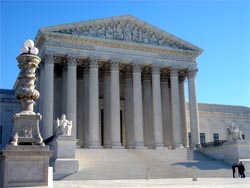 Earlier today we posted our in-depth breakdown of the majority/plurality opinion in the just-decided Hamden v. Rumsfeld. We’ve also got a breakdown of the three dissents to the case. But we’ve also got Justice Breyer’s brief concurrence, and Justice Kennedy’s concurrence-in-part. So let’s take a look at what’s going on there, shall we?
So what did Justice Breyer say in his little one-page concurrence? Breyer joined fully in the totality of Stevens’ opinion, both the majority and plurality portions. However, he would like to address a coment made by Justice Thomas in his dissent. Specifically, Thomas said that the Court’s decision would “sorely hamper the President’s ability to confront and defeat a new and deadly enemy.” In response to this, Breyer makes a very simple point:
Congress has not issued the Executive a ‘blank check.
Breyer notes that the President has already been explicitly denied, by Congrees, the authority to create military commissions like the one here at issue, and nothing is stopping him from going back to Congress and trying again. When there’s not an emergency preventing the President’s ability to consult with Congress, he should do so. This actually strengthens are nation, which is why this import check and balance was put in the Constitution.
Justices Kennedy, Souter and Ginsburg all joined in on this little pro-checks and balances message.
What’s Justice Kennedy’s deal? As discussed in our breakdown of the main opinion, Kennedy was on board with most of what Stevens was serving. In this opinion, Stevens explains why he agrees with most of Stevens’ analysis and he also explains why he didn’t join in the two plurality sections. Justices Souter, Ginsburg and Breyer all joined the portions of Kennedy’s opinion giving further explanation as to why he joined with Stevens, but they obviously don’t join the last part, where Kennedy explains his difference of opinion with STevens and them.
First, Kennedy notes that military commission trials bring up serious issues regarding the separation-of-powers, since you’ve got one branch, the Executive, defining, prosecuting and adjudicating offenses. And it almost worse here because the President is acting in a way which, historically, Congress has played a large part in (i.e., Congress set up the military court system, enacted the Military Justice Act, authorized courts-martial, etc.). Kennedy admits that the President should be given some level of deference with regard to his stated reasons for having the military commission utilize procedures that are different from court-martial procedures (this ties back to Stevens’ discussion that where “practicable,” he military commissions should use the same proceudres as courts-martial). However, Kennedy then breaks down some of the relevant statutory language to show why Stevens was right not to give too much deference to the President’s determination in this case, particularly because the statutes suggest that Congress, itself, has said not to give too much deference to the President (because the statute says that there should be uniformity insofar as is practicable, “not insofar as the President considers it to be” practicable).
Turning to another provisions which says that special military commissions can be convened to prosecute violation of other statutes, Kennedy notes that this affords no help to the Govermement’s position since the President doesn’t claim to be basing the charge against Hamdan on any statute and explicitly says the conspiracy charge stems froma violation of the law of war. Thus, Kennedy says Stevens was correct to focus on the relevant law of war, Common ARticle 3 of the Geneva Convention. And Stevens was also, therfore, correct that the military commission must satisfy Common Article 3’s requirement for a “regularly constituted court.” And the commission doesn’t do this: (i) it’s not a court formed by Congress, like other military courts; (ii) it’s not fashioned like courts-martial, as previous military commissions have been; (iii) there’s not an “acceptibel degree of indepdnedence from the Execitive,” such as what courts-martial have; and (iv) there is no sufficient explanation from the Government as to why there’s this deviation from court-martial practice
At this point, Kennedy has been talking fairly broadly, and he decides to hone in on a more detail analysis of the specific military commission in this case (and Justices Souter, Ginsburg and Breyer are still on board with him, joining this discussion as well). Once again, Kennedy points out that the military commission deviates from the general standards of a court martial without any “evident practical need.” For example, many of the many fucntions are concentrated into a single official, rather than being spread out. Similarly, there are less reigourous standards for how the tribunal, itself, is setup. And perhaps most importantly, the commission doesn’t have the same type of review procedures as is available in courts-martial (e.g., certain decisions from a court martial can be appealed to the independent Court of Criminal Appeals).
These difference would be okay if there was a supporting practical need for them, but Kennedy doesn’t see one, and this just means that the military commission has lost many of the fairness safeguards that courts-martial have. And it doesn’t help that the DTA allows for federal court judicial review since, as Stevens noted in the majority opinion, the scope of that review is rather limited and not automatic in every case (for example, it wouldn’t be automatic for Hamdan). Not to mention the fact that post-facto reviews can’t necessarily correct serious structural and procedural defects such as those identified here and in the majority opinion.
Kennedy’s final point here is that the commission also differs from courts-martial in its procedures. While Stevens didn’t focus so much on the structural differences Kennedy just discussed, we already know that he did spend some time looking at the procedural differences. Thus, Kennedy goes through this pretty quickly, dissing the military commission for having just one single evidentiary rule, allowing any evidence to be admitted if it has any probative value. So, for all these reasons, Kennedy is on-board with Stevens and the others in finding that the military commission simply exceeds the President’s authority.
Now comes the part of of Kennedy’s opinion where he explains why he didn’t join in portions of Stevens opinion (and the other Justices, who did join Stevens, obviously bow out of this part of Kennedy’s opinion). The basic reason is simply that he thinks Stevens addressed issued that didn’t need to be reached, since the majority had already concluded that the military commission was not authorized by the UCMJ. First, Kennedy thinks it was a mistake to delve into the issue of whether Common Article 3 requires the accused the be present at all parts of his trial. He actually likes Justice Thomas’ point (in his dissenting opinion) that the order creating the military commission disallows the use of seret evidence if it would impinge the ability of having a “full and fair trial.” Plus, he sais this determination of fairness would be subject to judicial review under the DTA. Now, if you’re curious about this, me too. Kennedy just went though a whole thing about he distrusts the military commission and its abitliy to be fair, but now, on this point, he seems okay with it. It’s a little odd. But then he goes on to say that he’s not so sure that it’s right to declare portions of the Geneva Conventions as binding law in light of the fact that the Government has decided not to be a part of those portions.
Finally, Kennedy notes that he doesn’t think it’s necessary to go into whether the conspiracy charge is valid. This is strictly because the majority has already concluded that the commission are unauthorized. Kennedy thinks the Court should be silent on this issue and let Congress take any steps it wants to try to define conspiracy as a valid, or invalid, charge.
Supreme Court Decision Update - Hamdan v. Rumsfeld
The Supremes waited ‘till the very end of the term to release their 185 page (!!) decision in one of the most anticipated cases of the whole term, Hamdan v. Rumsfeld (PDF of the opinion), the case about the Guantanamo military commissions. As many expected, the Court ruled in the Guantanamo detainee’s favor, finding the commissions illegal.
QuizLaw Analysis: With this case, the Supremes have ruled that President Bush was acting outside of any valid authority when he set up the tribunal commissions at Guantanamo Bay, and that these commissions are illegal under both the Geneva Convention and U.S. military justice law. This raises obvious questions about “what happens next” for the current Gitmo detainees, but it is certain to bring further criticism of Bush’s, and his administrations’, handling of the war on terror.
What’s the background of this case? In 2001, while U.S. forces were fighting in Afghanistan, they captured Salim Ahmed Hamdan, a citizen of Yemin. In 2002, they sent him to Guantanamo Bay, a U.S. naval base in Cuba (often referred to as “Gitmo”) where many suspects in the “war on terror” were being detained. In 2004, Hamdan was charged with being involved in a conspiracy to commit terrorism, and he was set to be tried before a military commission that had been setup at Guantanamo. Hamdan filed petitions for writs of habeas corpus and mandamus, claiming that he was being detained in violation of his due process rights and that he could not be prosecuted in this manner. Specifically, Hamdan argued that neither Congress nor the general laws of war recognize the authority of a military commission to prosecute someone for this type of conspiracy crime. Hamdan also argued that the actual procedures of the commission violate military and international law.
Hamdan’s writ for habeas corpus was granted by the District Court, which ruled that the Government has to show that a detainee is a prisoner of war before it can prosecute the detainee before a military commission. The District Court based this requirement on the Geneva Conventions, which the U.S. is a signatory to. However, the Court of Appeals for the D.C. Circuit reversed the District Court, finding that the Geneva Conventions were not judicially enforceable and that the military commissions were therefore legal.
So what does the Supreme Court say? The short version of things is that there is a majority ruling on two issues. First, the Court has the authority and jurisdiction to rule on the validity of military commissions. Second, the Guantanamo military commission is illegal under U.S. military justice law and under the Geneva Conventions, and the commission was not authorized by either Congress’ authorization of a response to the 9/11 attacks or the Detainee Treatment Act of 2005. There was another issue, whether or not detainees can be tried under conspiracy charges such as the charge before Hamdan, which the Court split on. Only four Justices ruled that Hamdan could not be charged with conspiracy, so this decision is not really binding and its long-term effect is unclear.
How did the votes break down? While there are six separate opinions in the decision, the vote breakdown is actually relatively easy. Stevens, Souter, Ginsburg, Breyer and Kennedy were the majority which ruled that the Court had jurisdiction in this case and then went on to find the military commissions illegal. Those same Justices, except for Justice Kennedy, are the ones who ruled that Hamdan couldn’t be charged with conspiracy. Justices Scalia, Thomas and Alito dissented to everything, each writing their own opinion. And Chief Justice Roberts didn’t take part in this case because he ruled on it when he was sitting on the Court of Appeals for the D.C. Circuit (and he supported the commissions’ legality, so he’s probably a bit tweaked to see his decision overturned today by his brethren).
So for those keeping score, it’s 5-3 that the Court had jurisdiction, 5-3 that the commissions are illegal and 4-3 on whether detainees can be charged with conspiracy (while Kennedy didn’t join with the plurality on this point, he also declined to express a view in his own written opinion).
Do the Supremes have the authority to hear this habeas application? Yes, one of the things we have a majority ruling on is that the Court has jurisdiction over this case. The Government made two arguments here, and the first one involves a rather intricate reading of the Detainee Treatment Act of 2005 (the DTA). One section of the DTA, § 1005(e)(1), says that no court has jurisdiction to consider any application for a writ of habeas corpus filed by any Guantanamo detainee. Section 1005(e)(2) and 1005(e)(3) of the DTA say that the D.C. Circuit Court has exclusive jurisdiction to review: (i) any final decisions of a Combatant Status Review Tribunal that a detainee was properly designated as an enemy combatant; and (ii) any final decisions of a military commission (but the review’s scope is limited to only questions of compliance with military standards and the Constitution). Finally, section 1005(h) says that 1005(e)(2) and (e)(3) apply to cases pending at the time of the DTA’s enactment. However, it is silent as to § 1005(e)(1).
Ok, so the Government says that § 1005(h) should also apply to § 1005(e)(1), meaning that the courts have no jurisdiction over habeas applications pending at the time of the enactment of the DTA (remember, Hamdan’s application was pending at that time). Stevens turns to basic statutory interpretation to decide that the government is wrong, at least with respect to cases like this, where the habeas application was already pending at the time § 1005(e) was enacted. Stevens cites “[a] familiar principle of statutory construction,” which allows for a negative inference to be drawn when certain language is excluded from one provision but “included in other provisions of the same statute.” It’s conclusive for Stevens that § 1005(h) explicitly applies itself to (e)(2) and (e)(3) but is silent as to § 1005(e)(1). In addition, an earlier draft of § 1005(e) actually included similar language but since that language was not included in the final draft, Stevens argues that the Court can make a negative inference that Congress did not want this section to apply to pending cases.
The Government’s second argument was that, even if the Court has jurisdiction, it should abstain from exercising that judgment because of a prior Supreme Court case, Councilman. In that case, the Supremes basically created a new rule that courts should keep-out of pending court-martial proceedings against service members. There were two reasons the Court created that rule in Councilman: (i) the military justice system can most efficiently deal with military discipline if the civilian courts stay out of it; and (ii) the courts should respect the balance that Congress created between military procedure and fairness to service members, when it created the military justice and review system. These reasons simply don’t apply to the current situation: (i) Hamdan is not a member of U.S. armed forces; (ii) the tribunal trying him isn’t part of the military judicial system; and (iii) there’s not the same type of appeal/review process set up for tribunal decisions as there are for military courts. Stevens thinks it’s better to look at another Supreme case, Quirin, where the Court did not abstain from hearing the habeas applications of some Germans who were before a military commission. The Court got involved because of the importance of the questions at issue, the public interest in those issues getting resolved quickly, and the Court’s duty and obligation to preserve Constitutional safeguards. As far as Stevens is concerned, those same reasons rule the day here, at least for this particular case.
With that out of the way, what about these military commissions - are they legal? Stevens, still with a majority in his pocket, does not believe that the Guantanamo military commission is legal. First, the commission “was born of military necessity,” but is not actually authorized by the Constitution nor created by any statute. The Constitution makes the President the “Commander in Chief,” presiding over the armed forces, but it put Congress in charge of making rules relating to “captures on land and water” and regulating the armed forces. In other words, Congress makes military laws, and the President executes those laws. Stevens then recognizes that Congress has explicitly authorized that military commissions can be set up to try folks for “offenses against the law of war in appropriate cases.” This does not give the President “a sweeping mandate” to invoke military commissions whenever wants; instead, it allows him to use such commissions in compliance “with the law of war.” This is not changed or overridden by either the Congressional Authorization for Use of Military Force granted to the President or the DTA. Neither includes any language even suggesting that Congress intended to expand the President’s ability to use military commissions.
Since there is no Congressional authorization for the Guantanamo military commission trying Hamdan, Stevens says we should next look at whether the commission is otherwise “justified under the ‘Constitution and laws,’ including the law of war.” Here, Stevens loses his majority, as Kennedy bows out of this portion of the opinion. We’ll discuss it in more depth below, but the plurality ultimately concludes that Hamdan has not been charged with an offense which the law of war allows military commissions to try - that is, “conspiracy” is not a valid offense under the law of war. It doesn’t matter that Stevens lost his majority on the above issue, however, because he regains his majority in concluding that the commission’s structure and procedure violate the Uniform Code of Military Justice (the UCMJ) and the Geneva Conventions.
Stevens begins by explaining some of the procedures involved in a trial before the Gitmo commission. The emphasis of Steven’s displeasure is with the evidentiary aspects of the proceeding. The detainee is entitled to an appointed military counsel or to hire his/her own civilian counsel (if that attorney has sufficient security clearance). The commission also allows the detainee to have a copy of the charges, and affords some other basic defendant rights. “These rights are subject, however, to one glaring condition,” which is that the commission has the discretion to “close” proceedings, preventing the accused detainee from learning anything about the evidence presented against him. The commission also has discretion to deny access to any “protected information,” if it decides that a full and fair trial can still be had even if the accused doesn’t know about it. Finally, the commission is also allowed to admit any evidence (Steven’s emphasis, not ours) that may have probative value, such as hearsay and coerced testimony.
Stevens then turns to the Government’s argument that a procedural challenge is premature because the commission proceedings against Hamdan aren’t finished yet - Hamdan can challenge them when all is said and done, the Government argues, and there’s no reason to think that the procedure won’t be done in a manner faithful to the law. Stevens doesn’t buy this. First, Hamdan would not have an automatic right to appeal a decision against him since he’s not subject to the death penalty or more than 10 years in prison. Second, the commission has already exercised procedures in violation of the law, because Hamdan has been excluded from his trial. So Stevens tells the Government, essentially, to get bent - the Court’s looking at the procedural challenge.
How does this military commission violate the Uniform Code of Military Justice? The short version is that Stevens and his majority have decided that the commission’s procedures vary from the procedures used in courts-martial, and no proper justification has been provided by the President. While there are differences between military commissions and courts-martial, the same rules and procedures have historically applied to both (Stevens mentions a “glaring historical exception,” the World War II trial of General Yamashita, but says that the precedent involved in that situation “has been seriously undermined by post-World War II developments”). Nevertheless, Stevens recognizes that there are times when court-martial procedures can be departed from, if that departure is “tailored to the exigency that necessitates it.” Such a departure is governed by Article 36 of the Uniform Code of Military Justice (the UCMJ). Article 36 gives the President the power to promulgate procedural rules for both courts-martial and military commissions, with two restrictions: (i) any such procedural rule cannot be contrary to or inconsistent with the UCMJ; and (ii) all rules must be “uniform insofar as practicable,” meaning the same rules should be applied to courts-martial as to military commissions (i.e., don’t deviate from the procedures in the Manual for Courts-Martial unless you have to). Stevens skips over this first restriction, declining to decide whether any of the commission procedures are contrary to or inconsistent with the UCMJ. This is because he has concluded that “the ‘practicability’ determination the President has made is insufficient to justify variance from the procedures governing courts-martial.”
Although the President has concluded, in his official Article 36 determination, that it would be impracticable to apply the rules of law used in District Court cases to Hamdan’s commission, he has not made such a determination as to the rules for courts-martial, and that’s what is called for by Article 36. So Stevens looks to the record and finds nothing to suggest that it would be impracticable to use court-martial rules. And even if he is willing to consider the reason provided by the President with regard to District Court procedures, the only relevant one is the danger presented by terrorism. However, while Stevens acknowledges the importance of this danger, he just doesn’t see how this requires using different procedures. And Stevens says that he finds the lack of a showing of impracticability especially troublesome in light of the fact that Hamdan was denied “one of the most fundamental protections afforded not just by the Manual for Courts-Martial but also by the UCMJ itself: the right to be present.” At the end of the day, it boils down to this - since there’s no showing of impracticability, the courts-martial rules must apply, and since the commission “deviates in many significant respects from these rules, it necessarily violates Article 36(b).”
How does this military commission violate the Geneva Conventions? Stevens notes that the Court of Appeals dismissed Hamdan’s challenge based on the Geneva Conventions because it decided, among other things, that the Conventions aren’t judicially enforceable, that Hamdan isn’t entitled to their protection anyway, and that even if he was entitled to their protection, the Court should abstain from enforcing the Conventions under the principal addressed in Councilman. Stevens has already talked about why the Court is not abstaining under the Councilman rule, so he focuses here on the other two issues.
First there’s the issue about whether the Geneva Conventions are judicially enforceable (this harkens back to Monday’s Supreme decision in Sanchez-Llamas v. Oregon, where Chief Justice Roberts declined to decide whether the Vienna Convention was judicially enforceable). The Court of Appeals relied upon a 1950 Supreme Court case, Johnson v. Eisentrager, which involved several German nationals challenging their war crime conviction by a tribunal in China. The Eisentrager Court decided the case on the merits but included a “curious statement [buried in a footnote] suggesting that the Court lacked power even to consider the merits of the Geneva Convention argument.” The Court of Appeals relied on this footnote in making its decision, and Stevens notes that the footnote is simply not controlling. Further, whatever rights Hamdan has, those rights are clearly “part of the law of war” and the UCMJ requires compliance with the law of war.
The bigger issue here is whether the Geneva Conventions even apply to Hamdan. The Court of Appeals’ rationale that the Conventions did not apply went like this - Hamdan was captured while the U.S. was at war with al Qaeda, this war is separate and distinct from the U.S. war with the Afghani Taliban, and since al Qaeda is not a signatory to the Conventions, the Conventions don’t apply to the present situation. Stevens sort of punts this issue, deciding that the Court doesn’t need to decide whether all of the Geneva Conventions apply where “the relevant conflict is not one between signatories” because “there is at least one provision” that does apply.
The provision in question is Common Article 3 (referred to as “Common” because it appears in all four of the Geneva Conventions), which says that whenever there’s a “conflict not of an international character” which is taking place in the territory of a Conventions signatory, any party to the conflict must apply certain protections to people not actively involved in the hostilities. This includes opposing armed force members who lay down their weapons and those who are detained. One of the protections that falls within this category is that sentences can’t be handed out without a judgment being “pronounced by a regularly constituted court affording all the judicial guarantees which are recognized as indispensable by civilized peoples.” The Government argues that Common Article 3 shouldn’t apply here since the U.S.’s fight with al Qaeda is of an international character. Stevens rejects this however, saying that “conflict not of an international character” is simply intended to provide a broader scope than that of Article 2, which is more directed towards international war between nations. This broader scope is intended to encompass situations where one party to the conflict is not actually a legal entity (i.e., a nation). For example, this affords protection where a country is involved in a civil war - the rebels, who have no international legal status, are afforded the protections offered by Common Article 3. Thus, Stevens concludes, Common Article 3 applies to the current situation.
Since Common Article 3 applies to Hamdan’s situation, he may only be tried by “a regularly constituted court affording all the judicial guarantees which are recognized as indispensable by civil peoples.” Since Common Article 3 doesn’t specifically define what “a regularly constituted court” is, Stevens looks to other sources. Although he doesn’t actually provide a definition of his own, he appears to latch on to the Red Cross’ definition of the term, which requires such a court to be “established and organized in accordance with the laws and procedures already in force in a country.” Here, this means that a military commission, to meet this definition, must follow the standards of our own military justice system which, in turns, means it must follow court-martial procedure or have an justified explanation for why it deviates from those procedures. And as we know, Stevens and his majority have already decided that the military commission fails to do so.
As a final point here, Stevens also notes that the procedures employed and followed by the military commission do not afford the guarantees which civilized folks would recognize as being indispensable. This is the other place where Kennedy declined to join, so this again lacks the weight of a majority. However, the only real import in this section is Stevens’ repeated emphasis of his discomfort with the fact that the military commission dispenses with customary international law by not allowing for the accused to be present at his trial and aware of the evidence against him.
Anyway, at the end of the day, the point here is relatively clear:
Common Article 3 obviously tolerate a great degree of flexibility in trying individuals captured during armed conflict; its requirements are general ones, crafted to accommodate a wide variety of legal systems. But requirements they are nonetheless. The commission that the President has convened to try Hamdan does not meet those requirements.
As a final point on this issue, the folks over at SCOTUSblog have raised an interesting interpretation of this portion of the decision. Namely, that because Common Article 3 applies to the war against terror, there are “enormous implications for the Administration’s detention and interrogation practices, because the Administration’s legal conclusion that [Common Article 3] does not apply…was the the key linchpin to the entire edifice of legal maneuvers that led to waterboarding, hypothermia, degradation, etc….Per today’s decision, the Administration appears to have been engaged in war crimes.”
Ok, but if the military commissions are illegal, can Hamdan still be detained in Guantanamo? Stevens concludes by noting that the Court has assumed that the Government is correct in assessing that “Hamdan is a dangerous individual whose beliefs, if acted upon, would cause great harm and even death to innocent civilians, and who would act upon those beliefs if given the opportunity.” Thus, Stevens wants to make it very clear that the Court has not addressed, in any way, the Government’s ability to “detain him for the duration of active hostilities in order to prevent such harm.” So at the end of the day, Stevens has told the President that he can keep all the Guantanamo detainees locked up, if they’re assessed to be a danger, but he cannot try them in the fashion that Hamdan was being tried.
Now can we back up and take a look at this “conspiracy” and “rule of law” business that Stevens lost his majority on? Ok, so if you remember back, we were talking about Stevens’ determination that the military commissions aren’t legal under the UCMJ or the Geneva Convention. But first, he looked into the fact that they’re not authorized by Congress. He then went on a slight sidetrack to explain why doesn’t think that the charge against Hamdan is even justified under U.S. law or the law of war. It didn’t matter for his ultimate decision, which is good for him since he lost Kennedy in this part of the opinion, giving him a mere plurality of four votes. So what is this plurality section all about?
Well, Stevens begins by looking at the historical use of military commissions, identifying three situations where they’ve generally been used. The first is in the place of civilian courts when there’s been a declaration of martial law. That is not analogous to the present situation, since no martial law has been declared in Guantanamo. The second place military commissions have been used is where there’s no civilian government yet and, instead, a temporary military government has been setup, such as in occupied territories. Again, this doesn’t apply to the current situation because Guantanamo Bay isn’t an occupied enemy territory. The third and final historical use of military commissions has been where they’ve been “convened as an ‘incident to the conduct of war,’” to allow for the immediate seizure and trial of military enemies who have attempted to attack the military or get in its way. This third type of commission is the only one that’s close to what is going on in Guantanamo Bay. For such a commission to have proper jurisdiction, Stevens identifies four preconditions that must be met.
First, the military commission can only assume jurisdiction of those offenses which were committed within “the theatre of war.” Second (and pay attention, because this is the one that Stevens focuses on), the offense which the accused is being charged with must have been committed during the war in question. Third, the commission can only try members of the enemy army who have conducted “illegitimate warfare or other offences in violation of the laws of war” or members of the military commission’s own army who, during wartime, committed some crime not otherwise triable by criminal courts or under the Articles of War. Fourth, and finally, the commission only has jurisdiction over two types of offenses - where the law of war, as recognized by military tribunals, has been violated, or where military orders or regulations have been breached (and where the offender can’t be tried by court-martial).
So, with these four preconditions in mind, the issue is whether they exist in Hamdan’s case. Hamdan is charged for conspiracy extending from 1996 through November 2001. Stevens notes that of this 5-year period, only two months fall after September 11, 2001 and the Congressional enactment of the AUMF which gave the President his current war powers. The Government doesn’t allege any specific act against Hamdan which took place after 9/11, meaning that “[n]one of the overt acts that Hamdan is alleged to have committed violates the law of war.” So the second precondition to such a military commission, that the charge took place during war time, simply isn’t present. Stevens says this casts doubts on the commission’s legality and, more importantly, is symptomatic of “the most serious defect of this [commission’s] charge: The offense it alleges is not triable by law-of-war military commission.”
So now, we finally get to the real meat of the plurality portion of the decision, Stevens’ conclusion that “conspiracy” is not a valid charge for the military commission to try. While Congress hasn’t included “conspiracy” in its definition of war crimes, that’s not the end of the argument because Congress has “‘incorporated by reference’ the common law of war,” which means that military commissions may be able to try some offenses which aren’t explicitly defined as a war crime by Congress. But here, there’s no clear precedent for defining “conspiracy” as a war crime. Stevens says that “conspiracy” has rarely been charged by U.S. military commissions acting as the third law-of-war type of commission, and there’s nothing about “conspiracy” in either the Geneva Conventions or the Hague Conventions. Similarly, it’s not been recognized by other international sources, such as the International Military Tribune at Nuremberg, which actually explicitly refused to allow conspiracy charges. And the Government’s attempt to rely on Quirin, the case where German prisoners brought habeas applications, is not persuasive to Stevens. He says that the Court didn’t actually decide, in that case, whether conspiracy was a triable war crime and, more importantly, that Court emphasized an offense being “completed,” which is a limitation Stevens says kicks “conspiracy” firmly outside the scope of war crimes.
As a result of all of this, Stevens concludes that the military commission doesn’t have proper jurisdiction to try a conspiracy charge, which means it has no authority to try Hamdan. But again, this decision is only a plurality, and its impact is therefore entirely unclear.
What about the concurring opinions? Justice Breyer wrote a brief one-page concurrence, and Justice Kennedy wrote a concurrence-in-part (coming in at a longer 20 pages). You can read about those two opinions here.
What about the dissenting opinions? As mentioned above, all three dissenters (Justices Scalia, Thomas and Alito) each wrote their own dissenting opinion. You can read about these three dissenting opinions here.
The Daily Memo - 6/29/06
The NFL and the NFL Players Association have been sued by seven current and former players over an investment fraud scheme allegedly endorsed by the NFLPA. (SI)
D.C. has rent control for the first time in about two decades. (Metroblogging Washington)
A bankruptcy judge has approved the sale of Adelphia’s assets to competitors Time Warner and Comcast. (Blogging Stocks)
Tiffany & Co. has entered into a settlement over its defective silver baby rattles. (Rocky Mountain News)
A Florida man received several squirrel-related citations, including citations for “squirrel at large” and “squirrel on the beach.” (Political Gateway)
A 17-year-old St. Louis girl has been awarded $180,000 in a sexual-harassment suit because, among other things, her employer referred to her as a “whore” and “skank” and a coworker tried to rape her. (Kansas City Star)
Palm and Xerox have settled a heated patent battle they’ve been involved in for nine years. (Engadget)
A $15 million verdict against comic book creator Todd McFarlane, stemming from a comic book mobster character in “Spawn” which he based on hockey player Tony Twist, has been upheld. (The Hollywood Reporter, Esq.)
Supreme Court Decision Update - Clark v. Arizona
For those of you lawyers who slept through much of your first-year crim law classes and missed the intricacies of the M’Naghten rule, the Supremes, in Clark v. Arizona (PDF of the Opinion) are here to offer you a refresher. Indeed, in today’s decision, the Supremes have just made it a little more difficult for crazy killers to escape conviction by reason of insanity.
QuizLaw Analysis: If you are completely batshit, and you go out and kill a cop, it no longer matters if you were unaware of what you were doing when you pulled the trigger. Now, the threshold question is whether you were unable to understand that what you were doing was wrong when you pulled the trigger. In the insanity context, cognitive capacity is now only material inasmuch as it disproves that our crazy killer knew what he was doing was morally wrong. That may seem like splitting hairs to you, but for the defendant in this case, it means a life sentence. Moreover, in Arizona at least, a judge may only allow our crazy killer to introduce mental disease evidence to prove insanity, not to negate mens rea. Got it? Yeah. Me neither. So, let’s go through it together.
The facts, at least, are straightforward: 17-year-old Jeffrey Clark was driving around in his truck early one morning, blaring his music, when a police officer tracked him down, pulled him over, and asked him to get out of the car. Clark did so, and then shot the police officer dead.
Initially, Arizona found that Clark was incompetent to stand trial and ordered him institutionalized. Two years later, however, Arizona deemed that his competence had been magically restored, so they put him on trial. Clark did not contest that he was the one who shot the officer. Instead, he claimed that because of his paranoid schizophrenia, he had not formed the specific intent, required by the murder statute, to shoot the officer. The prosecution, however, presented evidence that Clark did know he was shooting the officer and had, in fact, lured him out in order to kill him.
Clark countered by claiming that he was mentally ill, and sought to introduce evidence of that illness 1) to raise the affirmative defense of insanity, and 2) to rebut the prosecution’s evidence that he had formed the requisite mens rea, i.e., to prove that he had not acted “knowingly” or “intelligently” when he shot the police officer.
The trail court, however, held that he could not present evidence of his mental stability to disprove mens rea. In other words, he could not present evidence of mental illness short of insanity to disprove his intent to kill. Therefore, to escape conviction, Clark had to mount enough evidence to prove that he was actually insane. On that count, Clark presented a lot of evidence from friends and classmates which tended to show that he wasn’t exactly in his right mind — he thought aliens were after him, he kept a bird in his truck to warn of airborne poisons, and he rigged wind chimes out of fishing reel to warn of intruders. A psychiatrist also testified that Clark was suffering from paranoid delusions about an attack by aliens when he shot the officer. The prosecution, however, rebutted much of this, asserting that Clark’s paranoid delusions did not prevent him from knowing the difference between right and wrong (indeed, he must have known what he was doing was wrong, the prosecution argued, because after shooting the officer, he ran away, hid the gun, and otherwise evaded the police).
The trial judge convicted Clark of first-degree murder, finding that – though he was suffering from paranoid delusions at the time of the shooting — his mental illness did not distort his perceptions enough to show that he didn’t know what he was doing was wrong. This appeal followed.
The first issue presented to the Supremes was whether Arizona’s insanity test provided for due process. Under the traditional McNaghten rule (which dated back to Victorian times in England), to prove insanity, due process required asking two questions 1) did the defendant have cognitive capacity, i.e., did he understand what he was doing, and 2) did he understand that his actions were wrong? The Arizona definition of insanity, however, did away with the first prong (i.e., Arizona doesn’t require the defendant to have cognitive capacity).
In the 5-4 opinion written by Justice Souter, the Supremes determined that having only the second element of the McNaghten rule was enough to pass constitutional muster. In doing so, Souter asserted that, though it was an oft-used rule, the McNaghten rule did not rise to the level of “fundamental principle,” and that the insanity rule is open to state choice. Moreover, Souter wrote that the cognitive capacity element was extraneous, because if a defendant did not know what he was doing then he wouldn’t have known that what he was doing was wrong. In application to this case, Clark may not have known — because of his paranoid delusions — that the officer he shot was a human being, but he did know what he did was wrong. And apparently that was enough to disprove insanity.
Having ruled out complete insanity as an affirmative defense to murder, the second issue presented to the Court was whether Clark could put forth evidence of mental defect to disprove the mens rea element. The lower courts said no, and the Supremes agreed. Justice Souter acknowledged that mental-defect evidence could be used to disprove mens rea, but that any state has the right to force a defendant to channel that evidence into the insanity defense exclusively. Why? In large part, because — when going to the element of mens rea — the probative value of such evidence might be outweighed by unfair prejudice, confusion of the issues, and the potential to mislead juries. For instance, in this case, evidence of mental disease might “mislead jurors (when they are the factfinders) through the power of this kind of evidence to suggest that a defendant suffering from a recognized mental disease lacks cognitive, moral, volitional, or other capacity, when that may not be a sound conclusion at all.” Indeed, even if mental disease is proven, it may not have a bearing on mens rea and such a suggestion has the potential to confuse the jury, especially if they consider concepts of psychology instead of concepts of legal sanity, which is the issue here.
Kennedy, in his dissent, disagreed with the majority on the second issue, and he’s got a fairly good point. Nevermind that such evidence may unfairly prejudice, confuse, or mislead a jury - evidence of mental defect should be allowed to show that the defendant didn’t actually commit the crime. In other words, Kennedy is saying that this exclusion of evidence is tantamount to prohibiting evidence from an eyewitness saying that the defendant didn’t kill the officer because such evidence might mislead or confuse the jury. Of course, it’s not designed to mislead or confuse, such evidence is introduced to prove that the defendant didn’t commit the crime, and how in God’s name can you keep that out of a trial? Moreover, evidence of mental-disease should not be channeled exclusively into the insanity defense because it is the defendant’s burden to prove insanity, while it is the prosecutions burden to prove mens rea, and this rule thus decreases the burden on the prosecution.
In this case, Kennedy offers a brilliant illustration of why the majority’s reasoning is unworkable: If Clark were to get up on the stand and say that he thought the police officer was an alien, the majority’s rule would not allow Clark to introduce corroborating evidence to show why he thought that the police officer was a space invader. In essence, the jury would be led to believe that Clark engaged in unexplained behaviors for no obvious reason at all, because they wouldn’t be privy to mental-defect explanations.
Breyer wrote separately to sort of agree with the majority’s reasoning, but to say that the case should be remanded for the lower courts to decide the case on the basis of the Court’s ruling.
But the real question is, does this distinction mean I can claim that 5 inches is actually 8 inches?
 On the technology front, Western Digital has decided to settle a class-action lawsuit brought by consumers over its alleged misrepresentation of hard drive storage capacity. There are several lawsuits like this floating around across the country (I was actually involved in defending another tech company in a similar class-action lawsuit several years ago), and they all stem from the difference between the decimal and binary systems.
In a nutshell, the tech companies like to advertise storage using the decimal system, so a “gigabyte” to them is 1 billion bytes. The software folks, meanwhile, use the binary system and therefore see a “gigabyte” as being 1.07 billion bytes. Thus, a drive which Western Digital advertises as 50 gigabytes is reported by Windows or Mac OS X as only being about 47 gigabytes. While this is arguably misleading by the hard drive and storage folks, my interpretation of the law at the time I was involved in the matter is that it’s totally on the up-and-up from a legal standpoint. In fact, there’s even a federal statute which says that a company can’t be sued for properly using the decimal system, which is exactly what Western Digital and others are doing. But Western Digital clearly decided it was best to just get out of this muck-a-muck, rather than trying to carry on the fight.
Today’s Reading Assignment
 Just a quick heads-up to suggest you go read Senator Feingold’s excellent statement on the Daily Kos about the disparity between how Congress gets a raise and how the rest of get raises (which are harder to come by for many when Congress continually refuses to raise the minimum wage).
Supreme Court Decision Update - League of Latin American Citizens v. Perry
In one of the more anticipated Supreme Court cases this term, in League of Latin American Citizens v. Perry (PDF of the Opinion), i.e., the “Texas redistricting case,” our Justices decided that now was a good time to wreak havoc on summary writers, deciding several issues with different majorities in a whopping 132 page decision in which six of the Justices wrote an opinion.
QuizLaw Analysis: The (really) long and short of it is this: On the two issues that the Supremes came to a majority consensus on, the Court held that 1) part of the redistricting plan violated the Voting Rights Act by screwing over the growing Hispanic population in District 23. However, 2) in what was obviously a power-grab by Republicans to entrench themselves in the majority, the Texan Congress did not violate the Constitution by redrawing the electoral map mid-decade, even though new maps were only required to be drawn once every ten years to account for shifts in population. In essence, besides the one district (23), the Republicans redistricting map was upheld.
Here is some preliminary background: After the 1990 census, in which the Republicans gained on the Democratic majority, the Democrats redrew the Texas electoral map in the hopes of holding on to its slim lead in the congressional delegation. The Republicans unsuccessfully challenged the new map, arguing that it constituted impermissible partisan gerrymandering. By 2000, the Republicans had increased their numbers, but since there was no clear majority in the State House, the job of redrawing the electoral map fell to the courts, which largely held the 1991 Democrat-drawn map in place. However, in 2003, the Republicans finally gained a foothold in the state legislature and, with that power, they redrew the map again, resulting in a 2004 election that gave the Republicans a 21-11 lead in the House.
In 2003, several contingents of voters brought suit, challenging the Texas redistricting map (referred to as 1374c), arguing: (i) that redistricting could not take place mid-decade; (ii) that the map unconstitutionally discriminated on the basis of race; (iii) that the map constituted unconstitutional partisan gerrymandering; and (iv) that the map, in effect, diluted the voting rights of minorities in violation of Section 2 of the Voting Rights Act. A Texas district court, however, upheld the map, holding that it was neither unconstitutional nor in violation of the Voting Rights Act. While the case was pending appeal, however, the Supremes came down with an opinion on another redistricting case in Pennsylvania, Vieth v. Jubelirer. In Vieth, the Court decided that it did have jurisdiction over partisan gerrymandering cases, but it didn’t come up with any consensus on a test for determining impermissible partisan gerrymandering. In light of the Vieth case, the Texas court reaffirmed its earlier holding in the Texas redistricting case. This appeal followed.
First, as to the violation of Section 2 of the Voting Rights Act, Justice Kennedy wrote the opinion in which the court’s liberal members joined, creating a 5-4 majority. This majority held that the redrawing of Texas District 23 amounted to vote dilution, in violation of Section 2. Kennedy found that the new configuration of District 23 prevented a Latino candidate from taking a seat from a Republican incumbent because Hispanics constituted a majority of the voting population under the old map - thus, the Texas legislature did, in fact, redraw the map to protect the incumbent by unnaturally shifting a large segment of the Hispanic population into another district. Indeed, the new map resulted in only five Latino opportunity districts in Texas, despite the fact that Latinos made up 22 percent of the population (and therfore should have been accorded two more districts to account for proportional representation.) “In essence,” Kennedy wrote, “the State took away [the Latinos] opportunity [to oust the incumbent] because they were about to exercise it.” Indeed, Kennedy noted, the redrawing of the map was not done on behalf of the Texas voters (specifically the Latino population) but on behalf of an incumbent who was on the verge of losing his seat. Therefore, under the “totality of the circumstances,” section 2 was violated.
On the separate issue of whether redrawing the congressional map mid-decade constituted political gerrymandering, Kennedy also wrote the 7-2 majority opinion (though the seven justices in the majority differed to some extent on the reasons why it did not constitute political gerrymandering). Kennedy concedes that there was political motivation behind the redistricting plan, recognizing that the sole purpose was to achieve a Republican majority. However, he noted (and four other Justices agreed) that partisan aims did not guide the entire redistricting plan, evidenced by the fact that the Republicans did take into account “mundane and local interest” as well as some of the Democrats’ suggestions in redrawing. Kennedy further noted that there was nothing “inherently suspect about a legislature’s decision to replace mid-decade a court-ordered plan with one of its own,” and that — though the new plan did represent a shift in Republican seats — it reflected the distribution of state party power better than did the previous two plans. Six other Justices agreed with Kennedy, rejecting the argument that mid-decade redistricting for exclusively partisan purposes violated the one-person, one-vote requirement because there was no evidence (at least ascertained by the District Court) to support the argument.
Beyond those two issues, however, the Supremes were split and there were no majority opinions on the other issues (though the SCOTUSblog disagrees slightly, if “sympathetic votes” are accounted for). Specifically, three judges (Kennedy, Roberts, and Alito) all agreed that redistricting in Dallas (District 25) did not dilute the African-American vote because African-American voters consistently voted for the white incumbent and thus, African-Americans were not denied their choice of seat-holder. Moreover, the challengers didn’t present enough evidence that African-Americans wielded enough power (with only 25 percent of the population in the area) to change the outcome. Thomas and Scalia implicitly agreed on this count, without actually joining Kennedy’s opinion, by simply rejecting the Voters Right’s Act claims in their entirety.
Souter, joined by Ginsberg, didn’t necessarily disagree with the plurality about the redistricting in District 25, he simply advocated that the matter be remanded to the district court for further consideration, specifically with regard to the question of whether a voting dilution claim can prevail even though the minority population is less than 50 percent.
Justice Breyer chimed in with his own opinion to agree with Kennedy in ruling that Section 2 of the Voting Rights Act was violated with regard to the dilution of the Latino vote. However, Breyer would go many steps further, suggesting that the entire redistricting plan violated the Equal Protection Clause of the Constitution because the plan “overwhelmingly relies upon the unjustified use of purely partisan line-drawing considerations … which will likely have seriously harmful electoral consequences.”
Chief Justice Roberts, joined by Alito, wrote separately to agree that the new redistricting plan was not unconstitutional partisan gerrymandering, but disagreed that the redrawing of District 23 violated the Voting Rights Act. Roberts argued that the existing redistricting plan actually maximized the Latino vote (as found by the District Court) and he therefore found the majority’s reasoning absurd, noting that there is no alternative redistricting plan that would have fared better for the Latino vote. “When a State’s plan already provides the maximum possible number of majority-minority effective opportunity districts, and the minority enjoys effective political power in the area well in excess of its proportion of the population,” Roberts wrote, “I would conclude that the courts have no further role to play in rejiggering the district lines.”
Justice Scalia, joined by Thomas, also wrote a separate opinion, disagreeing with the majority’s holding that District 23 violated the Voting Rights Act. The crux of his argument was that the Voting Rights Act could only be violated if the reason behind redrawing the map was racially motivated. Here, Scalia asserts that it was not racially motivated, it was motivated by a desire to keep the Republican incumbent in office, i.e., a political motivation (that had an unfortunate side-effect on the Latino community). Though an argument might be made that there was an inference of racial motivation behind the political action, Scalia asserted that simple inferences cannot overcome the district court’s finding of fact because the Supreme Court could only overturn a lower court in the case of “clear error,” i.e., “inferences” do not amount to “clear error.”
The Daily Memo - 6/28/06
John Cusack had to file a restraining order against a homeless woman he says is stalking him with letters inserted into bags of rocks and screwdrivers. (Defamer)
The Senate Judiciary Committee is looking into President Bush’s claim that he doesn’t have to obey the laws that he, himself, signed into effect. (Law.com)
A federal judge in Atlanta has ruled that Georgia cannot enact a broad law which would ban sex offenders from living within 300 feet of a school bus stops, effectively barring them from many cities and towns. (FindLaw)
An Ohio judge threw a man into the clink for trying to get out of a death penalty case jury pool by claiming he was addicted to heroin and had killed someone. (Law.com)
A Texas county failed to do a background check and ended up appointing a new county prosecutor who has a criminal record. (Amarillo.com)
A Missouri federal judge has stopped all executions in Missouri until the state changes its execution methods to ensure that there’s no excruciating pain involved. (Seattle PI)
An Ohio man convicted of murder ridiculed the jury in open court (and he’s previously called the jury dumb and stupid), in an attempt to get a death sentence which, he believes, will allow him to file appeals looking into the competence of the jury. (NewsNet5)
Supreme Court Decision Update - Sanchez-Llamas v. Oregon
In Sanchez-Llamas v. Oregon (PDF of the opinion), the Supremes look at a portion of the Vienna Convention which says that when a foreign individual is detained, the U.S. authorities are required to tell him that he can notify his government of his detention.
QuizLaw Analysis: The Supremes basically skirted the big issue here, which is what really happens when the cops fail to tell a foreign suspect that he’s entitled to get in touch with his government. Instead, they ruled that, when the cops do actually fail to do so, (i) the detainees aren’t entitled to have evidence suppressed and (ii) the detainees must make any claims about the violation in a manner consistent with federal and state procedural law (so if they don’t raise the alleged violation in trial, they lose the right to claim it later). The majority ruling, by skirting the big issue, appears to leave this treaty requirement with little power or effect, almost telling U.S. authorities that it’s ok if they don’t tell foreign suspects that they can get in touch with their consulates.
This decision consolidates two cases, Sanchez-Llamas and Bustillo v. Johnson. At play in both of these cases is the Vienna Convention on Consular Relations, an international treaty which 170 countries, including the U.S., are a part of. The relevant portion of the Vienna Convention is Article 36, which establishes that a detaining country must notify the authorities of the detainee’s home country that they are detaining that person, if that person so requests. Article 36 also says that the detaining country must notify the detainee of his rights under the Article, including this notification right (i.e., local authorities are obligated to tell foreign detainees that they have a right to get in touch with their consulate.
In December 1999, Moises Sanchez-Llamas (a Mexican national) got into a shootout with cops, hitting one in the leg. He was arrested and read his Miranda rights, in English and Spanish, but he was not told that the could request to have the Mexican Consulate informed of his detention, pursuant to Article 36. He was then interrogated by the police with the help of an interpreter and during these interrogations, he provided several incriminating statements about the shootout. He was charged with several criminal offenses, including attempted murder and, before going to trial, he tried to suppress his statements to the police on the grounds that they were involuntary in light of the cops failing to comply with Article 36. The court denied his motion and he was eventually convicted and sentenced to over 20 years in prison. Sanchez-Llamas appealed, again arguing that his statements should have been suppressed, but the Oregon appellate court and Supreme Court both affirmed the trial court decision, holding that Article 36 doesn’t create any right of access or notification to a consulate which a detainee can enforce within the context of a judicial proceeding.
Meanwhile, in 1997, Mario Bustillo (a Honduran national) was in a Virginia restaurant where a man was hit in the head with a baseball bat, eventually dying. Bustillo was identified as the man’s attacker, and he was arrested and charged with murder. The cops did not notify him of his Article 36 right to request that the Honduran Consulate be notified of his arrest. During his trial for murder, Bustillo argued that another man was responsible for the attack, presenting several corroborating witnesses. The jury convicted him of murder, anyway, and sentenced her to 30 years in the clink. Following his conviction, Bustillo filed a writ of habeas corpus arguing, for the first time, that his Article 36 rights had been violated and that he would’ve notified the Honduran Consulate immediately if he had known of these rights. He also had an affidavit from the Honduran Consulate stating that it would’ve helped Bustillo in his defense if it had been notified of his detention. Bustillo claimed that the consulate could have helped him track down the man he claimed was the actual attacker. Bustillo’s claim was dismissed, however, on the basis that he was procedurally barred from raising it because he did not raise the issue at trial or through a standard appeal.
With these facts under our belt, we can turn to the majority opinion, written by Chief Justice Roberts and joined by Justices Scalia, Kennedy, Thomas and Alito. Roberts identifies three issues which are raised by these cases. First, there is the question of whether a detainee can invoke their Article 36 rights in a judicial proceeding (i.e., enforce an alleged violation of those rights). Then, there’s the question of whether the remedy for a violation of Article 36 should be the suppression of evidence. And finally, there is a question of whether a detainee can forfeit a claim that their Article 36 rights were violated by not first raising the issue at trial. Roberts punks out on the first issue, which is really the big one here. He decides not to actually rule on whether there are any judicially enforceable rights created by the Vienna Convention because, even if there are, the second and third issues would play out the same way for him. So he’s just going to work under the assumption that Article 36 does create some judicially enforceable right, without actually deciding this issue.
The second issue, whether suppression of evidence is a viable remedy for an Article 36 violation, comes from the Sanchez-Llamas case. Roberts rules that the Vienna Convention does not support the suppression of evidence for an Article 36 violation, nor does Supreme Court precedent. The Vienna Convention says that Article 36 should “be exercised in conformity with the laws” of the detaining state. This is important because Roberts says that the Supreme Court can only order the suppression of evidence for procedural violations where it’s a federal statute that’s been violated and where the proceeding is in a federal court. “It is beyond dispute that we do not hold a supervisory power over the courts of the several States.” In other words, the Supremes can only otherwise step into state proceedings when there’s a constitutional issue at play. So Sanchez-Llamas can only win if the Vienna Convention, itself, gives the Supremes the authority to create a judicial remedy which applies to the state courts (in that case, the Court can step-in and enforce the treaty in the state courts because of the Supremacy Clause of the Constitution). Here, however, there is no such authority created or granted by Article 36.
Sanchez-Llamas tries to argue that the Court must give “full effect” to Article 36, by its own terms, and that this requires some judicial remedy to be created (even if that remedy isn’t the suppression of evidence). Roberts doubts this interpretation but says, even if it’s true, it still doesn’t support application of an exclusionary rule allowing for the suppression/exclusion of evidence in this situation. This is because the Court does not apply the exclusionary rule lightly, only doing so where there are constitutional issues at play, such as improper search and seizures or compelled self-incrimination. Article 36 has nothing to do with these kinds of rights, since it simply grants a right of notifying and informing the home country of the detainee’s arrest - it doesn’t require police to stop interrogations, or require the consulate to intervene, etc. So a remedy calling for the suppression of evidence would simply be out of proportion with an Article 36 violation.
The third issue in this case, whether a claim that Article 36 rights were violated can be waived due to procedural errors, arises from the Bustillo case. Roberts says that the same procedural default rules which generally apply in the United States equally apply to Article 36 claims. Roberts looks to a 1998 Supreme Court case, Beard v. Greene, and finds that case controlling in this situation. In Beard, the Court addressed this exact issue, ruling that a defendant who didn’t raise his Article 36 claim in trial or on appeal, could not raise it in a habeas proceeding. Bustillo tried to get out of having Beard apply with two different arguments, both of which Roberts rejected. First, Bustillo argued that the ruling in Beard was actually unnecessary because the defendant would have lost in that case anyway. Roberts flat-out rejects this because “[i]t is no answer to argue…that the holding in Beard was ‘unnecessary’ simply because the petitioner in that case had several ways to lose.”
Bustillo’s other attempt to avoid the application of Beard relies on an argument that the International Court of Justice (which the US withdrew from in 2005) has ruled that Article 36 claims can’t be precluded because of procedural default rules such as the one used to preclude Bustillo’s claim. Roberts rejects this argument as well. While the Court should respectfully consider how the ICJ interprets the Vienna Convention, it is not obligated to defer to the ICJ because the Supreme Court, alone, has the power to enforce treaties within the United States. So the ICJ’s interpretation simply doesn’t overcome the fact that Article 36 says it should be exercised in the United States in conformity with U.S. law. And under U.S. law, procedural default is used to waive claims, even alleged violations of the Constitution – so procedural default also applies to Article 36 claims. For example, if a criminal defendant has a valid claim that his Miranda rights were violated but doesn’t raise this issue at trial, he’s barred from raising the violation later. Why, asks Roberts, should this be any different?
So in conclusion, Sanchez-Llamas is out of luck because there is no reason that an Article 36 violation should mean that evidence can be suppressed, and Bustillo is out of luck because he should have raised his claim at the original trial. Thus, both state Supreme Court decisions are affirmed. Roberts notes at the end of his opinion that none of this should be understood as a belittlement of the Vienna Convention. “It is no slight to the Convention to deny petitioners’ claims under the same principles we would apply to an Act of Congress, or to the Constitution itself.”
Justice Ginsburg pens a separate opinion, concurring the judgment. She actually joins in one section of the dissent’s argument, which we’ll discuss below. But regardless of that, she agrees that in these cases, the majority is correct on the suppression and procedural default issues and she therefore agrees that both cases should be affirmed. However, she does concede, unlike the majority, that there could be some situations where a violation of the Vienna Convention would warrant the suppression of evidence or the setting-aside of the normal procedural default rules (which is really what the dissent argues, so she is mainly disagreeing with the dissent on its application of this “sometimes” rule in these particular cases).
Justice Breyer wrote the dissent in this case, joined wholly by Justices Stevens and Souter, and joined in part by Justice Ginsburg. Breyer thinks the majority should’ve given an actual answer to the first issue (the big one), whether a criminal defendant can raise claims over the violation of Article 36. Breyer would rule that such a right to raise claims definitely exists. This is the portion of Breyer’s opinion that Ginsburg is on board with. However, Ginsburg doesn’t join the rest of Breyer’s opinion, where he argues that the majority and the two state Supreme Courts got the rest of it wrong. First, Breyer believes that, in certain situations, the procedural default rule should not be applied to claims of Article 36 violations. He relies heavily on international interpretation of Article 36, as well as ICJ decisions interpreting the Article (and he provides a page and a half of citations to cases where the Supreme Court has looked to the ICJ for guidance in deciding international law). He believes that Bustillo might present such a situation, and he would therefore remand the case so that the Virginia courts can decide if Bustillo has been afforded an effective remedy, as required by the Vienna Convention. Second, on the issue of suppression, Breyer again believes that suppression might sometimes be an effective remedy. So he would also remand Sanchez-Llamas so that the state court could make a substantive determination of whether suppression of evidence was warranted (since the Oregon courts denied suppression based solely on the position that suppression was not warranted under the Vienna Convention, without looking into the merits of Sanchez-Llamas’ claims).
The Supremes continue to fill up their docket for the fall term
 Next term, the Supremes will hear a controversial environmental case about whether the EPA is required to regulate car exhaust as a harmful pollutant. (CNN)
They’ll also take a look at patent “obviousness,” in a case that could have a big impact on US patent law and could possibly lead the way to reform of the whole patent system. (ars technica)
However, Roberts, Scalia, et al. have said “no Pooh for you” in declining to hear a copyright case in the ongoing battle over Winnie the Pooh rights. (CNN)
Supreme Court Decision Update - Beard v. Banks
In Beard v. Banks (PDF of the opinion), the Supremes take a look at prisoners’ rights, specifically, whether a prison that keeps newspapers and magazines from dangerous and recalcitrant prisoners is violating the First Amendment (the First Amendment is implicated by such a policy because it includes the right to receive and have access to public information).
QuizLaw Analysis: Yet again, we’re learning that the Roberts Court isn’t as united as it appeared earlier this term, as we again have no majority opinion (and just wait until you see the Texas redistricting case). We do have a 5-3 judgment that the prison policy doesn’t violate a prisoner’s First Amendment rights which means that, ultimately, this decision gives prisons the okay to deprive prisoners of rights they might otherwise have as free men, as long as there’s a prison-related reason for doing so.
Pennsylvania has something it calls the Long Term Segregation Unit, a special prison unit for the state’s most dangerous and recalcitrant convicts. There are about 40 inmates there, making up two different levels - the more restrictive Level 2 and the less restrictive Level 1. Level 2 prisoners are the most restricted prisoners in the state - they are typically stuck in their cells for 23 hours a day, they have no commissary access, they only get one visitor per month, they get no phone calls but for emergencies and, important for this case, they are denied access to any newspapers, magazines or personal photographs. In 2001, a Level 2 inmate, Ronald Banks, filed a federal lawsuit against the Secretary of Pennsylvania’s Department of Corrections, claiming that the magazine/newspaper/photo ban violated the First Amendment because it had no reasonable relation to a legitimate prison interest. During discovery in the case, prison policy manuals and related documents were entered into the court record. The Secretary then filed a summary judgment motion, which included a “Statement of Material Facts Not in Dispute” (a standard pleading filed with summary judgment motions) and a copy of a deposition of the deputy superintendent of the prison. Banks didn’t file an opposition to the summary judgment motion or challenge any of the facts put into the record, but filed his own cross-motion for summary judgment relying upon the same undisputed facts and claiming that they supported his position. The District Court granted the Secretary’s motion and denied Banks’ motion, but the Third Circuit overturned this ruling. The Third Circuit panel found that, as a matter of law, the prison regulation could not be upheld.
As mentioned above, we have no majority opinion in this case. What we have is a plurality opinion penned by Justice Breyer and joined by Chief Justice Roberts and Justices Kennedy and Souter. Breyer reverses the Third Circuit and remands the case, finding that the evidentiary record provides enough legal support for the prison policy and that Banks failed to offer any facts supporting a different outcome. Breyer begins by noting that, while constitutional rights can’t be deprived just because someone is in jail, there are situations when a prisoner’s constitutional rights can be deprived. Where a prison regulation that deprives rights is “reasonably related to legitimate penological interests,” it is not a violation of the Constitution or of a prisoner’s rights. So the question here is simply whether the evidentiary record establishes such relation. While the Secretary offers several justifications for the prison policy, Breyer focuses on one, the need to motivate difficult prisoners to behave better – the prison policy is okay as long as it is reasonably related to this issue. Breyer first looks at whether there’s simply a logical connection between the policy and this interest and, applying four factors, determines there is – the policy encourages inmates to behave well so that they can move up to Level 1 and regain some of these privileges, and it discourages bad behavior of Level 1 prisoners, who risk being demoted to Level 2 and losing their magazine and newspaper privileges.
Breyer now turns to the question at the heart of the matter, whether this logical relation is also a “reasonable” relation. In a prior case, the Court upheld the “severe” policy of restricting family visitation rights of prisoners with multiple violations of substance abuse policies and Breyer doesn’t see the newspaper/magazine ban as being significantly different from this policy. Both are about deprived rights with important constitutional elements, both involve deprivation of the rights of only the most seriously problematic prisoners, and both come from prison officials using their professional judgment to conclude that the policies are necessary. This is enough for Breyer, and he concludes that the policy is therefore reasonably related to a legitimate penological interest.
Breyer ends by turning to Banks and saying that Banks should’ve tried to fight the now-undisputed facts during the original filing of motions. The cases and statistics he now relies on don’t provide adequate support for his argument. And while the Third Circuit decided that Banks’ cases and statistics did support overturning the policy, Breyer says the Third Circuit “placed too high an evidentiary burden upon the Secretary,” essentially requiring the Secretary to prove that deprivation of rights has a psychological connection to improved behavior, and/or that the regulations actually offer incentives - the Third Circuit should’ve given more deference to the prison officials, as they’re the ones who know about these things. Based on all of the above, Breyer and the plurality therefore reverse the Third Circuit and remand the case.
Justice Thomas and Justice Scalia agree that the case should be reversed and remanded, bringing the tally to 5, and winning out the day. However, in a separate opinion written by Thomas, they take a different path to get to this judgment. Thomas says that “[j]udicial scrutiny of prison regulations is an endeavor fraught with peril.” Thus, he thinks review of prison policies should be done in a framework he proposed in a concurrence three years ago, rather than in the method employed by Breyer. The “reasonable relation” test, according to Thomas, comes from a faulty assumption that the Constitution has some implicit definition of incarceration. But since the Constitution doesn’t have any such definition, Thomas believes that states can define incarceration however they want and can deprive prisoners in any way that doesn’t violate the Eighth Amendment. And since Banks hasn’t claimed that this newspaper/magazine policy is an Eighth Amendment violation, it’s game over for Thomas (although he spends several more pages attacking the legal analysis applied by the Breyer plurality and the dissent just to emphasize the point that he thinks it sucks).
Justice Stevens, joined by Justice Ginsburg, dissents from the plurality on the basis that even the baddest of the bad have constitutional rights. Here, Stevens thinks the Secretary has failed to show that, as a matter of law, this policy is reasonably related to the prison’s interests and that the Third Circuit therefore got it right. Stevens doesn’t buy into any of the prisons’ reasons allegedly supporting the policy, including the one relied upon by the plurality, that it promotes rehabilitation. He thinks this notion of “rehab by deprivation” leads to a slippery slope where anything can be deprived on the basis that it will cause a prisoner to behave better, and that such a deprivation will be able to survive a constitutional attack because of the framework/analysis employed by the plurality. And he also thinks prisoners are sufficiently motivated to behave and move from Level 2 to Level 1 based on the other differences between the levels. Finally, Stevens thinks that this is simply moving us dangerously closer to a Big Brother world - “[w]hat is perhaps most troubling about the prison regulation at issue in this case is that the rule comes perilously close to a state-sponsored effort at mind control.”
Justice Ginsburg filed an additional dissenting opinion because she thinks the plurality is misinterpreting the summary judgment standard which requires the absence of a genuine issue of material fact as well as a showing by the moving party that they’re entitled to a judgment as a matter of law. She doesn’t think the Secretary made such a showing, and Ginsburg is concerned that under the plurality’s approach, particularly in giving deference to prison authorities, it will be hard for prisoners or other challengers to ever survive a summary judgment motion brought by prison officials. In the plurality opinion, Breyer actually addresses this argument, calling it poppycock because the prison still has to show not just a logical connection between the regulation and a prison interest, but that it’s reasonable. Plus, argues Breyer, prisoners can potentially get evidence showing that the policy isn’t reasonable (such as was done in a case which led to overturning a prison policy banning prisoner marriage). And finally, this isn’t a “de facto permanent ban,” in which case Breyer might reach a different conclusion.
Justice Alito wasn’t involved in considering or deciding this case because he was involved in the Third Circuit’s decision of the case (he was one of the dissenters, who would’ve upheld the District Court’s ruling, meaning he would have likely reversed and remanded here as well).
80’s music, money grabs and high school nuggets
 Last March, Boy George got hit with five days of community service in connection with getting busted for coke possession in his apartment. He hasn’t yet done the community service yet because picking up trash and working with AIDS charities would be “humiliating” and it would all “turn into a media circus.” Well, his judge doesn’t care, telling Boy that he must get his community service done by the end of August, or face jail time. Boy George reportedly responded by asking, “do you really want to jail me.” The judge, much like our readership, was not amused.
 Meanwhile, a Michigan man is also trying to keep himself out of jail after a $10 parking fine turned into a freedom of speech battle. When a Michigan man found the ticket on his car last month, he got tweaked at the fact that there was no sign indicating he had done anything wrong. He felt the township was “gaming me, collecting fines without giving people a fair chance to avoid it.” So when he sent in his check, the memo line was filled out to read “Bullshit Money Grab.” Well, the Court wasn’t amused, and hit him with a contempt of court charge. He’ll be in court later today, accompanied by an ACLU attorney, to argue that his remarks, while possibly not the best choice of words, are legal and constitutionally protected by the good ol’ First Amendment.
 Finally, a former New Jersey high school student had his 2002 lawsuit tossed out of court. The lawsuit stemmed from the publication of a photo in his high school yearbook where his genitals were somewhat exposed. However, the school did a fast printing halt and recall, and the only presently known copy of the yearbook is the one kept for evidentiary purposes in this litigation. The student ended up suing the board of education, the superintendent, the principal, the vice principal, a teacher, the yearbook advisor, the yearbook’s publisher, and other students who worked on the yearbook. New Jersey’s appellate court has upheld the dismissal of his lawsuit, finding that his privacy was not invaded, that none of the alleged defendants acted with malice, that the student didn’t suffer any emotional distress and that his claims were “without sufficient merit to warrant discussion in a written opinion.” In other words, they basically kicked him in his partially visible nuts.
CONSTITUTIONAL AMENDMENT UPDATE - Flag Burning Remains Legal
 The Senate failed to approve a proposed constitutional amendment banning flag burning (and any desecration of the flag) by just one vote, in a final tally of 66 to 34. As proponents of free speech (you know, that pesky little bugger in the First Amendment), we here at QuizLaw applaud the 34 voters who kept this thing from moving on, and wag our fingers at the 66 others, many of whom appear to be playing equal games of fall-election-politics and let’s-F-with-the-Bill-of-Rights.
Welcome to the Jungle, Baby
 There is nothing we love more here at QuizLaw headquarters than the law and celebrities who run afoul of it. It gets our blood pumping; our juices flowing, just knowing that someone with more fame and money than we have has to answer to a tacky blue uniform or a judge who has no idea who the celebrity is. And today, we have been blessed with the mother load.
First up, fat man and conservative blowhard, Rush Limbaugh, was arrested last night in a Palm Beach airport when police found a bottle of Viagra on his person. The catch: The Viagra wasn’t in his name. And since Limbaugh was already on probation for doctor shopping for his Oxycontin fix, police detained him for three hours, by which time his erection had subsided and his girlfriend, CNN anchor Daryn Kagan, had to pointlessly spend the evening dressed in her FemiNazi getup blowing on Limbaugh’s little man to no avail. If convicted of the crime, Limbaugh may have his probation revoked. Fortunately, if he has to spend any time in the big house, his cellmates will know to leave him alone.
Next: Axl Rose, bitches. The elusive GNR frontman, who looks like he’s spent the last twenty years alternating between the crack pipe and a box of Ho Ho’s, was arrested last night in Sweden after biting his security guard. Indeed, Rose was allegedly involved in an altercation with a female (who no doubt tried to withhold his fried pie), and in the fracas, attacked, threatened, and bit a security guard who had tried to step in. At the time, Rose was too drunk to answer police questions — either that, or officers simply couldn’t understand what he was saying because he had a hunk of thigh in his mouth. Congratulations, Axl – your emasculation is complete.
Finally, supermodel Naomi Campbell, who looks as though she could stand to eat a little thigh herself, appeared in a Manhattan court yesterday to answer assault charges after she threw her cell phone at a maid over a missing pair of jeans that Campbell accused her maid of stealing. Naomi faces up to seven years in prison and possible deportation if convicted of the crime. This, of course, comes on the heels of a separate lawsuit filed against her by another maid who is blaming Campbell for roughing her up.
My, my, my. Perhaps what is needed here is one of the unholiest of unsexy threesomes: Rush could pop a Viagra and relieve some of Naomi’s tension while Axl sat back with a box of Dunkin Donuts and watched.
The Daily Memo - 6/27/06
The ACLU is threatening to sue the Michigan High School Athletic Association because a new policy bans boys from participating in the postseason tournament for competitive cheerleading. (The Denver Channel)
BlogNYC has been forced to retain actual legal counsel in its ongoing battle with Stephanie Adams, which is sad really, as there may not be much more ongoing hilarity. (BlogNYC)
Illinois’ governor has signed off on a new law requiring parents to spend at least 50 hours in the car with their children as the kids learn to drive. (Sun Times)
A Florida civil rights attorney has been arrested after getting into a fight with a film crew working on a documentary about tolerance. (St. Petersburg Times)
A New York politician has dropped his lawsuit against Google seeking its alleged profits from child porn. (New York Post)
A Maryland judge has employed the well-known-among-lawyers Laugh Test (called the “silliness test” in this instance) in a Wal-Mart case. (Law.com)
Sony has been issued a patent protecting the use of headlights to transmit messages between cars. (Gizmodo)
Colorado’s Supreme Court has affirmed its earlier decision to disallow a ballot initiative seeking to deny state services to illegal immigrants (the basis being that the language was vague and confusing). (FindLaw)
TGIF
 In 2003, Robert Figueroa and another New York man shot a third man outside of a bar. The following year, Figueroa was convicted of aggravated manslaughter and possession of weapon charges, and he was sentenced to 46 years in the clink. That verdict came after just one day of jury deliberations, on a Friday. On the afternoon of that Friday in question, jurors told the judge overseeing the case that they were unable to reach a decision. When the judge said they might have to work through the weekend, they came back with a verdict in under an hour and a half.
Figueroa appealed his conviction, arguing that the jury was coerced by the judge’s comments. The judge in that case says he was merely letting the jury know they had all the time in the world to make a careful and considered deliberation, and prosecutors argued that the judge was simply being facetious and reasonable jurors would know it. Well last week a New York appellate court sided with Figueroa, deciding that the jury was coerced by the judge’s comments. It may not do Figueroa that much good, however, as it doesn’t get him off the hook, but just gets him a new trial.
Supreme Court Decision Update - Randall v. Sorrell
In Randall v. Sorrell (PDF of the opinion here), the Supremes look at a Vermont statute limiting campaign financing and determine that it is unconstitutional.
QuizLaw Analysis: With six separate opinions and no majority decision, the only thing we really take away from this case is that the Supremes declined to offer any help in reforming campaign finance law by reigning in the spending, a seminal 1976 campaign finance case is not getting overturned and Vermont’s current campaign finance law violates the First Amendment (but we’re left with a slightly amorphous cloud as to why, exactly, this is the case). So much for the “we all get along” Roberts Court.
The focus of this case is Act 64, a Vermont law which created stringent expenditure and contribution limits. The expenditure limits restrain how much state candidates can spend on their own campaigns, while the contribution limits restrain how much others (individuals, organizations and political parties) can contribute to someone’s campaign. This Act 64 was challenged by a variety of different people (candidates, political parties, supporters, etc.) on the grounds that it violated their First Amendment rights. The District Court found that the expenditure limit violated candidates’ First Amendment rights. It also found that the contribution limits, as directed toward a political parties’ ability to contribute to a campaign, were unconstitutional. But it otherwise upheld the remaining contribution limits (i.e., as applied to non-political parties). On appeal, the Second Circuit ruled that all of the contribution limits are actually constitutional, not just the non-political party limits. As for the expenditure limits, the Second Circuit found that they might be constitutional because there are compelling interests in having them (they prevent corruption, and the appearance of corruption). So the Second Circuit ruled that this portion of the case should be remanded so that the District Court could determine if Act 64 was narrowly tailored to those compelling interests.
Right off the bat, let’s make clear the one thing we can take away from the Supreme decision here - six of the Justices agree that the Second Circuit was wrong, and that the contribution and expenditure limits are both unconstitutional. That’s all we really get in terms of new law, since the six can’t agree on much of anything else.
The main plurality opinion was penned by Justice Breyer and only Chief Justice Roberts joins with him entirely, although Justice Alito joins in most of the opinion. Breyer first looks at the expenditure limits and find that they violate the First Amendment in light of this Court’s 1976 ruling in Buckley v. Valeo. In Buckley, the ‘76 Supremes looked at the validity of a federal law creating contribution and expenditure limits. They found that the governmental interest in preventing corruption (either actual corruption or the appearance of corruption) supported federal contribution limits. Contribution restrictions are a “marginal restriction” which leave the contributor free to adequately discuss issues. However, the expenditure limits in that case were found to violate the First Amendment because expenditure limits are significantly more severe than contribution limits. They affect the protected freedom of political expression and association of many people, while also reducing the quantity and quality of political issues which may be discussed. Thus, Buckley and the thirty years of subsequent jurisprudence mandate the overturning of Act 64’s expenditure limits (and Breyer “declines” an invitation to limit Buckley on the grounds that expenditure limits help candidates focus on campaigning among the public rather than focusing on raising money).
With the expenditure limits taken care of, Breyer then turns to the contribution limits and finds that they also fail because they’re not carefully tailored; thus, the law effectively places a “disproportionately severe” burden on “First Amendment interests.” In Buckley, the Court upheld the relevant contribution limit, capped at $1,000, because it was “closely drawn” to the important governmental interest (of avoiding corruption). The Buckley Court noted that in determining whether a limit was “closely drawn,” the level or amount of the limit comes into play, but that there’s no clear-cut line. So the question here, for Breyer, is whether the limits of Vermont’s Act 64 are sufficiently “closely drawn” or whether they’re too low to allow for effective campaigning, and he goes with the latter. He doesn’t like that Act 64 sets its limits per election cycle, with a limit of $200 for both the primary and final campaigns in a gubernatorial race (and even lower limits for state congressmen). Breyer calculates this limit, in 1976 dollars, to be about $57 per election, in comparison with Buckley’s $1,000 per election. When looked at in total, Act 64’s limits are also the lowest in the country, and “well below the lowest limit this Court has previously upheld.” When these low limits are combined with the effect these limits have on Vermont political parties and potential volunteer activity, Breyer just finds them too restrictive.
Breyer goes on to list five factors which further support a finding that the limits aren’t closely drawn to the governmental objectives in the limits: (i) the limits will likely restrict the funding available for challengers to effectively campaign against incumbents; (ii) that political parties must comply with the same limits as other contributors threatens the ability of “a particularly important political right, the right to associate in a political party;” (iii) the limits apply equally to volunteers, which means that a volunteer can only offer limited services or support to a candidate (for example, Breyer says that once they’ve amassed travel expenses beyond the limit, they’re arguably cut-off from any more volunteer work); (iv) the limits are not adjusted for inflation, so the limit declines in real dollar value every year; and (v) the record is void of anything to support such a restrictive set of limits. When all of these factors are taken together, Breyer just doesn’t see any way that Act 64 doesn’t unreasonably burden First Amendment interests. And he sees no way to pull out and save some provisions of the contribution limit, while only striking down others, because he would have to either write in additional words to the statute, leave “gaping loopholes” or make a determination of how the Vermont legislature, itself, would resolve the issues.
As mentioned, Justice Alito did not join in the entirety of Breyer’s opinion. He was with everything just discussed. However, there is another part of the opinion that he declined to join, leaving Breyer and Roberts on their own. In that section, the question was whether the Court should overrule Buckley because experiences since have shown that contribution limits on their own can’t actually deter corruption. Breyer says that they can’t overrule Buckley because of the legal principle of stare decisis, which says that courts should respect prior decisions. In other words, the norm is to adhere to precedence and only depart from it in light of “special justification.” Here, there’s no such special justification, because Buckley does not appear to be an anomaly and there’s no demonstration that the factual assumptions made by the Buckley Court are no longer valid. Breyer also argues that overruling Buckley would wreak havoc on Congress and state legislatures, which have relied upon it in drafting campaign finance laws.
Justice Alito, meanwhile, filed a separate opinion, concurring in part and concurring in the judgment, to explain why he didn’t sign off on the stare decisis portion of Breyer’s opinion. It’s not that he necessarily disagrees with Breyer’s assessment. Rather, he doesn’t think the issue should’ve been touched in the first place, because he believes the parties’ argument to “revisit Buckley” wasn’t really their main argument, and was only an “afterthought.” In fact, he says they didn’t even bother to discuss the doctrine of stare decisis or why this was an appropriate situation for ignoring the doctrine. Thus, Alito thinks Breyer never should have mentioned any of it in his written opinion.
The next concurring opinion comes from Justice Kennedy. Kennedy agrees that Act 64’s contribution and expenditure limits violate the First Amendment. However, he is skeptical about the Supremes’ past jurisprudence regarding campaign finance laws. He thinks that “[t]he universe of campaign finance regulation is one this Court has in part created and in part permitted by its course of decisions” and that the plurality opinion “may cause more problems than it solves.” Basically, he’s uncomfortable with the Court deciding something like the fact that a $200 limit is no good while a $1,500 limit is. Because he’s so skeptical about this whole business, he refuses to join in the substance of the opinion.
The last concurring opinion is from Justice Thomas, joined by his buddy, Justice Scalia. Thomas also concurs in the judgment, agreeing that Act 64 is unconstitutional. But he gets there by taking a different path than Breyer and the plurality. Thomas doesn’t think that Buckley sufficiently protects political speech. In fact, he thinks the decision is “illegitimate” and should not be entitled to stare decisis protection - that is, Thomas would overturn Buckley and put in place a different standard entirely. There should not be any distinction between contribution limits and expenditure limits because, to Thomas, expenditure limits violate First Amendment protections of political speech just as much as contribution limits. Thus, Thomas would review all campaign limits with strict scrutiny. In this case, all of Act 64’s limits fail to satisfy strict scrutiny, which is why Thomas concurs in the judgment.
Justice Stevens files the first of two dissenting opinions, deciding that Buckley should be overruled with regard to expenditure limits. He believes that Buckley, in its ruling on expenditure limits, went against the “long-established practice” of treating expenditure limits as permissible regulations of conduct. Stevens also thinks that the Supremes have previously upheld Buckley, really, only with regard to contribution limits rather than expenditure limits, so stare decisis isn’t as strong here. Ultimately, Stevens really doesn’t like the notion that Buckley “equate[s] money with speech,” because “a candidate can speak without spending money.” He also believes that “the Framers would have been appalled by the impact of modern fundraising practices on the ability of elected officials to perform their public responsibilities” and that they would’ve fully supported Congressional authority to limit campaign spending.
Justice Souter gives us the second dissenting opinion, and the last opinion of this case, joined by Justice Ginsburg and, in part, by Justice Stevens. Souter begins by saying that he thinks it’s premature to say that the expenditure limits of Act 64 definitely violate the standards of Buckley. In Buckley, the Court left the door open for some constitutionally valid expenditure limits, and Souter thinks that there’s a new governmental interest at play here that must be considered, in addition to the interest in avoiding corruption. That new interest is in “slow[ing] the fundraising treadmill” and alleviating the drain on time caused by “endless fundraising.” Souter would have the Second Circuit remand to the District Court so that the District Court could decide if the spending limits are the least restrictive means to accomplish both of these interests, in combination. This is the part of Souter’s opinion that Stevens doesn’t join - he agrees that there should be more proceedings, but not for further interpretation of Buckley, but in light of his desire to overturn Buckley. Stevens does join in the remaining portions of Souter’s opinion, however.
Souter next says that he believes the contribution limits are totally valid, because they really don’t depart from any other limits previously upheld by this Court or adopted by various states. While the plurality thinks the dollar value place on these limits is “laughable,” Souter thinks they’re still above the threshold which would not withstand constitutional scrutiny. Finally, Souter turns to four other “issues of detail:” (i) while he agrees with the plurality that accounting for volunteer expenses is a nuisance, he’s not sure that Act 64’s limits would actually limit volunteer efforts; (ii) he doesn’t think the failure of Act 64 to account for inflation is important because the question is about the law as it is now, not as it may be after future inflation; and (iii) there’s no problem with putting the same contribution limits on political parties as on everyone else. The fourth “issue of detail” Souter addresses is one untouched by the plurality, but raised by some of the parties, having to do with the Act’s prohibition of coordinated expenditures - Souter sees no problem in the fact that the Act presumes prohibited coordinated expenditures by and between a political party and a candidate until the party presents evidence showing no such coordination. In any event, the point is this - Souter, Ginsburg and Stevens are ok with the contribution limits and would like to have the lower courts look more into the expenditure limits.
Supreme Court Decision Update - Washington v. Recuenco
In Washington v. Recuenco (PDF of the opinion), for the second time today, the Supremes decide whether a case is subject to harmless-error analysis (I know – party time!). This time, unlike in Gonzalez-Lopez, the Supremes hold that sentencing enhancement elements should be subject to harmless-error analysis because they are not structural errors – they are constitutional errors.
Quizlaw Analysis: Oh boy. In an almost incoherent Thomas opinion, the Supremes conclude that failure to submit a sentencing factor to the jury is not structural error, so unless failure to submit actually prejudices the defendant beyond a reasonable doubt, an automatic reversal is unwarranted.
Washington threatened his wife with a handgun. At trial, he was convicted of second-degree assault based on the jury’s finding that he assaulted her with a “deadly weapon.” During sentencing, however, the judge enhanced his sentence by two years based on the court’s finding that he assaulted his wife with a “firearm.” Washington appealed, arguing that the failure to submit the sentence enhancement element to the jury was a structural error, requiring automatic reversal (in other words, the jury decided that a “deadly weapon” was used but not, explicitly, that the deadly weapon in question was a “firearm”).
Justice Thomas, writing for the 7-2 majority, decided that failure to submit a sentencing factor to the jury was not a structural error — it was simply a constitutional error subject to harmless-error analysis. In the rare instances in which the Supreme Court has found a structural error, instead of a trial error, it was an error that “necessarily render[s] a criminal trial fundamentally unfair or an unreliable vehicle for determining guilt or innocence.” In Thomas’ opinion, the failure to submit the sentence enhancing element to the jury in this case did not render the trial fundamentally unfair. Thomas equates submitting sentence enhancing elements to the jury to submitting elements of a crime to the jury, and the Court had previously, in Neder v. United States, held that failing to submit all elements of a crime to the jury is not a structural error. Therefore, unless the failure to submit the sentence-enhancing element would have, beyond a reasonable doubt, changed the outcome of the case, reversal was not warranted under harmless-error analysis and Washington will have to serve his just desserts.
Kennedy filed a completely inconsequential concurrence, only to applaud the majority for not revisiting the rulings in a couple of cases it relied upon in its decision.
Ginsberg wrote the dissent, in which she was joined by Justice Stevens. In her opinion, Ginsberg argued that this case was unlike Neder, the case that Thomas relied upon to come to his decision. In Neder, certain elements of the crime were not submitted to the jury and the judge ultimately filled in the gaps — which the Supreme Court held was an error subject to harmless-error analysis. Here, Ginsberg argues, this case is different from Neder because the lower court did not fill in the gaps, it basically convicted him of a separate crime altogether — “assault with a firearm,” instead of “assault with a deadly weapon,” which was the crime submitted to the jury. Ginsberg rightfully held that charging a person with one crime and convicting him of another violated the Fifth and Sixth Amendments. The majority, clearly, did not see it in the same way.
Finally, Stevens wrote a separate dissent, basically just to note that the Court should have never granted cert to this case in the first place because jurisdiction was questionable.
The Daily Memo - 6/26/06
A freelance critic has been busted for illegally hawking over 100 movie screeners. (Cinematical)
Rogers, Arkansas has passed a ban on roosters, and now limits residents to no more than 4 hens per home. (CNN)
The Fourth Circuit has ruled that North Carolina was entitled to keep the original copy of its Bill of Rights, seized from two Connecticut men back in 2003. (AP)
The Michigan Supreme Court says that drivers can be convicted for DUI’s if weed shows up in a blood test, even if the joint was smoked weeks before the driving incident in question. (DetNews)
A Massachusetts homeowner has been ordered by the state Appeals Court to tear down his $1.24 million home because he built it without complying with local codes. (Boston Herald)
A small group in Pasadena has gone to court in an attempt to block a November ballot proposition which would let the NFL setup an L.A. team to play at the Rose Bowl. (SI)
After denying a grieving family’s request to use the copyright-protected image of Winnie the Pooh on their child’s tombstone, Disney realizes it doesn’t want to look evil and relents. (UPI)
Supreme Court Decision Update - United States v. Gonzalez-Lopez
In United States v. Gonzalez-Lopez (PDF of the opinion) the Supremes take up the issue of whether a criminal defendant is entitled to his or her paid counsel of choice under the Sixth Amendment. The Supremes hold that the right to a counsel of a defendant’s choosing is not subject to Sixth Amendment harmless-error analysis; so long as the attorney is fit and qualified to act as counsel, a defendant cannot be deprived of his or her first choice of counsel.
QuizLaw Analysis: Conceding that the decision is actually a bit of a surprise given the current makeup of the Court, the bigger surprise here is that, in a 5-4 opinion, the conservative stalwart, Justice Scalia, is writing the majority decision, in which the court’s liberal members join. I somehow doubt, however, that Scalia is turning over a new leaf – indeed, Scalia’s motives lie elsewhere, as he suggested during oral arguments: “I don’t want a ‘competent’ lawyer. I want a lawyer to get me off. I want a lawyer to invent the Twinkie defense. I want to win.”
Gonzalez-Lopez was brought up on charges of conspiring to distribute drugs in Missouri. His family initially got him one lawyer, but Gonzalez-Lopez wanted another lawyer, Low, and he was all too willing to pay for him. However, the district court — without explanation — denied him his first choice of Low (though, the court did offer an explanation after the fact — but, by that time, it was too late and it was a crappy reason anyhow). Gonzalez-Lopez was convicted, and appealed, arguing that he had the right to the counsel of his choosing and that deprivaition entitled him to have the verdict vacated.
In the 5-4 opinion written by Justice Scalia, the quirky justice followed through on his suggestion that a criminal defendant was entitled to a lawyer who might “invent the Twinkie defense.” Indeed, in your run-of-the-mill Sixth Amendment case, wherein a defendant argues that he was deprived of a fair trial because of his lawyer’s incompetence, harmless-error analysis is required, i.e., did the lawyer’s incompetence affect the outcome of the trial? The government stuck with that argument, asserting that the Sixth Amendment was not violated because the defendant had not been prejudiced by his second choice.
Scalia disagreed, however. “The right to counsel of choice … commands not that a trial be fair, but that a particular guarantee of fairness be provided—to wit, that the accused be defended by the counsel he believes to be best,” he wrote. Scalia insisted that the right to counsel of one’s choosing is not subject to harmless-error analysis because it is a “structural error,” and not a trial error. Scalia also noted that this ruling does not affect a court’s authority to set the criteria for which lawyers are allowed to practice in their court, i.e., they must be qualified, a member of the bar, and have no conflicts of interest.
It is worth noting, moreover, that despite the importance of the case, the more liberal members of the Court did not put forth a concurrence, preferring instead to allow Scalia’s opinion speak without reservation.
The remaining right side of the court put forth a dissent drafted by Scalia’s supposed legal doppelganger, Justice Alito. Alito wrote, in effect, that the right to counsel of choice should be subject to harmless-error analysis: “A defendant should be required to make at least some showing that the trial court’s erroneous ruling adversely affected the quality of assistance that the defendant received.” Alito further noted that, “fundamental unfairness does not inexorably follow from the denial of first-choice counsel,” and that “requiring a defendant to fall back on a second-choice attorney is not comparable to denying a defendant the right to be represented by counsel at all.”
And while I disagree with where the dissent ended up, Alito certainly does have a point when he remarks that it would be unfair if “a defendant who is erroneously required to go to trial with a second-choice attorney is automatically entitled to a new trial even if this attorney performed brilliantly.” But then again, under the majority’s ruling, a criminal defendant wouldn’t be put in this situation, because he or she would simply be entitled to his or her first choice.
Supreme Court Decision Update - Kansas v. Marsh
In Kansas v. Marsh (PDF of the opinion here), the Supremes take up the Constitutionality of Kansas’ death penalty statute, reversing the Kansas Supreme Court and ruling that the statute does not violate the Eighth or Fourteenth Amendments.
QuizLaw Analysis: At the end of the day, the law of this case is probably less important than the underlying discussion/argument between the Justices over the greater issue of the propriety of the death penalty. And, whatever your position on the issue, with the conservative Justices in control of the voting numbers, you know that the death penalty isn’t going anywhere for the foreseeable future.
Luckily, we don’t have to worry much about the gruesome facts underlying this case. Suffice it to say that Michael Lee Marsh II was found to have broken into a woman’s home. He camped out there, and when she returned with her 19-month-old daughter, Marsh shot the woman, stabbed her and slashed her throat, and then burnt down the house which ended up killing the toddler. Marsh was convicted by a jury for, among other things, capital murder (of the daughter), first-degree premeditated murder (of the woman), and aggravated arson. The jury then turned to sentencing, and Marsh was given the death penalty for the capital murder charge, and a lot of prison time for the other crimes. In sentencing him to die, the jury found that there were several aggravating circumstances supporting the death penalty and that these were not outweighed by any mitigating circumstances.
Marsh appealed, arguing that the Kansas capital statute was unconstitutional. That statute says that a jury “shall” sentence a defendant to death if it unanimously finds, beyond a reasonable doubt, that there were one or more aggravating circumstances which outweighed any mitigating circumstances; otherwise, the jury must sentence the defendant to life imprisonment. Marsh argued that the “shall” requirement basically created a presumption of death which violated the Eighth and Fourteenth Amendments (i.e., it’s cruel and unusual punishment). The Kansas Supreme Court sided with Marsh, finding the statute unconstitutional on its face, and remanding the case for a new trial on the capital murder conviction (as well as remanding for a new trial on the aggravated arson conviction, on unrelated grounds not at issue here).
In a 5-4 decision, the Supremes ruled that Kansas got it wrong, finding that the Kansas capital statute is constitutional. The majority decision was penned by Justice Thomas, and joined by Chief Justice Roberts and Justices Scalia, Kennedy and Alito. Before turning to the substantive issue, Thomas addresses two jurisdictional issues which the parties were asked to brief and argue. The first jurisdictional issue was whether the Supremes had jurisdiction to hear this case even though the criminal proceedings were ongoing (since a new trial was ordered). Thomas notes that federal law allows the Supremes to review any decision coming from the highest court of a state if that decision turns on the validity of a state statute in light of the federal Constitution. That’s exactly what was going on here. And prior Supreme Court decisions have ruled that this jurisdiction exists even if the underlying state proceedings aren’t over yet, as long as the federal claim has been given a final determination with no chance of additional review. Since the Kansas Supreme Court made such a final determination of the constitutional issue, and there was no chance of it being able to review the matter again, the Supremes were entitled to review this case even though Marsh will be having a new trial - that trial will only address the substantive merits of the charges against him, not any issues relating to the constitutionality of the Kansas statute.
The other question about jurisdiction relates to a doctrine well known to students of federal civil procedure, namely, that the Supreme Court does not have jurisdiction over a state case if the state decision is supported by “adequate state grounds independent of federal law.” If the state decision is supported in this way, the Supremes don’t have jurisdiction because they really can’t do anything. That is, even if they decide the state court got the federal issue wrong, the state decision would still stand because it had independent state grounds supporting it, and the Supremes aren’t entitled to overturn those state grounds. Here, however, Thomas says that the Kansas decision had no such independent and adequate state grounds - the Kansas Supreme Court’s decision rested clearly on the finding that the sentencing statute violated the federal Constitution, and there was simply no state basis in support of this decision.
So, finding that the Supremes have jurisdiction over the case, Thomas turns to explaining why the Kansas Supremes got it wrong, and he has two reasons. The first relies on a prior Supreme Court case, Walton v. Arizona, which Thomas says requires the Supremes to find the Kansas statute constitutional. In Walton, the Court found that a state death penalty statute could place the burden on the defendant to prove that any mitigating circumstances outweighed aggravating circumstances, in order to avoid a death penalty. While Walton did not discuss the “equipoise” issue currently before the court (the case where mitigating and aggravating circumstances balance), Thomas says this issue was inherent in that decision, since Walton was all about whether the defendant could be required to show that mitigating factors outweigh aggravating factors; since the Court ruled that this is ok, inherent in that ruling is a decision that, if the factors simply balance, the defendant hasn’t met his or her burden. Don’t worry if this doesn’t make total sense – the point it that Thomas says that the Court is mandated to find the Kansas statute constitutional, as Walton controls the day.
And even if Walton didn’t mandate this outcome, Thomas says the Supremes’ prior decisions rereading the death penalty do. The Court has previously said that a state has discretion in implementing the death penalty, including how it determines aggravating and mitigating circumstances should be weighed and balanced, so long as (i) the state law defines a “rationally narrow” class of defendants that are eligible for death and (ii) permits the jury to make a reasonable and individualized determination of sentencing in each such case. In other words, the Supreme Court has never said how aggravating and mitigating factors should be balanced; rather, it has simply said that defendants are entitled to present mitigating factors and the jury must consider those factors (but how the jury should consider and weigh those factors is up to the individual states). So, Kansas’ law is ok because it falls within this standard - it keeps the class of defendants eligible for death rationally narrow and it lets the jury consider mitigating evidence. All Kansas is doing, according to Thomas, is providing “guided discretion” by saying that the jury has discretion to waive the death penalty if it finds that mitigating circumstances outweigh aggravating circumstances (although this seems like a poor choice of words, since the jury actually has no discretion in that case and must issue a life sentence). Thomas says this does not create any presumption of death because there is no death penalty unless and until the State makes a primary demonstration, beyond a reasonable doubt, that there was some aggravating circumstance - if the State can’t do this, or if it can’t show beyond a reasonable doubt that aggravating circumstances outweigh mitigating circumstances, or if the jury can’t unanimously agree on any of that, then the defendant gets a life sentence. So there is no presumption, according to Thomas, and the Kansas statute meets the constitutional requirements of the Eighth Amendment.
Finally, Thomas turns to an argument raised by the dissent, that DNA testing has changed the landscape and that Kansas’ statute imposes the death penalty without allowing for a reasoned moral judgment. Thomas poo-poo’s this argument, finding that DNA testing and any issues it raises about the determination of a defendant’s guilt has nothing to do with the issue of sentencing, which is what this case is all about. And he doesn’t find any legal support for the dissent’s purported notion that all disputes in a capital case should be resolved in whatever way acts to further limit the death penalty. In others word, “shut up, dissent.”
Justice Scalia files a concurring opinion in which he notes that he joins with the majority because Walton defiantly controls the day. But he also joins with the rest of the decision, despite finding that the Court’s capital jurisprudence has become “incoherent,” because he has previously said that he will never “vote to uphold an Eighth Amendment claim that the sentencer’s [i.e., the jury] discretion has been unlawfully restricted.” Scalia then turns most of the focus of his opinion on the two dissenting opinions, and we’ll discuss Scalia’s comments within the context of those dissents.
First, Justice Stevens files a solo dissenting opinion for two reasons. He wants to explain why he doesn’t think Walton is controlling here, even though he joined in the dissent of that case back in 1990, a dissent which specifically says that Walton addressed this very issue. The reason he says, contrary to Thomas’ accusations, that this isn’t inconsistent is because the plurality in Walton totally ignored the issue and the dissent was merely pointing that out. More importantly, Stevens doesn’t think that the Supremes should have even granted certiorari to hear this case because, in his estimation, the Supreme should let the state handle its own business; particularly as the Kansas Supreme Court decision would hold no weight over other states, which could treat the issue as they would like. He basically thinks the Supremes’ only interest in hearing this case was an interest in ensuring the death penalty remained valid in Kansas, and that’s not good enough for him. In Scalia’s concurrence, Scalia says that Stevens is simply wrong that the Supremes shouldn’t hear this case. To Scalia’s mind, Stevens’ logic could apply to the review of many, if not all, state cases. Not to mention, the Supremes have a duty to make sure the Constitution is being applied properly when a state court relies on it. In other words, “shut up, Stevens.”
The main dissenting opinion was penned by Justice Souter and joined by Justices Stevens, Ginsburg and Breyer. Souter agrees with the Kansas Supreme Court that, essentially, the Eighth Amendment forbids a mandatory death penalty in “doubtful cases,” and that this is precisely what the Kansas statute does (that is, a case where mitigating factors equally balance aggravating factors is a “doubtful case” in Souter’s estimation). Souter’s problem is that in such a case, which he calls a tie, the tiebreaker has nothing to do with the details of the crime or any facts about the defendant, but that the statute presents mandatory death as the tiebreaker. Souter is particularly troubled by this in light of the fact that the past decade has shown DNA test exonerating numerous death row defendants. “In the face of evidence of the hazards of capital prosecution, maintaining a sentencing system mandating death when the sentencer finds the evidence pro and con to be in equipoise is obtuse by any moral or social measure.” This issue is what gets most of Scalia’s attention in his concurrence (he even recognizes that he has “more than a few” word to say about the issue). Scalia basically thinks Souter is improperly judging the merits of having a death penalty and that he’s trying to force the Court stick its nose in business that should be left to the legislature, regardless of any judge’s personal opinion of the death penalty. And he also thinks Souter’s reliance on DNA evidence and other anti-death penalty arguments is inappropriate, sloppy and wrongfully employed.
Supreme Court Decision Update - Arlington Central School District Board of Education v. Murphy
In the first of five decisions handed down to us by the Supreme Court today, the Supremes tackle the issue of who should pay for expert fees under the Individuals with Disabilities Act (IDEA) in Arlington Central School District Board of Education v. Murphy (PDF of the opinion).
QuizLaw Analysis: In the first of many cases expected this week, the Supremes further signal their shift to the right, as newly appointed Justice Alito sides with the Man, holding that expert fees in IDEA cases are to be borne by the parents, even if they prevail in their case.
Under the Individuals with Disabilities Act, parents are permitted to sue a school board to recover tuition and other fees for students who need additional assistance because of disabilities. Here, the Murphy family sued the Arlington Central School District Board of Education (Arlington) and successfully forced Arlington to pay for their son’s private school education for a specified number of years. As prevailing parents, the Murphys were also entitled to attorneys fees, which they were awarded. However, the Murphy’s also sought nearly $30,000 for expert fees.
The question posed to the court, then, was whether IDEA authorized prevailing parents to recover expert fees. In a 6-3 decision, the Supremes decided that it does not. In an opinion written by Justice Alito, the court’s majority held that, though IDEA does provide for “reasonable attorneys’ fees” it doesn’t even “hint that acceptance of IDEA funds makes a State responsible for reimbursing prevailing parents for the services of experts.” According to the Court, the Spending Clause — which IDEA was enacted pursuant to — requires that the terms of funding be “unambiguous,” and that spending must be specifically authorized. Under IDEA, there is no provision allowing for “expert fees.” Indeed, the use of “costs” in the language of IDEA, instead of “expenses,” strongly suggests that Congress did not intend for states to pick up the bill for expert fees. In other words, for the majority, it came down to the difference of meaning between the terms “costs” and “expenses.” Attorneys’ fees apparently fit under the term “costs,” and expert fees fit under the term “expenses,” for which there is no recovery under IDEA.
Justice Ginsberg filed a concurring opinion, agreeing with the Court’s decision but disagreeing with its reliance on the Spending Clause. Ginsberg would read the language of IDEA not to allow for expert fees, but she just would not rely on the Spending Clause to come to that conclusion.
Justice Breyer wrote the dissent, which Stevens and Souter joined. In the dissenting opinion, Breyer agreed with the majority’s reading of IDEA, but concluded that expert fees would fall under “costs” because there is no clear definition for that term in IDEA. Breyer offered an abundance of legislative history to support Congress’ intent to have expert fees paid for by the state (but, as we know, the right side of the court doesn’t like legislative history). Furthermore, even disregarding the statute’s legislative history, he noted that paying for expert fees is within the sprit of the IDEA’s intent, which is to provide for a free and public education. If parents have to pay for expert fees, then — even when they prevail in their case — public education is not free, particularly where (as in this case), the prevailing parents have to pay $30,000.
Justice Souter wrote another dissenting opinion, basically just to give a shout out to Breyer and applaud him for his reasoning.
He keeps going and going and going and going….
 So back in 1996, an unfortunate Rhode Island handyman by the name of Charles Lennon was in dire straits due to a touch of the ol’ impotency. As this was before the modern boon of Viagra and Cialis, Lennon opted to solve his problems with a penile implant. This implant, the Dura-II, was designed to move around so that Lennon could put it into an “up” position for sex and a “down” position for the rest of the time. Only thing is, he wasn’t able to put it into the “down” position, so he’s now had a perpetual erection for 10 years. Over the past decade, Lennon has become a virtual recluse as a result of his pain and embarrassment. No biking, no swimming, no hugging folks. And when he does actually go out in public, he’s stuck wearing a fanny pack to hide his condition. And no, he can’t have the implant removed because of other health problems which prevent him from having any more invasive surgery.
So in his 2004 products liability lawsuit, the jury awarded him $750,000 in damages. However, the judge overseeing the case reduced the amount to $400,000, finding the jury’s award excessive. The requisite appeals followed and only last Friday did Lennon’s case, if not his erection, finally came to an end as the Rhode Island Supreme Court affirmed the $400,000 award. It’s a shame that Lennon is 68 - if he was a little younger, he probably could’ve moved to the Valley (outside of Los Angeles) and earned himself quite a little coin/reputation in the porn industry. And he’s already got a custom-made porn moniker, The Handyman.
In any event, to my mind there’s nothing excessive about the original $750,000 award. This guy’s living the eternal eighth-grade-with-your-books-in-front-of-you experience and that nightmare’s gotta be worth at least a million.
The Daily Memo - 6/23/04
The USPTO has a new website. (Patently-O)
A lawyer’s defamation lawsuit against another lawyer, which stemmed out of a malpractice lawsuit, has been tossed out. (Law.com)
Our lawmakers at work - Iowa representative Steve King has issued an apology after making an attempted joke at White House correspondent Helen Thomas’ expense. (Yahoo News)
Texas A&M is at it again, this time waving its ridiculous “12th Man” trademark in Yahoo’s direction. (KCEN)
A federal courthouse in Chicago had to be locked down for several hours after a defendant fled to avoid an arrest warrant. (CBS2)
A Pennsylvania man is being accused of illegally dumping 10,000 tires, while he says he was just storing them. (WGAL)
Folks in Ohio, Kentucky and Vermont are learning an unfortunate health lesson about why you shouldn’t get illegal tattoos. (al.com)
Granny’s got a gun
 In Georgia, we find little old 79-year-old Lena Driskell, a gold-rimmed glasses wearing granny-type. Well, sweet little Lena is getting ready to stand trial for murdering her former lover, 85-year-old Herman Winslow. She and Winslow, who both lived in the same Atlanta senior citizens home, had been dating for about a year. But after taking a trip to Daytona Beach together, Winslow broke it off with Driskell. When the 85-year-old began seeing other women (!!), Driskell got her mad on. So one day, she put on her favorite bathrobe and slippers and stormed into his apartment. They got into a heated argument which attracted a security guard’s attention. He tried to break the scuff up, but Driskell managed to pull an antique handgun out and fire off several rounds, killing Winslow.
When the cops arrived, they say they found Driskell waving the gun around and screaming “I did it and I’d do it again!” She was, of course, promptly arrested and now faces charges of murder, aggravated assault, and illegal possession of a firearm while committing a felony. Bizarre as this story is, we haven’t even gotten to my favorite part. On Monday, a jury pool of 58 potential jurors was put together and fifty-three potential jurors appeared to be under 65 years old (“appeared,” because there wasn’t a readily available list of ages). In other words, 91 percent of the potential jurors were at least 14 years younger than Driskell. See where this is going yet?
That’s right - Driskell’s attorney took this as an opportunity to argue that Driskell’s Constitutional right to a fair trial is being violated because it won’t be possible for her to be judged by a jury of peers. “This is the youngest jury pool I’ve ever seen,” complained Driskell’s attorney. The judge apparently didn’t bite, noting that Georgia law doesn’t exclude seniors from jury service (although it does provide an automatic exception for folks over 70 years old who are called for jury duty and provide an age affidavit).
And here’s a bonus for you. The article reporting this story presents the following concluding paragraph: “Prosecutors are not pursuing the death penalty.”
Supreme Court Decision Update - Woodford v. Ngo
In Woodford v. Ngo (PDF of the opinion), the Supremes look at the issue of when a prisoner can file a federal lawsuit to raise prison-related grievances. The Supremes ruled that a prisoner must “properly” exhaust all administrative remedies before filing any such federal lawsuit, which means complying with all substance and procedure requirements of the prison grievance system. And if, for example, they blow a deadline, they’re out of luck and can’t turn around and file a federal lawsuit.
QuizLaw Analysis: This whole case boils down, very simply, to an interpretation of the word “exhaust.” There’s a pun in here about “hot air,” but I’m too classy to make it, so I’ll leave it to you to fill in the blanks.
Viet Mike Ngo is a California prisoner, serving a life sentence for a murder conviction. In October 2000, after allegedly getting involved in some type of “inappropriate activity” in the prison’s chapel, he was put into administrative segregation for two months. When he was returned to general population, Ngo claims that he wasn’t allowed to participate in various special programs, including religious activities. So six months later, he filed a grievance with the prisons’ officials, challenging these actions. The grievance was tossed, as the officials deemed it untimely, because state law requires grievances to be filed within 15 days of the activity in question. So he ended up suing various correctional officials in a California District Court. The officials filed a motion to dismiss, relying upon a provision of the Prison Litigation Reform Act of 1995 (the “PLRA”). Specifically, section 1997e(a) of the PLRA requires prisoners to exhaust any administrative remedies before they can challenge prison conditions by filing a federal lawsuit.
The prison officials argued that this provision requires “proper exhaustion,” which means that prisoners must comply with all procedural rules of an administrative process, including deadlines, before filing a viable lawsuit - and since Ngo didn’t comply with the deadline procedure by filing his original claim in a timely fashion, he hasn’t exhausted the administrative process. Meanwhile, Ngo argued that the PLRA provision simply means a prisoner can’t file a lawsuit until there are no administrative processes left, which was his situation. The District Court sided with the prison officials and dismissed the case. However, the Ninth Circuit reversed on appeal, agreeing with Ngo that, because he was out of administrative options, the lawsuit was allowed. As there is currently a circuit split on how to interpret this exhaustion requirement, the Supremes have stepped in to try to resolve the issue.
The Court majority rules that the PLRA requires prisoners to properly exhaust all available administrative remedies before filing a federal suit (for those who don’t want to read on, this means the prison officials were right). The majority opinion, drafted by Justice Alito, and joined by Chief Justice Roberts and Justices Scalia, Kennedy and Thomas, explains that everying about this case turns in how we interpret the word “exhausted.” He begins by quickly looking at administrative law and habeas law for guidance, as the notion of exhaustion is a key doctrine in both areas. He concludes that, in both instances, folks are required to “properly” exhaust their administrative remedies (in the context of administrative law) or state remedies (in the context of habeas corpus law) before being allowed to head off to federal court. Turning, then, to the PLRA itself, Alito first argues that the Act “strongly suggests” that “exhausted” is meant to be interpreted the way it is in administrative law, since the section in question specifically refers to “administrative remedies.”
Alito’s second argument in support of his interpretation is that it fits within the overall scheme and structure of the PLRA. He says the PLRA’s purpose is to get rid of unnecessary federal interference with prison administration, by giving the prisons a chance to fix things on their own, and to decrease the number of prisoner lawsuits while raising the quality of those prisoner lawsuits that still occur. “Proper exhaustion” meets these goals, Alito says, because it requires the prisoners to go through all of the state’s and prisons’ procedural requirements. If one were to side with Ngo’s interpretation, the PLRA’s purposes could be easily defeated, as a prisoner could simply let his “administrative procedural” time expire, and then file a federal lawsuit. Alito also doesn’t buy any of the proposed arguments as to how this interpretation would cut down on frivolous prisoner claims and suits.
Alito’s final argument is that Ngo’s proposed reading of “exhausted” is unprecedented, as Ngo did not present any other case or law which requires exhaustion but allows that exhaustion requirement to be met where agency procedural rules are ignored.
With these three arguments under his belt, Alito goes after Ngo’s attempted word games. Ngo tries to spin the use of words like “until” and the present tense “are,” but Alito is having none of it. Alito similarly chomps away at several other smaller arguments, finding none of them even remotely persuasive. So, at the end of the day, the judgment is simple for Alito. Because Ngo was untimely in filing his prison grievance, he didn’t properly exhaust his administrative remedies and the PLRA therefore prohibits this lawsuit, meaning the Ninth Circuit’s judgment is reversed and remanded.
Meanwhile, Justice Breyer filed a brief concurring opinion to bring up a small point. He agrees with Alito that Congress intended the PLRA’s exhaustion requirement to be similar to that of administrative law, requiring proper exhaustion. However, he notes that administration law and habeas law both allow for several established exceptions to exhaustion, such as where the prisoner can “demonstrate cause and prejudice to overcome a procedural default, or if enforcing the procedural default rule would result in a miscarriage of justice.” So Breyer urges the Ninth Circuit, on its remanded reconsideration, to consider any such challenges Ngo may have which would perhaps qualify him for such a traditional exception.
Justice Stevens filed a dissenting opinion, joined by Justices Souter and Ginsburg, believing that the majority’s ruling just gets it wrong. He says that the PLRA, while requiring exhaustion, is silent on the distinction between administrative denials on the merits versus denials on procedural grounds. Thus, it doesn’t create any “procedural default” or waiver, where prisoners who make procedural errors are no longer entitled to rely on the PLRA’s provisions. The majority, meanwhile, imposes just such a distinction anyway, saying that prisoners who make procedural problems do waive the right to litigate under the PLRA. Stevens says Alito only reaches this conclusion by ignoring the text of the PLRA and by fudging with administrative law precedent. Stevens also says the PLRA purposes identified by Alito could be served even if the Court sided with the prisoner. And finally, Stevens thinks Alito has left the door open for years of litigation over a turn of phrase he used, “meaningful opportunity,” with regard to the question of whether prisons provide meaningful opportunity for grievances to be raised.
Supreme Court Decision Update - Dixon v. United States
In the Supreme Court’s fourth case today, Dixon v. United States (PDF of the Opinion), the Supremes tackle a case involving firearms and duress, which you’d think would be exciting. Unfortunately, the central issue in the case only involves burden shifting, which is not going to win the Court any points for entertainment value.
Quizlaw Analysis: The Supremes basically hold that, when arguing duress as an affirmative defense to a federal statutory crime, it is the defendant’s duty to prove duress beyond the preponderance of the evidence, and not the government’s job to disprove duress beyond a reasonable doubt. To get to that simple conclusion, however, two concurrences were apparently necessary, because our beloved Supreme Court likes to split its hairs.
The facts, at least, are interesting: In 2004, Keshia Dixon, who was under indictment, purchased several firearms at a gunshow and gave an incorrect address and withheld information about her indictment. As a result, she was charged and convicted of several crimes related to the purchases. Dixon, however, argued that she bought the firearms only under duress; it seems that her boyfriend had threatened to kill her or hurt her daughters unless she bought him the guns.
That’s where the interesting stops, however, because the issue turns to jury instructions and, more specifically, whose burden it was to prove or disprove the duress defense. The Fifth Circuit held that the jury instructions should ask the jury to consider whether Dixon had proved the duress defense beyond the preponderance of the evidence. The Supreme Court, in a 7-2 opinion, agreed. The majority opinion, written by Justice Stevens, based its conclusion on common-law precedent. Because federal criminal law does not speak to the issue of who has the burden when duress is introduced as a defense, Stevens wrote that Congress must have been aware of long-held common-law precedent that required the defendant to set up and establish the defense of duress when it chose not to draft contradicting language in the Omnibus Crime Control and Safe Streets Act of 1968. The long-held reason for making the defendant prove affirmative defenses like duress is that “where the facts with regard to an issue lie peculiarly in the knowledge of a party, that party has the burden of proving the issue.”
Dixon, however, relies on Davis v. United States, a Supreme Court decision which held that the government had the burden of proving a defendant’s sanity. The Supremes, however, dismiss the argument, noting that, in Davis, the government had the burden because insanity tended to “controvert the necessary mens rea for the crime,” and the government shouldered the burden because “the evidence that tended to prove insanity also tended to disprove an essential element of the offense charged.” Here, however, “the evidence of duress did not contradict or tend to disprove any element” of the crime.
Justice Kennedy wrote separately, concurring with the opinion, but emphasizing that the holding had less to do with Congressional intent and more to do with the fact that the evidence needed to prove or disprove the defense of duress “lie(s) peculiarly in the knowledge of” the defendant.
Alito, who also wrote a concurring opinion that Scalia joined in on, basically chimed in to disagree with Kennedy’s emphasis, and to reassert that the ruling had more to do with Congress’ intent to co-opt common-law precedent than it did with who had the superior evidence to prove or disprove duress.
Finally, Breyer — joined by Justice Souter — wrote the dissent, basically disagreeing with the majority’s view of Congressional intent. While the majority held that Congress intended for common-law precedent to fill in the gaps uncovered by federal statute, Breyer disagreed, noting that Congressional silence should not be interpreted to mean that courts should co-opt common-law precedent. Rather, Breyer suggested, courts should follow the lead of other federal courts who have interpreted the federal criminal statutes since their enactment. Here, some federal courts have shifted the burden to the prosecution with respect to actus reus, mens rea, mistake, self-defense and entrapment. Therefore, federal courts should do the same with duress, because it is similar nature to these other elements and defenses.
And while I’m a fan of Breyer, his reasoning in this case barely makes a lick of sense. Why would Congress have intended, by its silence, for federal courts to ignore common-law precedent in favor of holdings by subsequent federal courts that subverted common-law precedent? In essence, Breyer is suggesting that Congress was asking the federal courts to figure it out themselves and then subsequent rulings should rely upon precedent established after the federal criminal statutes were enacted, i.e., Breyer thinks that more recent federal precedent should trump common-law precedent established before the federal criminal statutes were drafted by Congress.
Supreme Court Decision Update - Fernandez-Vargas v. Gonzoales
 In Fernandez-Vargas v. Gonzales (PDF of the opinion), the Supremes look at a provision of a 1996 immigration law, to figure out whether current illegal aliens who were deported before 1997 and have since illegally reentered can be deported by having their prior deportation reinstated. In other words, the issue is about what time frame the statute applies to (because it clearly covers folks who were deported after 1997 and then illegally reentered). The Supremes say it applies to everyone.
QuizLaw Analysis: In light of the increased political discourse on the issue of illegal immigration, this is an interesting case. By giving the relevant provision of the 1996 law broad coverage, those opposed to broader immigration rights will laud this as a success. Meanwhile, others will say this goes against President Bush’s recent comments that we need to be more inclusive and helpful towards the good folks and hard workers who simply want to become citizens (that’s certainly the gist of the dissenting view). The truth is probably somewhere in between, since the law of this case only applies to folks who have already been deported at least once. But to those folks, it seems that a door for attempted legal residence has definitely been shut, for better or for worse.
In the ’70s, Humberto Fernandez-Vargas illegally entered the U.S. from Mexico. He tried again several more times, and got deported again. However, after illegally entering in 1982, as Justice Souter puts it, “his luck changed, and for over 20 years he remained undetected in Utah.” He set up a trucking business and later had a son. In 2001, he married the boy’s mother, a U.S. citizen, and his wife then applied to get him a relative-visa. Based on that, he filed to have his legal status adjusted so that he could become a lawful and permanent resident. At this time, the Feds started a legal proceeding to reinstate his 1981 deportation under a provision of the Illegal Immigration Reform and Immigrant Responsibility Act of 1996 (IIRIRA). The relevant provision, section 241(a)(5), amended the earlier Immigration and Nationality Act, enlarging the definition of those people who, upon illegally reentering the U.S., could be kicked out by having their prior deportation order reinstated. The government got Fernandez-Vargas’ deportation order reinstated, but he appealed to the Tenth Circuit Court of Appeals. Fernandez-Vargas argued that the IIRIRA should not apply to him because he illegally reentered the U.S. before it’s effective date. Thus, applying it to his situation would amount to improperly applying the statute retroactively. The Tenth Circuit didn’t buy this argument and ruled that his application for residence was barred by section 241(a)(5) of the IIRIRA and that this was not an impermissible retroactive application of the statute. However, other Courts of Appeal have ruled that section 241(a)(5) doesn’t apply to folks who illegally reentered before the IIRIRA’s effective date, so the Supremes agreed to hear this case in order to put an end to the circuit split.
In a majority opinion written by Justice Souter and joined by everyone but Justice Stevens, the Supremes side with the Tenth Circuit, holding that section 241(a)(5) does apply to folks who reentered before April 1, 1997 (the Act’s effective date), and that in the current case, at least, this doesn’t have an improper retroactive effect. Souter recognizes the fact that under the current status of our laws and jurisprudence, it is generally disfavored to apply a statute retroactively (to facts and situations occurring before the law’s effective date) if doing so would impair that person’s rights (rights which they had at the time they acted), if it would raise their liability for past acts beyond what it would have been at the time, or if it would impose some new duty to past conduct. As such, the current “rule of general application” is that a statute is only treated as having a retroactive effect if the language of the statue explicitly says it should be applied retroactively, or unless retroactivity is a necessary implication of the law. In deciding when a statute has an improper retroactive effect, the courts therefore look, first, at whether Congress expressly said anything one way or the other. If not, the courts will apply normal rules of statutory construction to figure the problem out. And if that doesn’t work, well, then the courts look at whether applying the statute retroactively in a given case would have one of the above described effects (i.e., impair rights, raise liabilities, or impose new duties). If so, the presumption against retroactivity kicks in and the statute will not be applied to the person or event in quesiton.
With this analysis in hand, Souter then turns to section 241(a)(5) of the IIRIRA and decides that none of this means that this section can’t apply to an illegal reentrent currently in the country, regardless of when they reentered. Congress didn’t include any express provission about whether this applies to folks who illegally reentered prior to its effective date. There was an argument that Congress implicitly decided it shouldn’t apply retroactively, but Souter doesn’t buy this because he believes that argument is based on an improper interpretation of the prior Immigration and Nationality Act. Plus, if the IIRIRA were limited in application to only those deported after April 1, 1997, it would mean that someone who was deported prior to that date and who then illegally reentered after the date would be exempt. And this doesn’t make any sense in light of the fact that the IIRIRA was specifically intended to expand the scope of who it applied to. Fernandez-Vargas says that this raises an issue about the IIRIRA being vague and ambiguous which means the presumption against retroactive statutes should kick in. Souter says that’s wrong because “it puts the cart before the horse” - that is, this presumption is only considered after the Court looks at whether the statute even has a retroactive effect. It’s also wrong because it ignores other provisions of the Act which do address its “temporal reach.” While those other provisions may not go to intent one way or the other with regard to section 241(a)(5), they do support the Court’s position with regard to its interpretation of the changes Congress made going from the Immigration and Nationality Act to this current Act.
In any event, Souter says that the usual methods of statutory interpretation simply don’t alter the finding that section 241(a)(5) applies to any reentrant currently in the U.S., regardless of when they came back in. This is confirmed, Souter says, by two specific features of the IIRIRA. First, under the Act’s language, it applies simply to anyone presently in the country and that means it applies to Fernandez-Vargas because he choose to stay in the U.S. after the law’s enactment. The provision isn’t punishing someone for a prior illegal reentry, its simply allowing a presently illegal alien to be removed via the use of a prior deportation. So it’s the present conduct of currently being in the country which predicates everything. The second feature confirming application of the IIRIRA is that its effective date means that Fernandez-Vargas had plenty of warning that hte law was going to change, yet chose to remain in the U.S. anyway. There was six month’s between its enactment and when it became effective, and Fernandez-Vargas could have left at any point during those six months, Souter argues, ending his immegration violation. Alternatively, he could’ve married his now-wife then, and applied for an adjustment of his status at that time, which at least would’ve given him a claim that he relied on the prior law and that this reliance should kick in the presumption against retroactivity. Souter recognizes that this amounted to difficult decisions for Fernandez-Vargas, possibly requireing him to leave his wife and established trucking business, “[b]ut the branch of retroactivity law that concerns us here is meant to avoid new burdens imposed on completed acts, not all difficult choices occasioned by new law.”
Meanwhile, Justice Stevens filed a dissenting opinion disagreeing with the majority’s conclusions (i) the IIRIRA applies to folks who illegally entered before 1997 and (ii) that the Court’s interpretation of the Act doesn’t give it a retroactive effect. The majority decided that there was no significant import to Congress leaving out a date provision from the IIRIRA which appeared in 1952’s Immigration and Nationality Act, but Stevens believes this should be interpreted as Congress showing its intent not to have the Act apply to prior reentries (otherwise, it would have included a provision similar to what was in the 1952 Act). Also, Stevens thinks the IIRIRA is being applied with a retroactive effect because it does touch on prior conduct. To be eligible for relief from deportation, Fernandez-Vargas had to remain in the U.S. for at least seven years and to have strong ties to the nation (for example, via business and family ties). So when he reentered in 1982, it was in his best interest to stay continuously, and work on building his business and establishing a family (so that if the government ever sought to re-deport him, he could raise the defense of being eligible for relief). However, once the IIRIRA became effective, Stevens says it changed the rules “midgame,” because all of these actions suddenly became irrelevant and Fernandez-Vargas could be kicked out based on his prior deportation. Coupled with the fact that the majority is applying the Act to his 1982 reentry, Stevens says this “has an undeniably harsh retroactive effect” and the presumption should kick in, requiring a holding that the provision doesn’t apply to Fernandez-Vargas.
The Daily Memo - 6/22/06
A Massachusetts lawmaker plans to introduce a bill banning fluffernutter from elementary schools. (Boston.com)
Diddy’s getting sued for working with Mary J. Blige and allegedly causing her to drop her manager. (Hollywood Reporter, Esq.)
The California bar is considering requiring lawyers to notify their clients if they are not carrying malpractice insurance. (Law.com)
New Line is in talks with Terrence Howard and Topher Grace to star in The Crusaders, a flick about 1954’s seminal Supreme Court case, Brown v. Board of Education. (Cinematical)
Malcom Gladwell has written an interesting critique of a New York Times article that also illustrates a little about the intersection between patents and pharmaceuticals. (Gladwell.com)
Reese Witherspoon is suing “Star Magazine” for its allegedly false story that she’s preggers. (Defamer)
Supreme Court Decision Update - Laboratory Corporation of America Holdings v. Metabolite Laboratories, Inc.
There’s not much to Laboratory Corporation of America Holdings v. Metabolite Laboratories, Inc. (PDF of the opinion), because the majority of the Court dismissed it. A dissenting opinion provides insight into what this case was about, the arguable invalidity of some patent claims, and why three of the Justices think the Supremes should have rendered a decision.
QuizLaw Analysis: Well, not much analysis to really provide here, since the only substantive discussion is a dissenting opinion, which holds no weight as precedent. Suffice it to say, Justice Breyer thinks the majority took the cheap and easy way out by not deciding this case, to the disservice of the parties and the public at large.
In a one sentence per curiam opinion (an opinion not signed by, or attributed to, any particular Justice), this case was dismissed because the Supremes ruled that the original writ of certiorari should not have been granted. This decision was made by five of the Justices, as three others filed a 15 page dissent, and Chief Justice Roberts wasn’t involved in the case.
The 15 page dissent was penned by Justice Breyer, and joined by Justices Stevens and Souter. Breyer explains that, back in the 80’s, some doctors found that there was a relationship to high levels of homocysteine, an amino acid, in someone’s blood and deficiencies of two vitamins. They eventually obtained a patent with several claims protecting methods of testing for homocysteine and, thereby, diagnosing these vitamin deficiencies. This patent eventually became owned by Metabolite Laboratories. In 1991, Laboratory Corporation of America Holdings (“LabCorp”) licensed this patent from Metabolite so that it could use the test, and it did use the test and paid royalties until 1998. By then, other ways of testing for homocysteine had popped up, and LabCorp started using one of these other tests. It didn’t pay royalties to Metabolite for using this new test - while the license agreement required them to pay royalties for using another test if that test fell within the scope of Metabolite’s patent, LabCorp decided that the patent didn’t meet this qualification. Metabolite saw it otherwise, and sued LabCorp for patent infringement and breach of the license agreement. It’s claim for patent infringement was a little different, arguing that one of the patent claims protected the use of any test (theirs or another) to find a correlation between homocysteine and the vitamin deficiencies. In court, LabCorp argued that this patent claim was invalid as it described a basic scientific relationship, which is not entitled to patent protection. The court didn’t buy this argument, and declared the patent valid. This decision was essentially affirmed by the Federal Circuit, although it didn’t address LabCorp’s argument about the claim essentially protecting a law of nature.
The Supremes originally granted cert to decide whether this claim, as construed and applied by the lower courts, would be invalid for wrongfully affording patent protection to a law of nature. According to Breyer, however, the majority basically decided that cert was wrongfully granted, based on a procedural reason (in the lower courts, LabCorp did not make reference to section 101 of the Patent Act, which is the section generally thought to forbid protection of laws of nature) and a practical reason (that the Supremes would benefit from getting the Federal Circuit’s take on the issue, since it was ignored during the original appeal). However, Breyer thinks the Court should have decided this case anyway. He argues that the procedural reason is weak, since LabCorp argued “the essence of its present claim” to the lower courts, even if it didn’t explicitly reference section 101. And he also thinks the practical reason for denying cert is weak, because the issue has already been briefed and argued by the parties to the Supremes, and there is a comprehensive record. Finally, Breyer thinks it’s in the public interest to decide this issue sooner, rather than later.
After scolding the majority, Breyer looks at the merits of the case and decides that the patent’s claim is invalid, even if one uses a narrow interpretation of the Patent Act’s prohibition against protecting laws of nature and abstract ideas. He believes that the simple fact that there’s a correlation between the presence of homocysteine and the relevant vitamin deficiencies is clearly a natural phenomenon, and he doesn’t buy Metabolite’s argument that its patent claim is actually an application of this unprotectable relationship. He says the claim amounts to instructing someone to get homocysteine test results and then to “think about” the results, which is not a real process in the patent sense. In light of this position, Breyer goes back to the public interest angle, and again says that this case really should have been decided by the Court because the failure “to do so threatens to leave the medical profession subject to the restrictions imposed by this individual patent and others of its kind.” He fears it will prevent doctors from properly doing their job. And even if his analysis of the case’s merits is wrong, he thinks it’s still important to decide the case since it would provide more legal certainty to the issue.
Supreme Court Decision Update - Burlington Northern & Santa Fe Railway Co. v. White
In Burlington Northern & Santa Fe Railway Co. v. White (PDF of the Opinion), the Supremes take on workplace discrimination, and ultimately create a broader standard for employees in retaliation cases.
QuizLaw Analysis: There had been some confusion amongst the Circuit Courts about whether the anti-retaliation provision of Title VII (which prohibits workplace discrimination) was confined to actions that occurred in the workplace or related to employment. The Supreme Court has now put the issue to rest, holding that the anti-retaliation provision — unlike the substantive provisions of Title VII, which only apply to actions occurring at the workplace or related to employment — is not so confined.
The case itself concerns Sheila White, who was the only female forklift operator in her department at Burlington Northern & Santa Fe Railway Co. (Burlington). After White complained of sexual harassment, her immediate supervisor was disciplined and ordered to take sexual harassment training. Nevertheless, White was taken off of forklift duty and reassigned to standard track laborer tasks, which was a less desirable position. She complained to the Equal Employment Opportunity Commission, claiming that the reassignment was illegal workplace discrimination and retaliation for filing the initial sexual harassment complaint. That complaint, however, led to her 37-day suspension for insubordination. Burlington later learned that she had not been insubordinate, however, and reinstated her, giving her 37 days of back pay. Nevertheless, White brought a lawsuit against Burlington, asserting that the reassignment and suspension amounted to unlawful retaliation.
The Supremes, in a 9-0 decision, agreed. As mentioned above, the Court addressed the issue of whether the anti-retaliation provision of Title VII was confined to actions occurring at the workplace or related to employment. The substantive workplace discrimination provisions of Title VII explicitly limit the scope to actions that affect employment or alter workplace conditions, using language such as “hire,” “discharge,” “compensation, terms, conditions, or privileges of employment,” “employment opportunities,” and “status as an employee.” The anti-retaliation provision, however, did not contain such terms, suggesting that Congress intended to prevent an employer from interfering with an employee’s efforts to secure or advance enforcement of the Title VII’s guarantees. Indeed, the anti-retaliation provision of the 1964 Civil Rights Act “seeks to prevent harm to individuals based on what they do, i.e., their conduct.” In Justice Breyer’s decision, he noted that the anti-retaliation provision applies to any actions that “well might have ‘dissuaded a reasonable worker from making or supporting a charge of discrimination.’”
In this case, the Supremes agreed with the lower courts, acknowledging that Burlington’s actions were in retaliation for her sexual harassment complaint. Breyer further asserted that, even though White was eventually reinstated and given back pay for the wages she lost during the suspension, the actions in and of themselves would sufficiently dissuade a reasonable worker from making a charge of discrimination. Therefore, under the newly created standard, White’s unlawful retaliation claim succeeded and her $43,000 award was upheld.
Justice Alito wrote separately, agreeing with the majority’s conclusion, but taking issue with the new standard — conduct severe enough to dissuade the filing of a discrimination complaint — fearing that it was too broad and would leave “juries hopelessly at sea.” While he agreed that White was retaliated against, he suggested a different standard: In order to succeed, the retaliatory actions must be “materially adverse” to the complainant’s employment.
And whatever you do, don’t actually read my citations within their original context
 I’ve always said that as much as one can have a favorite Supreme Court Justice, Scalia’s mine. Sure, I disagree with about 98% of his opinions and judgments. But I find his decisions to generally be very well reasoned with a clear logical flow, so I can at least understand how he gets to his outcome, though I probably don’t agree with it (unfortunately, not all the justices are nearly as clear in their written reasoning). Plus, he seems to have a good sense of humor, which I always appreciate - I saw him judging a moot court competition a while back and found him to be wildly entertaining throughout the proceeding. All of which is to say, this story saddens me just a tad, since it goes against the main reason I just gave for liking Scalia.
As we discussed here previously, last Thursday the Supremes issued an opinion in Hudson v. Michigan. In a majority opinion written by Scalia, the Court whittled down the “knock and announce” requirement of the Fourth Amendment, ruling that a violation of the Constitutional requirement does not necessitate suppressing the subsequent evidence. In working his way up to this ruling, Scalia argued, among other things, that civil rights violations by the police have decreased over the last 50-odd years thanks to increased internal discipline and a more professional police force. In support of this statement he cited a 1993 book, written by Professor Sam Walker, which noted the “wide-ranging reforms in the education, training, and supervision of police officers.” One would expect that Professor Walker would be pretty psyched about being cited in a Supreme Court opinion, right?
Well, not so much.
See, Radley Balko over at The Agitator tracked down Professor Walker to discuss his Supreme citation. Turns out, he’s a bit pissed because “Scalia turned my research completely on its head.” When Walker made his statement, he was talking about the fact that the reforms happened because of judicial oversight of the police, particularly by the Warren Court, and “Scalia now wants to take that oversight away.” Walker notes that Scalia also ignores the fact that Walker’s focus was on regular police work, which differs from drug policing. And, as The Agitator points out, Walker’s research is already sixteen years old. So, uhm, way to go Scalia.
When asked for a formal response regarding his misuse of Professor Walker’s quotation, Justice Scalia sent QuizLaw the following love letter:

Does a Hooter’s Outfit Make the Burgers Tastier?
 That was the question posed to the 11th Circuit Court of Appeals this week, and its answer: Kind of. A three-judge panel (PDF of the Case) took up an appeal of a district court case brought by Hooters against Ker’s Winghouse Restaurant, in which Hooters argued that the uniform the ladies of Ker’s donned infringed upon its trade dress protections. However, to obtain trade dress protection, Hooters had to prove that its style of uniform was not “primarily functional,” as trade dress laws only protect “inherently distinctive, nonfunctional trade dress from infringement.”
The case was originally brought after Hooters claimed that Ker’s outfits, which consist of black tank tops and black running shorts, were too similar to Hooters sport white tops and orange shorts. The district court ruled, and the 11th Circuit agreed, that the Hooter’s uniform was primarily functional, in that its overriding purpose was to “fulfill customers’ expectations and desire to see, be entertained by and interact with a sexy, barely clothed Hooters girl.” In other words, that uniform’s main function was to make sleazy men forget about the terrible wings and the watered-down beer and focus on those white tank tops and what’s barely hidden beneath them. Hooters, for its part, argued that the uniforms were not functional because there are alternative ways to have half-naked women sell food, such as — I’m assuming — offer a free lap dance with the purchase of a burger and fries.
Hooters also offered up a more novel, yet specious argument, asserting that the Hooters uniforms could not be considered functional because they did not make the “food taste better or the beer cheaper.” The 11th Circuit, however, clearly disagreed. And, if you want a good read, check out the district court’s original opinion (in PDF via How Appealing), in which the following line, read out of context, might send a few guys into a fit of despair: “Without Hooters Girls there would be no Hooters.”
The Daily Memo - 6/21/06
Orlando’s City Council is considering a plan that would limit the ability of folks to feed the homeless, leaving the right to certain select groups. (Local 6)
A 14-year-old girl is suing MySpace, for $30 million(!), for the site’s alleged failure to protect her from a 19-year-old she met online. (The Inquirer)
The Connecticut terror-cat, Lewis, was spared the death penalty, instead getting sentenced to house arrest. (CNN)
A non-legally binding resolution has been adopted by West Hollywood’s city council which calls on local sheriff’s deputies to leave most adult marijuana users alone. (FindLaw)
California lawmakers are considering a “Bad Santa” law, which would require sex offenders to tell employers about their sex-offending status if the job puts them around children. (KFMB)
The Ninth Circuit has ruled that LAPD officers didn’t violate a dock worker’s civil rights when they arrested him in connection with their investigation of 55 stolen Oscar statuettes. (Yahoo News)
“Good morning, may it please the court, go F yourself”
 Well, I’m a little speechless on this one. An Ohio man was on trial for allegedly raping a girl six years ago, when she was just ten-years-old. According to the prosecutor, the judge hearing the case made a comment, last year, that she thought the accusing girl had credibility problems. So last Monday, concerned that the judge was “rendering opinions from the bench before trial,” the prosecutor asked the judge to recuse herself. She said no.
So far, I’m ok with this. Even if the judge did make those comments, it doesn’t mean she couldn’t hold a fair hearing. We don’t even know what the context of the comments were or what they were in regard to (for example, since the girl was ten at the time and it’s now six years later, it would be entirely unreasonable to at least be curious about her ability to make an accurate identification of the rapist). And the whole issue of judge recusal is a rather sticky matter when there’s no clear-cut evidence one way or the other. But it’s what happens next that makes things wonky.
The trial was set to begin that afternoon at 1 p.m. Following the recusal hearing in the morning, the prosecutor began working on an appeal, feeling so strongly that the judge should not be on the case. According to him, phone calls were placed with the judge’s office to let her know that he was going to be running late for the trial’s start as a result of working on the appeal. The judge, meanwhile, claims that she received no notification about where he was was. So at 1:45 p.m. she threw out the child rape case. Our friendly Judge Gallagher says she took this action because of the prosecutor’s “unprofessional actions.” She says she was treated “like a punk” and if the prosecutor doesn’t show up, “too bad.” And, of course, she denies that it was any type of retribution for the recusal request or a result of her questions about the girl’s credibility.
I was late to court on a few occasions thanks to the never-ending joy that is L.A. traffic, and I knew to call the judges’ clerk and give them a heads up. And I never got any guff for it. Surely working on a recusal appeal minutes before trial is as valid an excuse as stoppage on the 405? But even if he didn’t call or offer her the professional courtesy that, yes, he should have, she certainly didn’t have to throw the damn case out. Has she never heard of sanctions? Hit him with a fine, hold him in contempt, etc. But letting a potential child rapist walk because, when you get down to it, the prosecutor was trying to ensure a fair trial? This judge is the one that needs to get tossed!
You Say Potato, I Say You Knocked the Shit out of Me
 Bruce Willis, a relatively obscure Hollywood actor who has managed to somehow earn a meager living “starring” in films like The Kid, Tears of the Sun, and Loaded Weapon I, apparently is so cash-strapped that he’s decided to file a lawsuit against a member of the so-called paparazzi. In a suit filed yesterday in Beverly Hills, the actor is asking for $1 million, alleging that a photographer defamed him by suggesting that Willis hit him outside a Japanese Restaurant popular with celebrities, with whom Willis presumably was trying to cajole a walk-on role in one of their movies.
Indeed, the photographer, Anthony Goodrich — who apparently mistook Willis for someone the public gave a damn about — accused the star of North of smashing his camera into his face, leaving the picture-taker with a chipped tooth and a lacerated nose. Willis, for his part, claims that his contact with Goodrich was “exceedingly minimal and inadvertent,” and that he’d only put his hand up to shield himself from the blinding flash. Willis’ lawsuit further claims that Goodrich “is a known stalker-paparazzi who makes a living by stalking and confronting celebrities to take their photographs and otherwise attempts to incite some physical contact or outburst by the celebrity.”
And while that may be true — can we really call Bruce Willis a “celebrity”? Clearly, he’s just some deranged, — probably homeless — Hollywood-wannabe trying to take advantage of a well-meaning photographer who’s out there trying to earn a buck in the highly-respectable field of “stalker-paparazzi.” And, of course, this Willis guy is exploiting the situation to call much-wanted attention on himself and, hopefully in the process, escalate his star enough to warrant at least a cameo appearance on VH1’s “Surreal Life.”
It’s sick, folks. Just sick what people in Hollywood will do today to get ahead these days.
The Daily Memo - 6/20/06
Microsoft has become the first company to take advantage of the Supreme Court’s recent eBay patent ruling, showing what a major impact the case is likely to have in the world of patent infringement and injunctions. (Law.com)
…sigh…the RIAA is hitting some kids with cease and desist letter because the kids’ YouTube videos of them dancing to music contain the unlicensed use of songs. (WWdN)
California’s Assembly has approved the Vampire Slayer Act of 2006 which, unfortunately, has less to do with Buffy and more to do with energy consumption. (DailyTech)
Bruce Willis has filed a defamation lawsuit as a result of last week’s story that he attacked a paparazzi. (The Superficial)
The Supremes have agreed to hear a case on partial birth abortions next term. (CNN)
In a 60 page opinion, a federal magistrate judge has thrown out a $240,000 jury verdict awarded to a 50-year-old man who claimed he was fired because of age discrimination. (Law.com)
Git offa’ my lawn!
 Last week, an attorney in California was sitting at home, just minding his own business on a simple Wednesday evening. Perhaps he was sipping on some ice tea while relaxing in his most favorite chair and watching his Wednesday night stories. But whatever he was doing, he clearly wasn’t expecting any company. And he certainly wasn’t expecting two men to wonder on over to his property and try to steal his truck away.
So, you can understand why this attorney would react to this surprising turn of events by snatching his trusty rifle and firing off some rounds at the men, telling them to leave his truck be and to skedaddle from his property. The men, of course, rightly complied. Once properly fled, however, the men called the cops on this attorney. For you see, the men were from a local towing company. They had been sent there by the finance company what owned Mr. Attorney Man’s truck, with orders to repossess said truck since the gun slinging lawyer was delinquent in payments.
So in actuality, our friendly neighborhood attorney probably should’ve been expecting some tow-related company.
Needless to say, the attorney is now getting a different look at the justice system, as he’s been arrested and charged with two counts of assault with a firearm (as well as a charge of criminal storage of firearms, for keeping a loaded gun in his house and within the reach of a child). One wonders if Mr. Attorney Man settles all of his legal disputes in such a hot-tempered and guns-a-blazing manner. As long as the gallery comes included with bullet-proof glass, it would shore make for an interesting and lively courtroom.
Supreme Court Decision Update - Rapanos v. United States
In today’s final Supreme ruling, Rapanos v. United States (PDF of the opinion), we get the Supremes looking at a pair of Sixth Circuit environmental cases to clarify when the Clean Water Act applies and, therefore, when federal courts have jurisdiction over certain water-related issues. This case is a real mess, with the four conservatives in the plurality, the four liberals dissenting, Justice Kennedy floating in the middle, and, therefore, no real holding.
QuizLaw Analysis: With this last decision of the day, the Supremes hit us with a whopping 104-page decision, including two concurring decisions and two dissenting decisions. And the kicker is that there’s no real holding in any of it, because there’s no majority opinion. So it took them a hundred and four pages to give us a whole lot of nothing. Quite frankly, the highlight of the whole mess is a footnote where Sclia gives thanks to the Ninth Circuit Court of Appeals for quoting Casablanca in a 2005 opinion, and then provides the relevant lines of dialogue (you can see footnote 2 on page 8 of Scalia’s plurality opinion, if you’re curious).
With 104 page opinion, it should go with out saying that this is going to be a long discussion, so tread lightly if you’re going to read on. …tread lightly.
This decision incorporates two cases that came up from the Sixth Circuit Court of Appeals involving several Michigan wetlands. To understand what’s going on here we will, unfortunately, have to take a quick look at a small portion of the Clean Water Act (the “CWA”). That relevant portion makes it illegal for anyone to discharge dredged or fill material, without a permit, into any “navigable waters.” So if someone wants to so make such a discharge, they must first get a permit from the Army Corps of Engineers. The real question, and the focus of this decision, is what qualifies as “navigable waters,” i.e., when does someone need to get a permit?
Well, the CWA defines “navigable waters” as including “the waters of the United States.” Prior court precedent has interpreted “navigable waters of the United States” to mean those waters which are, in fact, either navigable or easily capable of being made navigable. However, since the passage of the CWA, the Army Corps of Engineers has used a broader definition of what qualifies as “the waters of the United States.” Under the Corps’ definition, these waters include interstate waters, interstate wetlands, intrastate lakes and rivers, ponds, tributaries to any such waters, and wetlands which are near any such waters. And until this time, lower courts have repeatedly upheld the Corps’ very expansive definition of what qualifies as such water and, thereby, what falls within federal jurisdiction of the CWA (it’s in laying out this history, and noting how the Corps has even defined “washes and arroyos” in the middle of the desert to be qualifying waters, that Scalia goes to the Casablanca quote).
With these interpretations in mind, we can look at the two cases that got us here. In one of the cases, a guy owned some land that included wetlands which connected with drains to feed into various creeks and rivers. The closest “navigable water” was some 11-20 miles away from his property. He backfilled his wetlands, and after he was told that he couldn’t do this without a permit, got himself mired in over a decade of criminal and civil litigation. The District Court ruled that there was federal jurisdiction over his wetlands because they were adjacent to other United States water, and the Sixth Circuit affirmed this ruling on the basis of “hydrological connections” between the wetlands and “adjacent tributaries of navigable waters.”
In the other case, some folks sought a permit to dump fill material in their wetland, which is one mile from a lake (and which has a drainage ditch running along one side, on the other side of a four-foot-wide berm). Their request for a dumping permit was denied, so they eventually sued. The District Court here, too, found federal jurisdiction over their wetland because it was adjacent to a neighboring tributary, and the Sixth Circuit again affirmed on the notion that the wetland was adjacent to navigable waters.
So now we come to Sclalia’s opinion, joined by fellow-conservatives Chief Justice Roberts and Justices Thomas and Alito. Since there are only four Justices joined in this opinion, it’s a plurality decision rather than a majority decision, so it really doesn’t hold much weight. That is, lower courts are not obligated to follow the standard laid out by Scalia. On the other side, the liberal Justices have two dissents of their own, and only Justice Kennedy sits in the middle. He filed a concurrence so, as we’ll discuss below, the only real “holding” here is that the Sixth Circuit needs to rethink things (without a whole lot of guidance on how they need to think about these things).
Anyway, Scalia and his cohorts basically ruled that “the waters of the United States” should only include bodies of water like lakes, rivers, streams and oceans, which are relatively permanent. Intermittent channels of water or drainage ditches should not be included. Similarly, the way the CWA refers to “navigable waters” makes it clear, to Scalia, that the CWA is meant to apply to these same types of permanent water. Thus, Scalia is ultimately saying that the Corps’ expansive definition, and therefore its expansive application of the CWA’s federal jurisdiction, is way over the top.
Turning his focus to wetlands in particular, Scalia says that they should not be considered adjacent to waters of the United States simply because there is some hydrologic connection. Instead, there must be a continuous connection between a wetland and waters of the United States, such as a large creek, which would make it hard to really make a distinction between the wetland water and the other body’s water. Only then does the wetlands fall within the CWA’s purview and thus, only then is there federal jurisdiction over them. Since this is not the standard applied by the Sixth Circuit, both cases were remanded by the plurality so the Sixth Circuit could reconsider whether there is actually jurisdiction over the specific wetlands in question.
As mentioned above, Justice Kennedy did not join with the plurality, but filed a concurrence of his own. He concurs with the ultimate judgment, that the cases should be remanded for reconsideration by the Sixth Circuit. However, he disagrees with Scalia’s application of what qualifies as relevant waters. He believes the Sixth Circuit was correct in saying that a wetland falls within the CWA if there is some “significant nexus” between the wetland and other navigable waters – that is, if they have a significant effect on navigable waters. This is a more expansive definition than Scalia proscribes, because Justice Kennedy believes that the CWA should protect certain waters that fall outside of Scalia’s definition, particularly certain wetlands. However, this still reigns in the Corps’ current definition, which Kennedy believes goes too far, allowing for regulation of things like drainage ditches. But because Kennedy agrees that the Sixth Circuit needs to rethink things, he concurred with the judgment to remand.
Meanwhile, Chief Justice Roberts filed a concurring opinion. He signed off on Scalia’s decision, so he’s with Scalia on the standard that should be applied in determining what qualifies as relevant water. However, he writes a short opinion of his own to lament. He laments the fact that the Corps and the EPA weren’t able to establish their own proper and valid definition. He also laments that there’s no majority opinion in this case, leaving things a bit of a mess and requiring the CWA to really be applied on a case-by-case basis.
On the other side of the bench, the liberal Justices filed two dissenting opinions. Justice Stevens wrote the main dissenting opinion, joined by Justices Souter, Ginsburg and Breyer. Justice Stevens sees Kennedy and the Scalia plurality as wiping out decades of environmental protection by drastically reigning in the applicability of the CWA. Stevens believes more deference should be given to the Corps’ practice over the last 30 years, and the answer here, for him, is that the Corps has decided wetlands like those in these two cases fall within the CWA and need to be regulated to preserve the quality of our country’s water. Case closed, in his book. Stevens also believes this comports with prior Supreme Court jurisprudence, and that Scalia is taking a wrongfully revisionist approach to this precedent. The dissenters also agree with Kennedy that Scalia’s standard goes too far, creating two conditions/limitations which “muddy the jurisdictional waters.” Stevens sees no logic behind requiring CWA water to be “relatively permanent,” nor does he see any logic behind the requirement that wetlands have a continuous connection to navigable water. Finally, Stevens ends with a footnote which notes that he assumes that Kennedy’s approach is what most folks will use, but urging courts to uphold the Corps’ jurisdiction over waters even if they opt to go with Scalia’s test.
And finally, Justice Breyer wrote a brief additional dissenting opinion to hammer home the point that he believes Congress, in passing the CWA, intended for the Corps’ to make the technical judgments and decisions about what water falls within federal jurisdiction. Thus, he believes Scalia’s plurality and Kennedy, with their smack-down of the Corp’s standards, are going against Congressional intent. He also believes that the lack of direction offered by the mess of these opinions “call for the Army Corps of Engineers to write new regulations, and speedily do so.”
The Daily Memo - 6/19/06
David Schwimmer has won a $400,000 defamation lawsuit against the organizer of a fundraiser. (Defamer)
LoveCity.com has sued several search companies for alleged trademark infringement, dilution and unfair competition with regard to keyword advertising. (c|net)
The Philadelphia Archdiocese has been sued in a federal racketeering lawsuit, brought by 13 abuse victims, for allegedly covering up priests’ abuse. (FindLaw)
Ruben Studdard won a $2 million verdict against his former manager resulting from his manager skimming off his funds. (TV Squad)
The ACLU is looking into complaints by black Six Flags employees that being told to cut their long braids was discriminatory. (AP)
The Second Circuit has overturned a lower court’s sentencing because it strayed to far from the formerly-mandatory-but-now-only-advisory federal sentencing guidelines. (Law.com)
The defamation suit against Jay Leno has been tossed, based on California’s law banning “strategic lawsuits against public policy.” (Law.com)
Supreme Court Decision Update - Davis v. Washington
In today’s Davis v. Washington (PDF of the opinion), the Supremes address two cases, the titular Davis and Hammon v. Indiania, in looking at what qualifies as “testimony” for the purposes of the Sixth Amendment Confrontation Clause. They provide some clarification of when so-called hearsay evidence may properly be used in criminal proceedings, allowing a 911 call but disallowing a affidavit.
QuizLaw Analysis: Justice Scalia provides a fairly clear and well-reasoned test for determining when hearsay evidence qualifies as “testimony” (although Justice Thomas would beg to differ with me). The issue turns on the nature of how the evidence was gathered, and the important distinction is whether it was gathered in furtherance of learning about a current emergency and trying to prevent further risk of harm (which is not “testimonial” in nature) or whether it was gathered in an investigatory manner to learn about a past occurrence (which is “testimonial” in nature). Scalia even appears to throw a bone to domestic violence victim advocates, keeping a door open for the potential use of even “testimonial” evidence.
The factual background of both of these cases relates to domestic violence and the implications of the Sixth Amendment’s Confrontation Clause, which says that criminal defendants have the right “to be confronted with the witnesses against him.” In Davis, a man was convicted of violating a court order to stay away from his former girlfriend. During the trial, his former girlfriend did not testify, but the 911 recording of a call she made following an alleged assault was played for the jury. Davis appealed his conviction, and the Washington Court of Appeals and Supreme Court both upheld it, ruling that his former girlfriend’s identification of his identity as her assailant was not “testimonial” evidence. In Hammon, a man was on trial for domestic battery. While the victim did not testify, her battery affidavit was submitted and the cop who responded to the original domestic disturbance call and questioned her offered his own testimony. The man was convicted and appealed, arguing that his Sixth Amendment rights were violated as he did not have an opportunity to cross-examine the woman. The Indiana Court of Appeals and Supreme Court upheld the conviction with regard to this issue – while the courts found that the battery affidavit was testimonial and was therefore wrongfully admitted, they concluded that its admission was harmless in this case.
So with these two fact patterns in hand, the majority opinion, written by Justice Scalia and joined by everyone but Justice Thomas (who concurred in part and dissented in part), looks at the application of the Sixth Amendment, which, among other things, generally prohibits testimonial statements from being used in a criminal case where the witness did not actually appear (unless he or she was unavailable) and where the defendant did not have some opportunity to conduct a cross-examination. In particular, these two cases require the Supremes to figure out when witness statements resulting from interrogations qualify as “testimony.” Scalia says one should look at the facts behind how the statements were gathered. If they were gathered in circumstances which objectively suggest that the main purpose of the interrogation was to learn about an ongoing emergency and try to prevent further incident, then the resulting information is not “testimonial” in nature. Where, however, it objectively appears that the information was gathered after-the-fact, to learn about what already happened, the information is “testimonial.”
Turning to the facts of Davis and Hammon. Scalia shows how each of these objective conclusions can be reached. In Davis, there was no actual interrogation in a police station or even at the victim’s house. Instead, it took place during a 911 call, which is primarily intended to learn about an ongoing matter which requires police intervention. The woman was facing a live and current emergency, providing “frantic” answers to the operator’s questions. To Scalia, this is clearly the type of evidence which is not “testimonial” in nature and, therefore, the Washington courts were correct in upholding the 911 tape’s use at the assault trial, and the decision was affirmed.
Hammon, however, is a different matter. When the cops arrived at the house, the woman told them that everything was okay. Thus, there was no apparent ongoing situation (particularly because the cops separated the man and woman, questioning them separately), and the cops were asking questions to learn about what had already happened. This is more akin to an in-station interrogation and entirely unlike the situation in Davis. Thus, the Indiana courts were wrong to allow the battery affidavit to be used as evidence, even though they also concluded it was “testimonial,” and the ruling is reversed. However, the Supremes remanded the case so that the Indiana court could look at whether the evidence might have been allowed under the so-called “rule of forfeiture by wrongdoing” (which allows testimony to be used, which might otherwise violate the Sixth Amendment’s Confrontation Clause, if the witness was made absent by some wrongdoing). This is, presumably, at least in part to address concerns about the difficulties in obtaining evidence in domestic violence cases – i.e., if the domestic partner causes the woman to not appear and testify by way of threats or other means, a court could allow previous statements, such as this case’s affidavit, even if they are “testimonial” in nature.
Justice Thomas, often accused of being nothing more than Scalia’s lapdog, filed a separate opinion, concurring in part and dissenting in part. Thomas thinks Scalia’s test is going to be “difficult for courts to apply” and that it characterizes evidence as being inadmissible “testimony” even when such evidence looks nothing like the type of evidence which was previously the focus of the Confrontation Clause (i.e., Thomas is accusing Scalia of straying from history, not an accusation often hurled Scalia’s way). He would not apply the clause to informal police questioning, thinking that history limits the clause’s application to more formal evidence such as depositions and confessions. So Thomas ends up concurring with the majority’s Davis judgment, but dissenting with its Hammon judgment, since, under his standard, he would allow the evidence in both cases – neither situation involved formalized statements/testimony, there were no Miranda rights, the witnesses were not in police custody and there is no evidence to suggest that the prosecution in either case tried to use the evidence in an attempt to deprive the defendants of their confrontation right.
Supreme Court Decision Update - Samson v. California
In today’s second decision, Samson v. California (PDF of the opinion), the Court again looks at issues of criminal procedure, as it did with the earlier Youngblood case. Here, however, the ruling is all about a procedural issue, rather than diverging into matters of appellate practice and procedure, and the ruling is simple – it’s okay for states to allow their parolees to be subjected to searches, even where the cops have no warrant, probable cause or suspicion, and these searches aren’t a violation of the Fourth Amendment.
QuizLaw Analysis: When you’ve got Justices Thomas and Scalia on one side, and Stevens and Breyer on the other, you know we’re talking about a individual rights and liberties. And since Thomas wrote the majority opinion, you know those rights are going to be chiseled down. Here, Thomas gives the okay on suspicionless searches of parolees. The dissent does seem to have some valid concerns about Thomas’ logic and, more importantly, the lack of any real checks and balances. It’s almost like Thomas is mimicking grandmotherly advice – “once a criminal, always a criminal.”
In California, there’s a law requiring all parolees to sign a written statement agreeing that they can be searched by parole officers or cops at any time, even when there is no search warrant or any probable cause. Samson, a California parolee, was searched by a cop who had no reason to conduct the search other then the fact that Samson was a parolee, and the cop found some meth. At his trial for possession, Samson moved to have the evidence suppressed, but the trial court said no. The California Court of Appeal affirmed the trial court’s decision, ruling that the suspicionless search was valid under California law and did not violate the Fourth Amendment.
Now at the Supreme level, Justice Thomas delivered the majority opinion, joined by Chief Justice Roberts and Justices Scalia, Kennedy, Ginsburg and Alito. Thomas affirmed the California court, ruling that the suspicionless search of a parolee does not violate the Fourth Amendment. Delving into the issue, Thomas begins by noting that in deciding whether a search may have violated the Fourth Amendment, the question is whether it was reasonable under a “totality of the circumstances.” This, in turn, requires the court to consider how much the search intrudes on the searchee’s privacy and how much such searches are necessary in the furtherance of the government’s interests.
We’re talking about parolees in the current situation, who Thomas says are still under state-imposed punishment – for the remainder of their term, they’re under the state’s legal custody and are subject to various parole terms and conditions. Additionally, they have a lower expectation of privacy than someone on probation, since being paroled is much closer to being imprisoned on the “continuum” (again, because the prisoner is still within his jail term and is still subject to many rules). Here, Samson was well aware of California’s provision for the suspicionless search of parolees, since he signed an order agreeing to the condition. Thus, under the totality of the circumstances, a parolee such as Samson has no legitimate expectation of privacy. In addition, the State has a substantial interest in keeping a close watch on parolees since they’re “more likely to commit future criminal offenses” and because it needs to help reduce recidivism. California’s law helps address these interests, and it doesn’t matter that other states require suspicion before allowing parolees to be searched, nor does it matter that the cops are given apparent unbridled discretion (searches that go “too far” are prohibited by California’s ban on arbitrary, capricious and harassing searches, and Thomas thinks that offers enough protection to parolees). Thus, Thomas affirmed the California ruling because the search of Samson was valid.
Justice Stevens disagreed with Thomas and the majority, filing a dissenting opinion which Justices Souter and Breyer joined. He begins by acknowledging that parolees and probationers don’t get the same levels of protection as normal folk, but he doesn’t believe that prior case law “supports a regime of suspicionless searches, conducted pursuant to a blanket grant of discretion untethered by any procedural safeguards, by law enforcement personnel who have no special interest in the welfare of the parolee or probationer.” Stevens accuses Thomas, who shouldn’t be unfamiliar with such accusations, of “[c]ombining faulty syllogism with circular reasoning” in concluding that parolees are simply akin to prisoners with regard to their expectations of privacy, and he loathes this conclusion. Similarly, he’s not persuaded by any of Thomas’ reasons or arguments supporting the use of suspicionless searches, which is exactly what the Fourth Amendment was intended to but the kibosh on. Stevens especially doesn’t like Thomas’ emphasis on the idea that punishment is the basis for allowing prisoner searches, and he doesn’t think it matters that the parolee knows about the chance of suspicionless searches by nature of signing the parole agreement. Finally, Stevens thinks searches should be conducted by parole officers, or someone else who can help the convict reintegrate with society, and warrantless searches by cops do nothing to further this goal.
Supreme Court Decision Update - Youngblood v. West Virginia
In the first of today’s decisions, Youngblood v. West Virginia (PDF of the opinion), the Court basically tells a West Virginia court that it messed up and should try again, because it failed to consider a criminal defendant’s claim that his constitutional rights were violated by the suppression of relevant evidence.
QuizLaw Analysis: With regard to criminal procedure and evidence, this opinion doesn’t really create any new law – it just clarifies that all materially relevant evidence must be handed over to the defense by the prosecution, and that the prosecution can be held responsible for the cops’ destruction or suppression of evidence. However, according to Justices Scalia and Kennedy’s dissents, this opinion does open a door to problems with regard to appellate practice, and Scalia does his best to bitch-slap the court for doing what it did (vacating and remanding a lower court’s opinion without finding that the lower court committed any error in judgment).
In 2001, Denver A. Youngblood was indicted by West Virginia for abducting three women and sexually assaulting one of them. He eventually went to trial and was eventually convicted and sentenced to 26-60 years in the clink. After sentencing, he moved to have the verdict set aside on the basis that the case investigator had discovered new evidence which was exculpatory. He claimed that this evidence, a note written by two of the kidnapped women, was suppressed by a state trooper and that this suppression violated the constitutional requirement that evidence which favors the defense must be handed over. This is known as a Brady violation, named after the 1963 Supreme Court case of Brady v. Maryland, which affirmatively noted the State’s obligation to turn over such evidence.
The trial court denied Youngblood’s request. While it didn’t get into the Brady issue, it simply found that the evidence wasn’t exculpatory and, at best, simply could have impeached some of the testimony offered by the prosecution (that is, shown that the testimony was false, or at least given strong credence to an argument that it was false). In addition, because the trooper didn’t give the note to the prosecutors, the court said the State couldn’t be blamed for not sharing it with the defense. This decision was affirmed by the appeals court on the basis that the trial court had not abused its discretion in reaching its conclusion. The appeals court also did not look into the issue of whether there was a Brady violation, which the dissent took serious issue with.
In a per curiam decision (i.e., a decision issued without the name of the authoring Justice), the Supremes say that West Virginia done got it wrong. Brady doesn’t just apply to exculpatory evidence, it also applies to impeachment evidence. This is because the standard is that no “material” evidence can be suppressed, and any evidence is material if there’s a reasonable probability that the criminal case would have come out with a different result had the evidence been properly disclosed. And as for the issue of the West Virginia trooper being the one who suppressed the evidence, the Supremes turned to a 1985 Supreme Court case, U.S. v. Bagley, where it was clarified that a Brady violation occurs where such evidence is suppressed by the cops, without having ever gotten into the prosecutor’s hands, because the prosecutor “has a duty to learn of any favorable evidence known to others acting on the government’s behalf in the case, including the police.”
As such, Younblood had a valid Brady claim and the issue should have been looked at, as the appellate court dissenters noted. Rather than ruling on the merits of that claim on their own, however, the Supremes decided to vacate the appellate decision and kick the case back down (i.e., remand it) so that the Supreme Court of Appeals of West Virginia could take a first stab at looking at the issue.
Justice Scalia filed a dissent, his dissenting opinion actually running longer than the per curiam decision. The focus of his dissent is a 1996 case, Lawrence v. Chater, where the Supremes expanded the scope of when they could vacate and remand a no-fault case (i.e., where the lower court did not commit some error). Scalia dissented to that opinion because he thought this expansion was a bad idea with risky consequences. And he thinks today’s Youngblood decision “brings this prediction to fulfillment,” since the majority says it’s remanding the case simply because “it would be better to have the benefit of the views of the full Supreme Court of Appeals of West Virginia on the Brady issue.”
When Scalia dissented in Lawrence, he said that he believed there were only three narrow situations when the Supremes should vacate and remand without first finding some error in the lower court’s judgment, and he doesn’t believe any of those situations apply to Youngblood: (i) there has been no change in the law, such as new legislation or a Supreme Court ruling, that would effect the original outcome; (ii) there is no need for clarification of the lower court’s opinion to ensure that the Supremes actually have jurisdiction over the issue; and (iii) the State has not admitted to any error. As such, Scalia thinks the Court is going well outside of its bounds simply because it thinks it would be better to see what the lower court thinks first. He thinks this is essentially asking the lower court to write what amounts to an amicus brief, and he’s having none of it. In spanking the Court, Scalia even goes so far to quote the seminal 1803 Supreme Court case of Marbury v. Madison in discussing the fact that this ruling steps outside the bounds of appropriate appellate practice.
Justice Kennedy also filed a dissent, though his was a brief little paragraph. He notes that he assented to the Lawrence decision ten years ago, but thinks that today’s ruling unnecessarily expands on Lawrence and agrees with Scalia that cases shouldn’t be vacated and remanded, without a finding of judgmental error, “simply for further explanation.”
At least not everyone in Florida is nuts…yet
 In Gainesville, Florida, there’s a community group known as the Black on Black Crime Taskforce. The taskforce’s chairwoman, Rosa B. Williams, has acknowledged that when police “see someone naked, they’re going to stop them.” Makes sense. But Williams would like to see it taken a step further, having the cops go after the “disgraceful” folks who wear baggy pants that hang below the waist and, thereby, set a bad example for others. “Nowadays they’re so low, they have to hold them up just to walk,” Williams complained to the city’s Public Safety Committee last week.
Her argument was received with some chuckles, and the committee declined to pass any type of enforcement against the baggy lowriders. The chair of the committee noted that forcing folks to hike their drawers might be a good thing for the city, but there was a risk that this would violate their First Amendment rights since it doesn’t seem to reach the level of indecency. Another commissioner noted that baggy pants are actually more decent than some of the clothing she saw at a recent college freshman orientation.
Not letting this loss get to her, Williams intends to fight on by seeking a similar proposal in Tallahassee.
My favorite part of the story is the idea of another local resident, who was at the committee hearing for another matter. He offered the solution that all residents should be required to raise their hands above their heads when getting on city buses, because the hooligans with the low pants presumably wouldn’t want to find their pants around their ankles. Thing is, I’m not really so sure that would be a deterrent. In fact, I think some clever lad would simply devise a way to cut the pants so that one would still have most-if-not-full mobility while their pants were around their ankles, and then they could just wear them like that all the time. Coming, in 2007, Levi Ankle Riders!
The Daily Memo - 6/16/06
A Colorado teacher has been arrested for trying to get student girls to fight. (KUSA)
A Georgia couple is claiming that a grout sealer made the husband ill and is suing the sealer manufacturer and Home Depot for over $100 million, including for $1 million to compensate for their ruined sex life. (Access North GA)
Ohio’s Supreme Court has ruled that two smokers cannot file a class action lawsuit against Philip Morris USA because it allegedly marketed light cigarettes as being less dangerous. (FindLaw)
A federal court in Pennsylvania has set a high bar for lawyers to protect their own names as trademarks. (Law.com)
A Colorado court has ruled that minors can enter into common-law marriages. (CNN)
The White Stripes have won a royalties lawsuit against their former producer. (LawInfo)
The ACLU has filed a lawsuit against the Department of Defense, seeking the relase of information collected by Pentagon domestic surveillance programs. (Wired News)
President Bush has signed a new law raising, tenfold, the fines which can be thrown against broadcasters for violations of the FCC’s standards for indecency, obscenity, sexuality, fun, etc. (ABC News)
A Colorado woman has successfully challenged a 100-year-old Colorado Springs ban on potbellied pigs within the city limits. (Yahoo News)
Florida – where me, you, our moms and friends can steal some cars, fling some rocks and fight the Man!
 So let’s say you’re a bored 14-year-old Floridian girl with nothing to do. Well, why not kill some time and, just “for the thrill of it,” go on a month-long car stealing spree? You and a friend can snatch Hondas, Accords and Saturns, taking them for thrill rides and maybe even having a fun crash every once in a while! Of course, when you get busted by the cops, you’ll be hit with several charges of grand theft auto. Or, to be more precise, if you’re one Valrico, Florida girl, you’ll be charged with twenty-sex counts of grand theft auto! While the girl in question has admitted to 26 such car snatchings over the past month, folks are looking into whether she may have taken other cars in the Tampa area. Meanwhile, her friend-in-theft remains at large.
But Seth, you say, I’m not a bored 14-year-old Floridian girl with nothing to do – I’m a bored 17-year-old Floridian boy with nothing to do? Well, if stealing cars and taking joy rides just lacks that certain something that gets your blood going, why not head out onto a local overpass and start hucking rocks at the cars below? Although, if you’re going to do this, you might want to avoid hitting the car of an undercover deputy. Otherwise, like our friend in Orange Count, Florida, you may get chased for an hour on foot and ultimately find yourself being charged with the second degree felony of “firing a missile into an occupied vehicle.” Meanwhile, his friend-in-rock-hucking managed to avoid getting caught and remains at large.
So the thread here so far seems to be that it’s good to be the friend. Does the same hold true for moms? Well, let’s look at the 22-year-old who decided to drive around with a suspended license and then draw attention to himself by turning without using a turn signal right in front of a deputy sheriff. The sheriff chased the man down and they eventually got into a tussle in front of the man’s house. The struggle moved up the front porch and into the house (I picture the two of them rolling around in a Looney Tunes ball of dust), when the man’s mother got involved. She allegedly snatched the deputy’s gun belt and started scratching at him when he tried to radio for backup. Needless to say, they’re both being hit with felony charges. So no, it’s better to be the friend than to be the mom.
Of course, they’re all (arrestees, friends and moms) winners in the grand scheme of things, since they get to live in Florida (albeit, some may be living behind Florida bars for the foreseeable future).
Keep our young’uns away from ‘dem Homosex’ules
 In QuizLaw’s continuing efforts to apprise you of the backwards, retarded state of our nation, this afternoon’s entry will swing to the left of the dial and focus on gays and the law. While my colleague is fond of chronicling the antics in his hometown of Philadelphia (where cheese steaks must be ordered in English only), the folks in the part of the country where I hail from aren’t entirely progressively minded either.
In fact, in Arkansas today, the state’s highest court is hearing arguments over whether gay couples in the Natural State are allowed to become foster parents. The state, obviously, is arguing that a ban on such arrangements would protect a child’s moral and spiritual welfare. The ACLU, however, asserts that such a ban is not only unconstitutional and discriminatory, but it reduces the number of eligible parents willing to feed an extra mouth or two.
As it turns out, the state doesn’t allow unmarried heterosexual couples who live together to become foster parents, either; however, single unmarried folks are perfectly allowed to have foster children. What’s the reasoning behind this backwards logic? Apparently, the health, safety, and welfare of children is endangered if the child is forced to live in a home where “unmarried sex occurs.”
Really?! And here I thought that guns, drugs, and lawyers were the root of all evil. I grew up in Arkansas, and I have to say, unmarried sex is just part of life down there — how the hell else do you think they’re going to populate the pool of foster children?
Supreme Court Decision Update - Kircher v. Putnam Funds Trust
In today’s last Supreme Court case, Kircher v. Putnam Funds Trust (PDF of the opinion), we get the District Court and the Seventh Circuit and the Supremes all squabbling with each other over issues of federal jurisdiction and appealability.
QuizLaw Analysis: Much like the day’s earlier federal jurisdiction case (Empire HealthChoice Assurance, Inc. v. McVeigh), this case focuses on a narrow jurisdictional issue. Here, we learn that when a case is removed from a state court to a federal court and the federal court then sends the case back to the state court because it says it doesn’t have jurisdiction over the case, that decision isn’t appealable. This case may not be terribly interesting on a substantive level, but if you pull back and look at the big picture, it’s kinda fun to watch a great big judicial pissing match.
Various investors in mutual funds filed eight different lawsuits in Illinois state courts against some mutual fund companies, investment advisors and an insurance company. In all eight of these cases, the claims were state-law claims for things like negligence and breach of duty. The fund companies (and other defendants) all removed the lawsuits to federal court (“removal” is where a party basically takes the case from a state trial court to a federal trial court because the federal court has authority over the case). The fund companies relied upon the Securities Litigation Uniform Standard Act of 1998 (“SLUSA”) for making this removal. The fund companies also argued that SLUSA actually precludes such lawsuits from being filed in the first place, which means the District Court should throw out all eight cases. The investors argued that SLUSA did not preclude their claims and that the District Court lacked subject matter jurisdiction over them in the first place (because the claims were all state-law based). The District Court determined that SLUSA did not preclude the investors’ claims and that, since it only had jurisdiction over such precluded cases, and this case was otherwise based in state law, it had no jurisdiction. Thus, the cases were all remanded back down to the Illinois courts.
The fund companies appealed all eight decisions to send the cases back down to the state level. The Seventh Circuit first issued an opinion in one of these cases, basically shitting on the District Court. It began by looking at a federal statute, 28 U.S.C. § 1447(d), which says that an appeals court is not entitled to review a lower court’s decision to remand a case back to the state court it was originally removed from, if the lower court did so because it did not have subject matter jurisdiction. The Seventh Circuit said it could review the lower court’s decision here, despite this statute, because the District Court did not actually decide it didn’t have subject matter jurisdiction, even though that’s what it said. To fall under SLUSA, lawsuits must meet certain requirements (for example, the class-action must represent more than 50 investors). According to the Court of Appeals, if the District Court decided that SLUSA didn’t apply because one of these requirements was not met, that would be a jurisdictional decision which would kick in the appeal-ban of § 1447(d). However, in actuality the District Court only decided that the claims weren’t precluded and the Seventh Circuit argues that inherent in this decision is a finding that the lawsuits were all properly removed in the first place. Thus, the District Court’s decision was substantive (on the issue of preclusion), and an appeal is not barred by § 1447(d). In an attempt to further make sense of this, the Seventh Circuit suggested that SLUSA reserves the authority to decide the preclusion issue solely for the federal courts. So the case had to be removed for that issue to be decided by the District Court and the District Court’s didn’t reverse the removal by remanding the case, it was simply sending the case back on its way once it had done its federal business. The Seventh Circuit then turned to the District Court’s decision about preclusion, and decided the court biffed that one too. It consolidated all eight cases and threw them all out on the grounds that the investors’ claims were precluded.
At the Supreme level, Justice Souter wrote the virtually unanimous opinion (Justice Scalia declined to join in one large part, although he agrees with the ultimate judgment). It’s clear from the get-go that Souter is not happy with the Seventh Circuit. In going over the procedural history explained above, he notes that “[t]he Court of Appeals…decided that the District Court had the last word neither on the characterization of its decision as jurisdictional nor on the correctness of its conclusion that remand was required.” Turning to the substance of this case, Souter notes that statutes limit the ability of federal appellate courts to review decisions to remand a case precisely to avoid the long interruption of the actual litigation which we see in this situation (the investors’ cases have been tied up on this jurisdictional issue for almost three years). As for § 1447(d), the Seventh Circuit is right that it only bans appeals of a remand if the remand decision was based on a lack of subject matter jurisdiction (or a procedural defect). However, it applies where a lower court kicks out the case for lack of subject matter jurisdiction even if the appellate court thinks the District Court did have jurisdiction and was erroneous in its decision. So this ends the discussion - the District Court said it was remanding because it lacked subject matter jurisdiction, and that means the Seventh Circuit was not entitled to review the decision.
Only it doesn’t end the discussion, since we’re only on page 7 of a 14 page opinion.
Souter next turns to what was behind the Seventh Circuit’s decision, namely, a line of cases noting that some decisions “loosely called jurisdictional are patently not jurisdictional in the strict sense.” The Seventh Circuit thought this was one of those situations. Souter disagrees - the District Court was correct in deciding that it lacked jurisdiction. Without going into the nitty-gritty of the relevant SLUSA provisions, you can understand it like this - the Supremes read SLUSA as saying that the only cases which can be removed to federal courts are those that are precluded (and in that instance, the federal court then throws those cases out, since they’re precluded). Since the District Court decided these cases weren’t precluded, they were wrongfully removed to federal court in the first place and that’s a jurisdictional decision.
The last thing Souter wants to hit on is the Seventh Circuit’s suggestion that SLUSA only gives federal courts the jurisdiction to preclude and throw out cases (meaning any case where preclusion is an issue would have to first be removed from state court to federal court). If that were right, it opens a dangerous door in light of the Court’s ruling, namely, if a District Court’s remand decision can’t be appealed when it decides a case isn’t precluded, and only federal courts can decide the preclusion issue, there’s no possibility of reviewing that decision (because following the District Court’s decision, the case would go back to a state court). But that’s not the case, says Souter, because state courts can also decide the preclusion issue. Thus, once a case was remanded by a federal court, the state court could turn around on its own and decide that the case is actually precluded, and throw it out.
So the long and the short of it is that the Supremes remand the case to the Seventh Circuit and instruct the Court of Appeals to dismiss the appeal because there is no jurisdiction - meaning the whole mess goes back to Illinois now.
Meanwhile, Justice Scalia wrote a separate opinion concurring in part with the majority’s opinion and concurring in the judgment. So he agrees with the ultimate decision to remand and vacate, and he agrees with Souter’s argument that state courts can also decide the preclusion issue. Where he parts ways is on the manner in which Souter handled spanking the Seventh Circuit. The way Scalia sees it, Souter has told the Seventh Circuit that its recharacterization was wrong (by noting that the District Court was correct in remanding for lack of jurisdiction). Scalia wants to make it very clear that the recharacterization was “categorically forbidden.” So, basically, Scalia thinks Souter wasted a lot of words and the majority opinion should simply have said: “The original remand was because of lack of subject matter jurisdiction? No appeal for you!”
The Daily Memo - 6/15/06
A California judge has ruled in the NRA’s favor, putting the kibosh on a San Francisco voter-approved ban on hand gun sales and possession. (KRXI)
Skype’s request for an injunction to prevent Google from distributing Google Earth has been denied. (c|net)
A South Dakota court has become considerably less fun, as the wild marijuana growing out front has been taken away. (CBS News)
A New York judge has ruled that John Steinbeck’s son and granddaughter own the publishing rights to ten of his works, including high school perennials The Grapes of Wrath and Of Mice and Men. (CNN)
“Reassessing Rehnquist.” (Law.com)
The internets are making a lot out of Apple’s patent for a video conferencing iPod. (Engadget)
Supreme Court Decision Update - Hudson v. Michigan
In a case that actually means something to the world (or at least to criminal suspects who take a while to answer their door), the Supreme Court, in Hudson v. Michigan (PDF of the Opinion), took a big ole’ hunk out of the “knock and announce rule” today.
Quizlaw Analysis: For those of you narcotics traffickers (or even petty pot smokers) who have long thought that you had a few seconds after the police pounded on your door to dispose of your goods, think again! Sure, the knock and announce requirement is still required under the Fourth Amendment, but henceforth, y’all, the exclusionary rule will not apply to knock and announce violations, meaning that even if the police violate your k & a rights, those drugs can still be admitted into evidence.
Detroit police obtained a warrant authorizing them to search Booker Hudson’s premises for guns and drugs. When the police arrived to Hudson’s house, they announced their presence (without knocking) and waited only three to five seconds before barging in. Inside, they found a lot of cocaine and a loaded gun. Hudson was convicted and, on appeal, he argued that the seized evidence should have been suppressed because the police violated the knock and announce rule.
Here, the Supremes concede that Hudson’s k & a rights were violated. However, in a closely-contested 5-4 opinion drafted by Justice Scalia, the Court ruled that suppressing the evidence was simply too high a penalty to pay for violating one’s Fourth Amendment rights to a knock on the door. “Whether that preliminary misstep had occurred or not,” Scalia wrote, “the police would have executed the warrant they had obtained, and would have discovered the gun and drugs inside the house.” Suppressing the evidence, he further noted, would be tantamount “to a get-out-of-jail-free card.” While a violation of the warrant requirement would have led to a suppression, Scalia argued that there is very little deterrent effect to the knock and announce rule. “Ignoring knock-and-announce can realistically be expected to achieve absolutely nothing except the prevention of destruction of evidence and the avoidance of life-threatening resistance by occupants of the premises—dangers which, if there is even ‘reasonable suspicion’ of their existence, suspend the knock-and-announce requirement anyway.”
Justice Kennedy wrote a separate opinion to concur in the majority’s conclusion, but iterated that the knock and announce rule is not something that should be taken lightly. He further noted that, while suppression of evidence is not necessary when such violations occur, civil lawsuits can still be brought against the police and that legislatures have a duty to ensure police officers “act competently and lawfully.”
The dissent, written by Justice Breyer and joined by the other three liberal justices, Stevens, Ginsburg, and Souter, argued that the exclusionary rule should apply to knock and announce violations. Breyer wrote that not only is the knock and announce rule historically important, but that there are only a very small number of exceptions to the exclusionary rule, none of which the k & a rule fits within. The majority’s decision “weakens, perhaps destroys, much of the practical value of the Constitution’s knock-and-announce protection,” Breyer wrote, noting that violation of the knock and announce rule will henceforth come with no consequences to the police. He further wrote, with some vehemence I might add, that “the Court should assure itself that any departure from [the exclusionary rule] is firmly grounded in logic, in history, in precedent, and in empirical fact.” Here, he concluded, the Court “has not done so.”
Supreme Court Decision Update - Empire HealthChoice Assurance, Inc. v. McVeigh
In Empire HealthChoice Assurance, Inc. v. McVeigh (PDF of the opinion), the Supremes decided to resolve an issue that lower federal courts have disagreed on. That issue relates to whether federal courts have jurisdiction over claims brought by health insurance companies, against federal employees, to get reimbursed for prior payments made by the company to the employee.
QuizLaw Analysis: While it takes a long, long time to get there (just look at the length of this entry), the ultimate gist of this case is rather simple. When a health insurance company is looking to get reimbursed by a beneficiary to a federal health insurance plan (because it paid benefits to the beneficiary and the beneficiary later got his/her own payments from a third party), it must file its lawsuit in state court.
In 1997, Joseph McVeigh was involved in an accident which caused him serious injury. Between 1997 and 2001, when he died, he received over $150,000 from his health insurance plan (we’ll go into much more detail about this plan, to your chagrin, in a moment). Meanwhile, after Joseph died, his wife filed a lawsuit on behalf of his estate, herself, and their child. This lawsuit was against the folks who she alleged were the cause of Joseph’s accident, and they ultimately settled out-of-court for about $3.1 million. After the case was settled, Joseph’s insurance company filed a federal lawsuit against McVeigh to reclaim the $150,000+ it had paid out under the plan.
Ok, here come the chagrining details about this insurance policy. Joseph McVeigh had been a federal employee. Federal employees are covered by a nationwide health care plan provided by Blue Cross Blue Shield Association (“BCBSA”) and administered, locally, by various companies. Empire HealthChoice Assurance, Inc. (“Empire”) administers the plan for folks in New York, so they’re the company who paid benefits to McVeigh and then later sued his wife and estate. Now, the reason Empire sued is because the plan includes a “reimbursement provision.” Basically, this provision says that when someone is injured by another person and gets money from that person (by lawsuit, settlement, etc.), they are obligated to reimburse Empire for any benefits Empire paid-out for the injury. If the insured person does not provide such a reimbursement, Empire is required to take “reasonable efforts” to recover the money in question. It was with this provision in mind that Empire sued McVeigh.
Bare in mind, the issue here is not whether, and to what extent, Empire is entitled to reimbursement. Rather, we have to peel back another layer of this damn onion. This federal plan is covered by something known as the Federal Employees Health Benefits Act of 1959 (FEHBA). That is, FEHBA instructs a federal agency to enter into a health plan for federal employees, and places various requirements on the subsequent plan. It was under the auspices of this statute that the plan with BCBSA came about.
Now, we can finally get to the legal issue of this case. McVeigh filed a motion to dismiss, arguing that the federal courts did not have subject matter jurisdiction over this case. Empire argued that the court did have jurisdiction over the case pursuant to every civil procedure student’s friend, 28 U.S.C. § 1331, which grants federal courts jurisdiction over all cases which either raise a claim that comes from federal law or which require the courts to resolve an important federal question. Empire said there were two reasons this case qualified for federal jurisdiction - either because federal common law covered the reimbursement claim or, alternatively, because the plan itself was federal law. The District Court didn’t buy either argument, and dismissed the case. On appeal, the Second Circuit affirmed the District Court’s dismissal of the lawsuit.
Now at the Supreme Court, Justice Ginsburg wrote the majority opinion, joined by Chief Justice Roberts and Justices Stevens, Scalia and Thomas, and she affirmed the Second Circuit’s decision. Interestingly, the substantive portion of Ginsburg’s opinion begins, not by addressing her arguments for affirming the Second Circuit, but by addressing and refuting some of the dissent’s argument. We’ll discuss this below, when we turn to the dissent’s decision. After talking to the dissent, Ginsburg turned to the first of Empire’s two arguments, which was that it was bringing a federal claim because Congress intended the vindication of contract rights under FEHBA to be federal. Empire relied on a specific provision of FEHBA for this argument, a provision which says that any health contract entered into pursuant to the statute supersedes and preempts state law on matters of “coverage or benefits.” The Second Circuit didn’t buy this argument, finding that the provision simply preempts the application of state law but does not affirmatively create a federal cause of action (unlike another section of FEHBA which explicitly authorizes certain federal claims against the federal government). The Supremes don’t buy this argument either. There’s no question that FEHBA does not explicitly create a federal cause of action for providers to sue beneficiaries in federal court to get a contractual reimbursement. Nor does it appear that Congress intended this to be a federal claim. The reimbursement claim is not a “creature of federal law,” even though it involves federal interests (the federal interest being that any reimbursements actually go into a federal fund). A strong reason for finding that Congress did not intend this to be a federal claim is that Congress did consider federal jurisdiction in other places, and conferred such jurisdiction where it deemed it necessary (this is the reasoning the Second Circuit used). The preemption provision Empire points to is simply a choice-of-law provision, saying federal law trumps state law with regard to issues of coverage or benefits. While it is not even clear if this covers Empire’s reimbursement claim, the Supremes say it doesn’t matter. If the claims don’t fall under this provision, then there is certainly no federal jurisdiction. But even if the claims are covered by this provision (that is, if the reimbursement claims relate to “coverage or benefits”), Congress did not offer anything to explicitly suggest that this provision was broadly conferring federal jurisdiction.
The other argument raised in Empire’s favor (it was actually argued by the federal government) was that there is federal jurisdiction because Empire’s claim can only be resolved by federal law. Empire’s claim was not initially triggered by any actions taken by a federal department or agency, but by the private settlement of McVeigh’s state court personal-injury lawsuit. The “bottom-line practical issue [of the claim] is the share of that settlement properly payable to Empire.” This is a fact-based issue, and its resolution would not govern a broad swath of other cases. While the feds have a strong interest in the case, Ginsburg does not believe these interests make this into a “federal case.”
Meanwhile, Justice Breyer filed a dissenting opinion, joined by Justices Kennedy, Souter and Alito. Breyer believes that, unlike Ginsburg, he can find a basis for conferring federal jurisdiction to this case. Most of the facts are federal-related - it’s a federal health insurance program governed by federal statute, implemented by a federal agency, covering federal employees, largely funded by federal money and involving a federal fund. To Breyer, it’s clear that Empire’s claim arises under federal common law because it involves a federal contract and the Supremes have previously ruled that “obligations to and rights of the United States under its contracts are governed exclusively by federal law.” And while he admits that it may be overbroad to say that any case arising under federal common law is a jurisdictional federal case, his research has not found any case ruling that a case did not arise under federal law where the claim was covered by federal common law. More importantly, Breyer believes: (i) that the feds are the real party in interest in this case, since any money recovered by Empire would have to be put into a federal fund; and (ii) the health insurance system at issue here is a federal program which needs nationwide uniformity. And Breyer rejects Ginsburg’s argument that Congress would have explicitly created federal jurisdiction here if it wanted to, as it did with the other FEHBA section, because Congress’ failure to do so may have been inadvertent or due to the belief that it was already covered by federal jurisdiction. Addressing the majority’s second analysis, Breyer believes the federal interests in this case are significant enough to confer federal jurisdiction. He believes this because of the strong federal interest in uniform application and operation of the health insurance plan, and in applying a uniform set of rules regarding reimbursement.
As mentioned above, Ginsburg actually began her opinion by addressing Breyer. Specifically, she looked at a 1943 case which Breyer relied on in making many of the above argument. That case, Clearfield Trust Co. v. United States, involved the federal government suing a bank to get back some money after someone forged a government check. Back in ‘43, the Supremes ruled that there was federal jurisdiction because the U.S. was the plaintiff and because “the rights and duties of the United States on commercial paper” was a federal issue, not a state one. Breyer relies on this decision and some of its progeny to argue that resolving claims relating to a federal health insurance plan is also an explicit federal issue conferring federal jurisdiction. But Ginsburg pooh-poohs this because the whole issue of reimbursement is closely tied to an initial tort recovery from a third-party, which is a state law issue. And, Ginsburg concludes, there’s no conflict between these state law issues and other federal issues which arise out of the federal health insurance program.
Supreme Court Decision Update - Howard Delivery Service v. Zurich American Insurance
Among other things, the Supreme Court decided a bankruptcy case today. In Howard Delivery Service v. Zurich American Insurance (PDF of the Opinion), the Supremes interpreted § 507(a)(5) of the Bankruptcy Code to deny priority status to workers’ comp premiums when a company goes belly-up.
Quizlaw Analysis: Unless you are an insurance company that provides workers compensation insurance to other companies, this case will probably never affect you. Nevertheless, the Supremes dazzled the world by ruling that a bankrupt company with a long list of unsecured creditors does not have to give priority to their workers comp provider because workers compensation does not fit within “contributions to an employee benefit plan,” which are owed priority status under § 507(a)(5) of the Bankruptcy Code. I know! Exciting.
This is what happened: Zurich American Insurance provided workers compensation coverage in ten states to Howard Delivery Service, which was required to take out workers comp policies under state laws. After Howard filed for Chapter 11 bankruptcy, Zurich filed an unsecured creditor’s claim for $400,000 in premiums, asserting that they qualified as “contributions to an employee benefit plan” entitled to priority under § 507(a)(5) of the Code.
The Supremes, however, disagreed. In a 6-3 opinion written by Justice Ginsberg, the Court asserted that, under the Bankruptcy Code, wages, salaries, and commissions get first priority. After that, fringe benefit contributions get second priority, with a total cap on both wages and benefit contributions at $10,000 per employee. Zurich argued that workers comp premiums fall under these fringe benefit contributions. The Supremes rejected that argument, however, noting that workers comp premiums do not count as fringe benefits, which are provided as a trade-off for employment and count as a substitution or modification of wages. Workers compensation, conversely, is mandated by the state and is a modification or substitution not of an employee’s wages, but of the “common law tort liability to which employers were exposed for work-related accidents.” As such, an insurance carriers’ claims for unpaid workers compensation premiums owed by an employer fall outside the priority allowed by § 507(a)(5).
In the dissent, written by Justice Kennedy and joined by Justices Souter and Alito, the minority court disagreed with the majority’s assertion that workers compensation does not fall within “contributions to an employee benefit plan.” Kennedy wrote that, because it is clear that workers compensation does provide benefits to employees (“enable[ing] the insurer to give out substantial payments to employees” in the even of an accident), it’s clear that workers comp falls squarely within the meaning of an “employee benefit plan,” and thus should be accorded priority status.
Stupidity Reigns Supreme
 Lots of stupidity arising from the legal news out there these days. And since the merging of “the stupid” and “the law” is the meat and potatoes of these QuizLaw entries, we love it.
Stupid people, you say? Well, that obviously means we’re starting off with QuizLaw’s favorite flogged horse, Ms. Paris Hilton. Seems her cousin was driving Paris’ Mercedes back in 2004, and got in a little accident on the freeway when she failed to stop after the traffic started slowing down (seriously, what is with that gene pool?). A couple who was two cars up is now suing Paris, since she’s legally responsible for the car. They want $500,000, but the insurance company is saying it can’t cover it because Paris only has the absolute minimum policy coverage for property damage. All-in-all, this doesn’t register very high on the Paris-stupidity scale, since she wasn’t in the car. But it does show she’s cheap as hell, considering the money she’s got (by parental proxy, of course). And of course, this lawsuit may serve as a valuable lesson should she wind up back in court for her criminal hit-and-run incident, which is way high on the Paris-stupidity scale.
And speaking of greasy skin and bones, Kentucky Fried Chicken is in the middle of a finger-lickin’ lawsuit over its oils. Specifically, a consumer group and a retired Maryland doctor are suing the chain over its use of high-fat partially hydrogenated oil, insisting that KFC should use more healthy cooking oils simply because more healthy oils are available. The doctor has said that he would have reconsidered his choices if he had known that KFC used unhealthy frying oil. Uhm, because without that knowledge, he assumed that KFC was healthy? …moron.
Of course, that moron’s got nothing on this moron. A Florida family installed a hidden nannycam, which they used to find out that their nanny was shaking their poor 5-month-old baby. The criminal case against the nanny was eventually dropped because the prosecutors were worried about the quality of the footage. The nanny now says she was falsely arrested and embarrassed by the broadcasting of the footage, so of course she’s suing Tyco, makers of the nannycam in question. Her attorney says Tyco should warn consumers that the images are crappy and can be misleading. Maybe he should warn his client not to shake babies.
And finally, someone who needs to be shaken, repeatedly, is this “expert.” See, there was a mentally disabled high school student (IQ of about 50) who was sexually assaulted at her high school a few years ago by another student who had been assigned to her as a peer trainer. This student was assigned to her despite having a 0.0 GPA and having been suspended 20 times the prior year. The girl’s parents are now suing the school district over the whole mess, but they actually tried to mediate the case first, to avoid this very lawsuit. However, the school district decided to bring out a hired gun to avoid making any payments, and this douchebag argued that the girl found the experience to be “pleasurable,” and that “it ignited her female desires.”
Personally, I think he, the nanny and Paris should all be sentenced to 8 years of KFC meals.
What kind of perverts would stand idly by while a stranger rips the cover off his 9-iron and then serves a catered lunch?
 And you thought your parents’ divorce was traumatizing.
In the latest twist to prolonged, agonizing custody battles, the parents of a 8-year-old boy — hanging on ever so tenuously to his delicate foreskin — have taken it to a new level, arguing in court over whether little Timmy’s penis should get the full-on scalp treatment. As reported in the Chicago Tribune, the boy’s mother is battling to give her son’s pee-pee a buzz-cut, which she argues is necessary to save the kid from balonitis — a frequent inflammation of the hang-low. Meanwhile, the father is fighting the good fight to save his son from what he calls “an unnecessary amputation” that could cause irreparable harm.
The unnamed parents, however, are not alone. “Inactivist” groups have also joined the fray, hoping for the court to go their way by breaking new ground and paving the way for Johnson Hoodies for everyone. Doctors on both sides are also testifying, one side arguing that circumcision is medically necessary to prevent infection, while the other position asserts that subjecting the kid to the knife can be painful and psychologically traumatizing.
I have to say, though, that if the mother’s case is successful, I hope the kid gets one helluva Briss. From what I understand, you can even get a train-ride party, where the Rabbi snips the kid’s pip and sticks him on a train, where the whole family can get drunk on wine while the little guy mourns his loss.
Shalom!
The Daily Memo - 6/14/06
Part of New York City’s anti-graffiti law has been struck down by the Second Circuit. (FindLaw)
An Oregon court has ruled that the Vatican is not entitled to immunity against a sex abuse lawsuit stemming from the repeated transfer of a priest who was a known molester. (FindLaw)
Two California judges have been censured for trying to use their judicial status to help avoid getting DUI’s. (Law.com)
Jason Grimsley is planning to fight his former team, the Diamondbacks, for the salary they’re withholding since releasing him because of his involvement with the ongoing steroid scandals. (SI)
A felony case alleging animal cruelty against a thirteen-year-old Oregon boy who mercy-killed an injured snake has been dismissed. (KATU)
The Eleventh Circuit has ruled that it’s not unconstitutional for deputy sheriffs to be fired after they show up in internet porn (the Court ruled that, as government employees, their speech can be limited where it’s found to have a negative impact on the government’s integrity). (Law.com)
A Michigan judge has been told that she can’t bring her dogs to court anymore. (Law.com)
There’s no place like home!
 So let’s say you had applied with your local government for some business licenses, all in the hopes of pursuing your dreams. And let’s say your applications were rejected. Frustrated, you might lodge a complaint. Or file a lawsuit. Or blog about it. But if you live in my dearly-missed hometown of Philly, well, you probably go about things a little bit differently.
Take one Fatai King, a man with a dream. That dream? To operate newstands across the city. In early April, King decided to move forward with his dream by filing 42 application for newsstand licenses with the Philadelphia Department of Licenses and Inspection. When all 42 applications were rejected, King decided to take his dream into his own hands. So on April 23, he rented himself a crane and got down to it. The “it?” Well, he simply used the crane to snatch five newstands and relocate them to corners where he wanted to operate stands.
It should come as no surprise that Fatai King has now been charged with theft and the unlawful taking and receiving of stolen property. My favorite part of the story is the amount of city-space that he covered in his Operation Crane Snatch, from West Philly to Center City all the way up to the North East. Nicely played, Mr. King, nicely played.

And in other local ‘illadelph news, things have taken a turn for the worse for the owner of Geno’s Steaks, one of the famous caddy-corner South Philly cheesesteak meccas (the other mecca being the vastly superior Pat’s King of Steaks). Owner Joey Vento has been under the spotlight of late for his sign advertising that “This is AMERICA…WHEN ORDERING SPEAK ENGLISH.” That spotlight has become more focused now, as the Philadelphia Commission on Human Relations has filed a discrimination complaint against Vento and his establishment, on the grounds that the sign is discriminatory and discourages people from asking for cheesesteaks, even if Vento has never actually discriminated against anyone.
All this talk of ordering cheesesteaks in other languages makes me wonder, though, how the hell could you even say “whiz, wit” in any language other than South-Philly-ese.
You Know You’re Getting Old When You Get Shannon Tweed References
 As the Joe Lieberman’s and Tipper Gore’s of the world continue their political assault on nudity - while the country’s threshold for violence escalates - I have to applaud the efforts of the manufacturers of our pop-culture products for trying to slip a fast one past the “Man.” Indeed, Take-Two Interactive Software Corp., the folks behind the “Grand Theft Auto” video games - which have supplanted Metallica and Judas Priest as the nation’s #1 inspiration for real-life violence sprees - tried to slip some nip past the rating board in their latest release.
Last year’s “Grand Theft: San Andreas” was initially released as rated “M” (Mature 17+), until the FTC discovered that Take Two had included secret character nudity and graphic sex scenes that could be unlocked by installing a small modification. The FTC alleged that Take Two violated the law when it obtained the more lenient rating - rather than an Adults Only (AO) rating - even though it knew of the sex scenes.
Take Two settled this dispute with the FTC last week, agreeing to display content relevant to the game’s rating prominently on video game packaging, and also agreeing to create a system for reviewing content on future video games. In making this settlement, Take Two managed to avoid having any fines levied against it.
I suspect that anyone over the age of 11 had probably already discovered how to make that modification to “Grand Theft: San Andreas,” and gotten themselves an eyeful of pixels. If 12-year-old boys in the 80s could sit in front of a scrambled Playboy Channel for hours on end, with the small hope that the screen might unscramble for a millisecond so that Shannon Tweed’s left nipple might reveal itself, I’m guessing that “small modifications” are within the firm grasp of today’s teenagers. Hell, at least if our young’uns are inside watching cartoon nudity, they aren’t out shooting people in the face.
The Daily Memo - 6/13/06
Hans Zimmer has been sued over his score for Gladiator on allegations that it’s an infringing copy of Holst’s “Planet Suite.” (KNX 1700 via CopyBites)
Barry Bonds has dropped his lawsuit against the authors of Game of Shadows. (Deadspin)
A Florida! man has learned that it’s illegal to wave his man-junk around at drivers, and that it’s equally illegal to punch a motorist’s car when said motorist complains of said man-junk waving. (WTSP)
Five people have been arrested after advertising a sex/prostitution ring on Craigslist. (UPI)
TiVo has fired-off a cease and desist letter to SmugMug, claiming infringement of its “thumbs up” and “thumbs down” trademarks. (Gizmodo)
The Animal House frat (the movie was based on Dartmouth’s Alpha Delta house) was raided last week, as the result of a two-year investigation of as-of-yet unknown offenses. (Yahoo!)
An Indiana court has rejected the conviction of a man for criminal confinement after he tricked men into stripping for him by pretending to be a radio DJ. (Indystar)
What a feeling!
 Back in 2003, Jennifer Lopez made a video for her song “I’m Glad” (a sentiment not likely shared by most of the song’s listeners). Her video was based on 1983”s Flashdance, and included recreations of several well-known scenes from the movie. But a Ms. Maureen Marder, who was the apparent inspiration for the original flick, got her leg warmers in a bunch and, deciding that the video was an impermissible recreation of her life story, sued Lopez and Lopez’s label, Sony. While she was at it, she figured she also might as well go after Paramount Pictures, producers of the original movie, since they only paid her $2,300 for a movie that grossed over $150 million. Well, the lawsuit was quickly thrown out by the trial court and, on Monday, the Ninth Circuit Court of Appeals upheld that dismissal.
The case against Paramount was thrown out because Marder had entered into an agreement with Paramount way back in 1982, wherein she signed a pretty broad waiver and release of rights. While the Ninth Circuit noted that the agreement may have been exploitative and/or unfair in terms of the money Marder actually got, the court ruled that she wasn’t defrauded or unduly influenced (she even had her own attorney with her when she signed it). And because of this waiver, she holds no copyright interest in the movie, which means her infringement claims against Lopez and Sony are equally worthless.
But really, the Ninth Circuit’s 18 page opinion boils down to a simple ruling that…there’s always room for J.Lo!
(My apologies to KROQ’s Ralph Garman for blatantly stealing this entry’s corny punchline from him.)
Supreme Court Decision Update - House v. Bell
In today’s second case, House v. Bell (PDF of the Opinion), the Supreme Court - in a 5-3 decision - relaxed the guidelines for when a convicted criminal can obtain another round of appeals based on new evidence.
Quizlaw Analysis: Read with the Hill case, the Roberts Court seems to be softening their stance on death-row inmates. For the second time in a day, the Supremes reversed a lower court’s decision to deny an inmate another stab at a reprieve. Here, the court granted appeal even though the new evidence did not prove definitively that House was not guilty.
Paul Gregory House was convicted for the murder of Carolyn Muncey based, in part, on blood and semen evidence taken by the FBI. The jury in the case sentenced House to death because the semen evidence suggested both murder and rape. On appeal, House presented DNA evidence showing that the semen on Muncey’s shirt came from her husband, and that his blood was spilled on Muncey’s jeans after the murder while House’s blood sample and Muncey’s jeans were being transported by the police. There was also evidence not admitted at trial that Muncey’s husband could have been the murderer, including a history of domestic abuse, a fake alibi, and a confession.
The Supremes, in a decision written by Justice Kennedy, ruled that House had presented enough new evidence to justify an additional appeal, even though he’d already exhausted all of his other appeals. In an effort to balance the need to limit appeals with a convict’s right to present new evidence, especially in light of DNA testing and other scientific means, the Court basically ruled that a further appeal is warranted if new evidence might have changed the jury’s verdict, even if the offered evidence does not outright exonerate him. “He has cast doubt on his guilt sufficient to satisfy [the] gateway standard for obtaining federal review,” Kennedy wrote, even though “his showing falls short of the threshold” to prove actual innocence.
Judge Roberts wrote separately to concur in the judgment in part, and dissent in part. Joined by Justices Scalia and Thomas, Roberts would keep the standard for a new appeal much higher. Under his standard, a new appeal would only be allowed if the new evidence is reliable and conclusive enough so that “no reasonable juror would vote to convict him.”
Alito did not participate in the opinion.
Supreme Court Decision Update - Hill v. McDonough
In the first of two Supreme Court opinions today, Hill v. McDonough (PDF of the Opinion), the Supremes stop short of answering whether lethal injection constitutes cruel and unusual punishment, but do allow a death-row inmate to challenge the constitutionality of injenctions under a civil right’s law, 42 USC 1983.
Quizlaw Analysis: The opinion today doesn’t hold that the death penalty, or even lethal injection, is unconstitutional. It merely opens the door for death-row inmates to use another avenue to challenge their executions.
Back in 1983, Clarence Hill shot and killed a police officer during the execution of a bank robbery. He was convicted and sentenced to death by lethal injection. Earlier this year, after Hill seemingly exhausting all of his appeals, Justice Kennedy granted him a stay of execution only minutes before he was scheduled to die. Hill argued on appeal that execution by lethal injection causes “foreseeable and gratuitous pain,” in violation of the Eighth Amendment’s protections against cruel and unusual punishment. Typically, in the 38 states that use lethal injection, the process includes three injection-steps. Inmates are first injected with sodium pentothal, which is an anesthetic. This is followed by pancuronium bromide, which causes the lungs to shut down and paralyzes the body. The final chemical, potassium chloride, then induces a fatal heart attack.
In the unanimous opinion written by Justice Kennedy, the Supremes opened the door to constitutional challenges to lethal injection, but did not rule on the constitutionality of injections. The lower courts had said HIll’s case was barred. Their reasoning was that Hill’s case was the functional equivalent of a habeas corpus petition, and inmates can generally only file a single habeas petition in federal court. As Hill had already filed a habeas petition, the court reasoned, he was out of turns. The Supreme Court disagreed, however, noting that habeas corpus petitions are brought to challenge the lawfulness of a sentence or confinement. Hill’s case, on the other hand, was a challenge of the method of execution, rather than the lawfulness of his sentence, and was therefore distinct from a habeas petition (and thus it was not barred).
Indeed, Hill was not claiming that he could not be executed, only that he should not be forced into a painful execution. However, as Kennedy noted, “Hill’s challenge appears to leave the state free to use an alternative lethal injection procedure.”
The Daily Memo - 6/12/06
Supreme Court Justice Kennedy has been taking some knocks, recently. (Slate)
The battle over voting rights for D.C. wages on. (DCist)
A New York lawyer has argued that his client could not have committed the burglary he is accused of because he’s too fat to fit through the window of the broken-into home. (NewsDay)
Senator Arlen Spector, Chairman of the Senate Judiciary Committee, has asked Vice President Cheney to keep his nose out of the committee’s review of the White House’s warrentless surveillance. (Baltimore Sun)
A New York federal judge is being accused of playing solitaire on his computer in the middle of the recent Gotti, Jr. trial. (NY Daily News)
The House has rejected a proposal for net neutrality. (ZDNet)
Vegas judges apparently love the money. (Wall Street Journal Law Blog)
Who’s the guy with the Tom Cruise smile and the Rainman brain?
 Uwe Boll — the German film director probably best known for taking popular video games and turning them into unpopular video-game movies that you have to pay $10 to see but can’t actually play, giving you the same trapped feeling you had going over to your boyfriend’s apartment, only to have your boyfriend ignore you for two hours while he carries on a nonsensical conversation that not even he is listening to — is suing Billy Zane and his distribution company, Romar Entertainment, alleging that poor marketing led to the failure of Toilet Boll’s latest feature, Bloodrayne, which grossed a measly $2.5 million at the box office. Boll claims that his contract with Romar was breached because the film was released on only 950 films, instead of the promised 2,000. Dan Carlson over at Pajiba.com, however, offers this defense:
Boll’s tally doesn’t include the 7,000 screens in Hell that have been airing the film nonstop since its release. It’s an easy mistake to make; I get confused myself with the distinction between domestic and foreign sales, and factoring in supernatural screenings is bound to throw a wrench in the works.
Boll and his production company also allege that they gave about $900,000 out of the money provided for distribution and promotion, including an unauthorized $450,000, to Zane as a “finder’s fee.” In a related story, Zane was also given a $1.5 million finder’s fee for discovering a huge pile of shit on a New York City sidewalk.
If Clear was right, that means Nora and Tim are going to be killed by pigeons!
 Not that we’re bitter that the VNU Business Media backed Hollywood Reporter has jumped into the entertainment law foray only months after we have with The Hollywood Reporter, Esq. but now that they’ve actually broken a story, we are forced to source them, which is a bit like the local diner rushing out to Applebee’s and re-appropriating their bacon-and-cheese smothered mashed potatoes to their own customers.
Anyway, as reported by THRESQ, Nicollette Sheridan (better known as Slutty Spice on “Desperate Housewives”) has been sued by her former manager, Rob Lee, for $500,000 in commissions he says he is owed for rejuvenating her career. Lee is alleging that Sheridan broke their 2004 oral agreement, which provided for 10 percent of Sheridan’s gross earnings. The former manager claims that he was responsible for getting her the role of Edie Britt on “Housewives,” telling her that she either had to go forward with a call back, “or else she would need to find a new manager.”
Hey, guess what, Bub? It looks like she found herself a new manager. And, while I don’t know a lot about motivational techniques, I do know that whenever I’ve suggested to ex-girlfriends that either they make me dinner and watch the entire Final Destination series with me or “find a new boyfriend,” I’ve often found my stuff on the lawn the next morning after spending a night alone watching 7 hours of nubile teenagers get their heads lopped off. And you don’t see me asking for 10 percent of that engagement ring her new boyfriend bought her, now do you?
The Daily Memo - 6/9/06
A Texas teenager and his mother have gone to family court in the hopes of getting custody of a child that the teen, 13 at the time, had with a teacher’s aide several years ago. (Chron.com)
An Oregon man has been hit with a set-back, but plans to fight on, in his quest to create a claim of “loss of companionship” for pet owners whose pets die. (Law.com)
The Washington Post notes an “online romance epidemic,” stemming from internet dating sites. (Washington Post)
Hilary Rosen, the former head of the RIAA, says that the lawsuits against kids have probably “outlived most of their usefulness.” (p2pnet)
It’s happened again - a defendant punched his lawyer in the courtroom after the judge refused to let him withdraw guilty pleas on charges of assault and robbery. (Yahoo News)
A retired magistrate judge has admitted to using racist and sexist language, including referring to some of his female staffers as “dumb blondes” and “gold diggers.” (The Times Leader)
“So wait, what does the ‘shell’ part of shellfish stand for?”
 A New York woman went to a cafe/restaurant called Blue Moon Restaurant and apparently decided that the mussels marinara dinner sounded particularly appetizing. While eating said mussels, she accidentally ate a piece of shell that had snuck its way into her dish. The woman says that she wound up choking on the shell, which ultimately ended up puncturing her throat, leading to an infection and a 12-day hospital stay. Which of course led to a $750,000 lawsuit against Blue Moon.
The restaurant’s attorney argued that the woman should have been a little more careful in wolfing down her food, since meals with shell fish often contain bits of shell (a sort of assumed risk argument, if you will). An Acting State Supreme Court Justice agreed, dismissing the woman’s lawsuit for failing to prove that the meal was defective.
This obviously means you need to be careful when eating shrimp, crab, lobsters, etc. So if you want to avoid the chance of such injuries, say “no” to shellfish and “yes” to mermaid!

Did you ever wake up sober after a one night stand, and the person you’re next to is lying on your arm, and they’re so ugly, you’d rather chew off your arm then risk waking ‘em? That’s coyote ugly.
 In its massive efforts to combat the terrorist-level dangers of public nudity in middle America, law enforcement officials continue to treat this country’s naked women like third-class citizenry. It’s not bad enough that the demise of Motley Crue’s music video career has nearly tripled the unemployment rate for strippers or that strip clubs have been zoned into the outskirts of small-town America, where they have to share strip-mall space with EBay window fronts and wear those itchy, view obstructing tassels to keep their nipples warm. Now a gal can’t even leave her kids in the car for a few minutes while she flashes some skin in exchange for a few $1 bills and ear-piercing catcalls from balding, middle-aged men with Confederate flag belt-buckles and a fondness for untrimmed hair pie.
Indeed, out in Oklahoma, authorities arrested Christy Swing yesterday after she left her kids waiting out in the car of a nearby parking lot at 1 a.m., while she snuck into a bar, hopped onto a table, and took off her skivvies - giving the bar’s patrons an impromptu show featuring the pliant, jiggly flesh of a woman who managed to miraculously avoid giving her kids fetal alcohol syndrome. After police caught site of the children, they arrested Swing (charging, her with public lewdness) and the bar manager (on suspicion of allowing Swing to dance naked).
I just don’t get it. A woman has got to earn a living, right? And it’s not like child care is cheap. Seriously, if America’s white-trash ladies can’t sneak into a tavern minutes before last call and exchange a glimpse of their cho-chas for a few free drinks and some spending money, how the hell do you expect them to be able to make those car payments - and without that 1983 Datsun 280ZX with 192,000 miles on it and an orange fender, where the hell is she gonna park her kids while she’s selling her body? Think, people. Think!
The Daily Memo - 6/8/06
The RIAA has turned its piracy eye towards YouTube and Google Video (WiredFire)
The MPAA, meanwhile, is aiming its piracy sights on isohunt.com. (The Inquirer)
An Alabama man is currently facing charges of bestiality due to his alleged schtupping of a pony. (WSFA)
The ACLU is suing the state of Alaska over a law signed by the governor last Friday which would criminalize marijuana possession (prior to this, it was legal to possess up to 4 ounces). (Guardian Unlimited)
The timber industry has been excused from needing to comply with the Endangered Species Act for the next 50 years. (Seattle PI)
A Pennsylvania court has ruled that website publishers aren’t liable for the allegedly slanderous comments of others posted on their site forums, even where they have some editorial control. (Info/Law)
Chuck Yeager, who was the first pilot to break the sound barrier back in 1947, is involved in a heated legal dispute with his kids over the fact that they allegedly snaked hundreds of thousands of dollars from his pension. (CNN)
“Good ol’ `rock’. Nuthin’ beats that!”
 One of the first times I ever made a court appearance, it was for a little case where I was not, to put it lightly, getting along well with the attorney for the other side. So on this particularly day, we were in court for a simple status conference, where the judge basically just wants to see how things are going. At the time, things were not going well as we were involved in a heated discovery dispute (discovery is the grueling pre-trial process where each side tries to get documents and information from the other).
In trying to explain this dispute to the judge, the discussion quickly devolved into a shouting match between myself and the other attorney. Rather than resolving the matter on his, as judges are wont to do, the judge gave us an interesting order. “It’s early in this litigation, and I don’t like seeing you guys not getting along. So what we’re going to do is this - you two are going to walk into that jury room, and you will not come out until you have a handwritten stipulation resolving this matter, signed by both of you. It’s Friday morning right now, and I don’t care if you’re stuck in there all weekend. Don’t come out without a stipulation.” So we went into the jury room, where there was more huffing and shouting (in fact, the court reporter had to come in to shush us, as we were disturbing a trial that had started). But eventually we were able to find some middle ground, and we gave the judge his stipulation (of course, we then spent the next year fighting over that handwritten piece of paper).
I bring this up because a Florida judge has taken this notion in a whole new, and infinitely more fun, direction. This past Tuesday, he was faced with two attorneys who could not agree on where a deposition should be held. Rather than deciding the issue for them, Judge Presnell ordered them to use “a new form of alternative dispute resolution.” Specifically, they are to meet on the courthouse steps on June 30, where they will conduct one round of “rock, paper, scissors.” The winner gets to pick the deposition location.
Simple and to the point. I commend Judge Presnell for issuing this ruling. He even had the foresight to set a time where either side can appeal if they end up disputing “the outcome of this engagement.” While it would be an enormous waste of judicial resources, I kinda’ would like to see an appeal if for no other reason than to find out what the hell one could appeal about in a rock, paper, scissors game.
How We Love it When Bloggers Screw the Man
 So, from what we understand, People Magazine was the first to secure exclusive American rights to pictures of Brad Pitt and Angelina Jolie’s Namibian love-child, Shiloh Nouvel Pitt-Jolie for a hefty $4.1 million. For their part, the British tabloid, Hello! magazine then secured overseas’ rights for $3.1 million, all of which will go to several charities of the couple’s choice [we’re guessing most will go to People for the Ethical Treatment of Ugly People (PETUP)].
Unfortunately for People magazine’s parent company, Time Inc., Hello! magazine’s photo cover was immediately leaked and picked up by several stateside blogs, most notably the fantastic DListed, and thereafter Nick Denton’s flagship blog, Gawker.com. Attorneys for Time, Inc. - presumably upset that they didn’t have paparazzi swarming Jennifer Aniston to get her reaction shot to the photos - immediately emailed DListed and Gawker (among other websites), asking them to take down the photos because they allegedly infringed upon People’s very expensive exclusive rights. And though DListed, which doesn’t have the Yahoo! backed resources of Nick Denton, immediately removed the photo, Gawker took a stand, citing the fair use doctrine and refusing to remove the allegedly offending photo, which can be seen in thumbnail size here.
Indeed, our new blogging hero, Lockhart Steele (the Editor in Chief of Gawker Media) even had the tenacity to respond to People’s legal counsel with this gem, “Should People wish for us to substitute a cover of its magazine featuring the image in lieu of the Hello cover, we’d be amenable.”
For those of you more interested in the legal aspects of this story, it does seem that Gawker Media has the upper hand, since fair use laws do make exceptions to general copyright laws for commentary and criticism. Fair use laws, however, only allow you to reproduce a small part of the copyrighted work for commentary purposes; here, Gawker only posted a small 150 pixel thumbnail image.
Likewise, weighing our understanding of what the fair use laws allows in terms of discussing a now newsworthy legal matter against our own tiny monetary resources, we have taken it upon ourselves to publish a 56 pixel image of the photo in question. (Source: Defamer, via DListed)

Enjoy!
The Daily Memo - 6/7/06
A Michigan man has pled guilty, and been sentenced to over two years of prison time, for getting involved in a scam involving frozen mouse bits and a burrito. (CNN)
Skype and its parent, eBay Inc., have been sued for patent infringement over Skype’s internet telephony service. (Washington Post)
An actor from “The Sopranos” (the dearly-departed Vito) has been sued for failing to properly promote diet pills. (Defamer)
A Virginia student was suspended and thrown off his school’s baseball team because he took and ate a cookie from a staff cookie jar. (WTOP)
A lawsuit filed by twenty-three people against a priest, alleging decades-old molestation, was thrown out of court for being filed too late. (FindLaw)
Eminem’s publishing companies have settled their lawsuit against various companies who Em claimed were illegally distributing his songs as ring tones. (FindLaw)
But What if Your Cellmate is Adebisi or Ryan O’Reily?
 So back in 1995, New York State correctional facilities converted 796 single-prisoner cells into double-occupancy cells. This of course led to an immediate lawsuit brought by inmates at 13 various maximum-security prisons. They claimed that it was cruel and unusual punishment, in violation of their Constitutional rights, to force two prisoners to reside in a cell built for one. The prisoners argued that this policy forced them into a harsh living environment (because, you know, prison is supposed to be all sunshine and lollipops), exposing them to greater likelihood of assault and disease. For example, they had to smell their cellmate’s, uhm, “number twosies.”
Well, eleven years later, a federal judge has finally decided that he doesn’t buy it, and the case has been tossed. What about the Eau de Derriere, you ask? Well Judge Lynch believes this argument is a non-starter, since prisoners in a cell all by their lonesome would still have to smell their own business. More importantly, Judge Lynch busted out some high school math and used the Pythagorean theorem (you remember, that for any right triangle, A-squared plus B-squared equals C-squared) to show that these prisoners weren’t being forced to sleep any closer to the toilets than their single-cell compatriots.
This ruling, of course, appears to dash the hopes of many college freshmen hoping to sue their universities for the cruel and unusual punishment inherent in the criminally small dorm rooms. However, it leaves the door open for lawsuits relating to the cruel and unusual punishment of the horror that is known as dorm cafeteria food.
I’m a Yale Law Student. And Today is the Longest Day of my Life
 Yale Law students, apparently, have all the fun. Not only do they get a small class size, renown law professors, ranked year after year atop the U.S. News and World Report’s law schools, and not have to worry about actual grades, but they get homemade sex videos, too. Bastards.
Indeed, according to the New Haven Register, a Yale Law student’s roommate was searching the Internet the other day for an episode of “24” and wound up finding a video of their third roommate and his girlfriend showering (I wonder, actually, where this roommate was purportedly searching for an episode of “24”? Daboink.com?). Naturally, he called in the cops, and his law school roomate, the 26-year-old Joseph Masters, was arrested on voyeurism charges. Masters admitted making the shower video, along with an additional video of his girlfriend, with a tiny pinhole camera. According to Masters, however, he simply installed the camera out of “sheer curiosity,” but he is now seeking psychological treatment to better himself.
On the plus side, the Yallies get their own law school porn. On the negative side, however, if you’re at all familiar with law students at the top schools, these videos likely don’t offer anything you can’t already find at a naked PETA protest, only I suspect that Yale Law students cover up their nudie bits with Con Law texts even while they’re showering. Hmph.
The Daily Memo - 6/6/06
A New Jersey cop being charged with running away, naked, from an off-duty accident testified that he was naked because he didn’t want his wet shorts to get the car seat wet. (The Star Ledger)
Yesterday’s Zedner Supreme Court opinion suggests that Alito won’t always be arm-in-arm with Scalia, as many presumed. (Law.com)
An Alabama appellate court is allowing a lawsuit brought by a woman for damages suffered by her child while it was in the womb, those damages the result of a botched abortion. (Montgomery Advertiser)
The Supremes have agreed to hear a pair of cases next term that will likely have a major impact on affirmative action. (CNN)
The unanimity the new Supreme Court has shown of late may be less prevalent as the term comes to an end. (CNN)
A student was arrested for trying to attend her high school graduation after arriving late. (Chicago Sun-Times)
“I gotta’ know right now, before we go any further…do you love me, will you love me forever?!”
 Meat Loaf has slept on it and, apparently, the answer to his former collaborator is “no, I shan’t love you forever.”
Back in 1977, Meat Loaf nee Michael Aday worked with Jim Steinman to produce the extremely popular “Bat Out of Hell” album (containing the 148 minute long “Paradise by the Dashboard Light”). After years of relative failure on his own, Meat Loaf returned to the Bat’s gilded horse and, again with Steinman, released 1993’s “Bat Out of Hell II: Back Into Hell.” Another 13 years have passed and Meat Loaf has yet to find any success away from the Bat so, of course, this October will see the release of “Bat Out of Hell III: The Monster is Loose.” However, the third Bat installment, unlike its predecessors, lacks any of Steinman’s creative juices thanks to a falling out between the pair.
That falling out has heated up of late, as Meat Loaf filed a lawsuit against Steinman last week over the trademark rights to “bat out of hell.” The Loaf is ticked off that Steinman has applied for a federal trademark registration of the term despite rarely, if ever using it. And Meat is particularly peeved because he has extensively used it over the last three decades (see above comments re: gilded horse; see, also, milking the teat bone dry).
I can admit, my head held no-small-part in shame, that I saw Meat Loaf in concert about a decade ago and the truth of the matter is, he should’ve retired at least two and a half decades ago. However, I’ll be rooting for him in this lawsuit anyway, if for no other reason than the hope against hope that the judge rules in his favor and orders Steinman’s punishment to be smothering by Meat’s man boobs.

Now is the time on Sprockets When We Dance
 True story: Back in the 9th grade, I had an English teacher, the late Mrs. Maxwell, who I’m not ashamed to admit had a bit of a crush on me. She was one of those cat-owning older ladies with droopy cheeks that liked to smack students in the hand with a ruler when they misbehaved or used grammar improperly. I know she had a crush on me mostly because, out in school hallways, she liked to grab hold of my hand and advise me on matters of the heart, often decrying whatever girl I was “going out” with at the time while stroking the top of my hand. It was harmless, really - except that my classmates, before class would start, would often give me the business, walking to the front of the class and doing their best Mrs. Maxwell impression, using Mike Myer’s “Sprockets” character, Dieter, to express her fondness for me: “Hi. Welcome to ‘Sprockets.’ My name ish Mishus Maxwell. And this is my shlover, Dushty.”
In a retroactive sense, it’s sort of nice to learn that the sort of conduct “Mishus Maxwell” engaged in would not be recognized as sexual harassment, at least in Illinois, where a judge ruled that an art teacher’s singling out of a first-grader - by calling her his girlfriend and telling her that he loved her - did not rise to an unconstitutional level of harassment. During the school year, that poor first-grade girl, known only as Jane Doe, suffered from stress that often caused crying, anxiety, vomiting, and bed-wetting. However, even conduct that led to that sort of anxiety did not constitute conduct that was “severe, pervasive, and objectively offensive” enough to fall within the sexual harassment laws.
It’s probably best that this generation’s first graders aren’t familiar with Dieter yet, lest that first-grade girl take a header out of a first-floor window and scrape her noggin. Here’s hoping, however, that someone takes a big-ass ruler to that teacher’s hand and thwacks off his nerve-endings.
Supreme Court Decision Update - Mohawk Industries, Inc. v. Williams
Today’s shortest Supreme Court decision, Mohawk Industries, Inc. v. Williams (PDF of the opinion) comes in with one nice, short paragraph under 100 words. Basically, the Supremes are sending the case back to the Eleventh Circuit for reconsideration in light of today’s ruling in Anza v. Ideal Steel Supply Corp.
Supreme Court Decision Update - Anza v. Ideal Steel Supply Corp.
One of today’s Supreme Court decisions, Anza v. Ideal Steel Supply Corp. (PDF of the opinion) is a 41-page whopper dealing principally with the fun topic of “proximate cause” (that is, the connection between an alleged injury and the conduct which supposedly caused that injury).
QuizLaw Analysis: Basically, if you think your competitor is doing sketchy activities to undercut your business, that’s not enough to sue them for RICO violations.
This case is rather sticky in terms of the legal issues it deals with, so you’re really going to have to bare with us here. The law at the center of this case is RICO, the Racketeer Influences and Corrupt Organizations Act. Among other things, RICO prohibits folks from undertaking various racketeering activities and section 1962(c) of RICO allows third-parties to sue someone who has conducted such racketeering activities if that third-party was a proximate cause of the injury (“proximate cause” is a sometimes-complicated legal principal which basically boils down to meaning that the conduct in question must have some causal connection to the alleged injury). Another section of RICO, section 1962(a), makes it illegal for folks to “use or invest” any money which comes from a pattern of racketeering activities relating to interstate or foreign commerce.
Ideal Steel Supply had supply stores in Queens and the Bronx. Anza’s National Steel Supply also had stores in Queens and the Bronx and was, obviously, therefore a chief competitor of Ideal’s. Ideal claims that National had been failing to charge or pay New York’s state sales tax in connection with cash sales, allowing it to undercut Ideal’s prices without losing any profit in the process. Ideal also claims that National used fudged tax returns to cover-up this practice, and that it thereby committed mail and wire fraud in submitting these returns (mail fraud for mailing some returns, and wire fraud for electronically filing other returns). Since mail and wire fraud fall within RICO’s definition of “racketeering activity,” Ideal filed a lawsuit against National under RICO, arguing that the mail and wire fraud was a “pattern” because of National’s submission of tax returns on an ongoing basis.
Ideal’s first claim was brought under section 1962(c), and Ideal argued that it was injured by National’s pattern of racketeering activity and that National’s purpose in taking these actions was specifically to gain a competitive edge over Ideal. Ideal also filed a claim under RICO’s § 1962(a), claiming that the section’s prohibition on the use or investment of racketeering money was violated by National when it used money from its tax scam to open its Bronx location, further cutting into Ideal’s business and market share.
In the District Court, National filed a motion to dismiss. The heart of National’s argument was that mail and wire fraud claims only fall under RICO when the third-party relied on some misrepresentation of the alleged racketeers - since Ideal did not show that it had relied on any such misrepresentations from National, National argued, the claims aren’t RICO claims. The District Court agreed and granted National’s motion. On appeal, however the Second Circuit disagreed. According to the Court of Appeals, someone can bring a RICO claim where they allege that a pattern of racketeering activity gave the racketeers a competitive advantage - the requirement that there be some “proximate cause” is met by the allegation of an intent to gain a competitive advantage. The Second Circuit said this is the rule even if the alleged racketeer made fraudulent communications to someone else (as opposed to the allegedly injured party). Since Ideal made such allegations in its initial section 1962(c) claim against National, the claim should not have been dismissed. Similarly, Ideal’s section 1962(a) claim should not have been dismissed because it claimed that National’s use and investment of racketeering proceeds was a specific cause of injuries to Ideal (separate and apart from any injuries generally caused by Ideal’s racketeering activities).
Don’t worry if this all doesn’t make too much sense - we’ll try to clear it up in discussing the Supremes’ take on the issues. The majority opinion was delivered by Justice Kennedy, and joined by Chief Justice Roberts and Justices Stevens, Scalia, Souter, Ginsburg and Alito. Justice Thomas also joined, but only with regard to one part. The bulk of the majority’s discussion focused on Ideal’s claim under § 1962(c). Specifically, the Court reversed the Second Circuit, finding this claim invalid. The majority relied upon an earlier decision which it says clearly requires the racketeering activity to have been a proximate cause of the alleged injury, which means there must be a direct relation between the racketeering conduct and the ultimate injury. Here, the direct victim of National’s alleged tax scheme was not Ideal, but the State of New York (since the state was deprived of sales tax revenue). While Ideal claims that it was injured because of National’s lower prices, the Court notes that National could have offered lower prices for reasons having nothing to do with the alleged tax scheme and, further, Ideal’s lower sales may have resulted from other things. Thus, there was an “attenuated connection” between Ideal’s injury in its loss of sales and National’s alleged racketeering. In fact, the Court says that if Ideal were allowed to pursue its claims, the result would require much speculation, because the lower court would have to make a determination of how much of National’s lower prices were directly due to the alleged racketeering and then figure out how much of Ideal’s lost sales were a result of that piece of National’s lower prices. The whole point of the “proximate cause” requirement, Kennedy’s majority reasons, is to avoid just such a process.
So the Second Circuit was wrong in saying that there doesn’t have to be proximate cause if there are allegations that the racketeers were trying to increase market share at their competitors’ expense. One has nothing to do with the other, and § 1962(c) claims must always include a proximate cause of the injury in question. Since Ideal’s claims do not include such proximate cause, its claims necessarily fail, contrary to the Second Circuit’s decision. And because Ideal’s claims are out on the proximate cause issue, the Court doesn’t need to address the other issue raised here (whether the injured party is required to have directly relied on misrepresentations when the RICO claims are based on mail and wire fraud).
Now, the above discussion was specifically with regard to Ideal’s claim under § 1962(c). But Ideal also had that claim under § 1962(a), relating to the use and investment of racketeering proceeds. Here, the Supremes vacated the Second Circuit’s decision, rather than flat-out reversing it (and this is the portion of the majority opinion that Justice Thomas joined with). A claim under § 1962(a) also requires a showing of proximate cause. However, the Second Circuit did not look at this issue on the first go-round, as to whether there was such proximate cause, so the Supremes are remanding to let the lower courts look at the specifics and sort it out.
Justice Scalia filed a short one-paragraph concurring opinion to simply note his belief that “it is inconceivable” that Ideal’s alleged § 1962(c) injury is even “within the zone of interests protected by the RICO cause of action for fraud perpetrated upon New York State.”
Justice Thomas filed an opinion considerably longer than one-paragraph (in fact, it was seven pages longer than the majority’s opinion). As mentioned above, Thomas concurred with the Court’s decision regarding the § 1962(a) claim, but dissented with regard to its analysis of the proximate cause requirement for § 1962(c) claims. Thomas believes the majority’s decision will act to preclude recovery in many RICO cases, including cases that Congress specifically intended to fall within RICO’s purview. Thomas’ beef is with the Court’s interpretation of the relevant precedent, which held that there must be proximate cause in the sense that there must be a direct relation between the racketeering and the alleged injury. Thomas says the majority has expanded this by saying that an “attenuated and uncertain relationship” between the conduct and injury can never satisfy this proximate cause requirement, and he doesn’t buy into any of the majority’s reasons for doing so. As mentioned, Thomas believes that this rationale will act to limit civil recovery in other cases which Congress clearly intended to fall within RICO’s scope, particularly, organized crime cases (because, Thomas argues, organized crime could clearly create competitive advantages which, under the majority’s rationale, would not support an injured competitor’s RICO claim).
Finally, Justice Breyer filed an opinion also concurring in part and dissenting in part. Breyer concurs, in part, because he would also reverse the Second Circuit’s decision regarding § 1962(c). But he dissents in part because he would also reverse the § 1962(a) decision. Breyer argues that RICO simply does not authorize any private action like the one at issue here because it doesn’t apply to “claims of injury by one competitor where the legitimate pro-competitive activity of another competitor immediately causes that injury.” As he explains it, “ordinary competitive actions undertaken by the defendant competitor cut the direct causal link between the plaintiff competitor’s injuries and the forbidden acts” (emphasis in original). So he would throw out both of Ideal’s claims because National is a legitimate business, regardless of the tax scheme (because that can be addressed by a lawsuit brought by the State of New York). With regard to the § 1962(a) claim, Ideal’s alleged injuries resulted from legitimate competitive activities such as National’s opening of a new outlet and attempting to attract new customers - that cuts off any finding of proximate cause in Breyer’s mind. As for the § 1962(c) claims, Breyer sidesteps the tax fraud by arguing that the legitimate competitive activity was offering a lower price to customers, and that this was ok because National didn’t tell the customers it was running a tax scam to help support those lower prices.
Supreme Court Decision Update - Zedner v. United States
The second of today’s Supreme Court cases, Zedner v. United States (PDF of the Opinion), deals with the fascinating Speedy Trial Act, and whether a defendant can waive his right to a speedy trial even if it goes against the public’s interest in the prompt prosecution of criminal indictments.
Quizlaw Analysis: The Supremes basically rule that the right to a speedy trial is not just in the interest of a criminal defendant but that it’s also in the public’s best interest. Therefore, courts cannot allow defendants to waive their right to a speedy trial unless the reasons for the delay are permitted under the Speedy Trial Act.
Back in 2003, Jacob Zedner was convicted of six counts of attempting to defraud a financial institution - crimes originally brought against him in federal court in 1996. Zedner appealed his conviction under the Speedy Trial Act, which requires that a defendant’s trial commence within 70 days from the date of indictment. Failure to meet this deadline requires dismissal of the indictment.
After Zedner was indicted in 1996, there were a series of delays. The first delay was actually requested by Zedner in November 1996. However, because the court had a full docket and feared that Zedner would invoke his rights under the Speedy Trial Act, the court requested that Zedner condition the delay on a waiver of his speedy trial rights “for all time.” Zedner requested several other delays over the next few years and the court never addressed whether these delays were permitted under the Speedy Trail Act, allowing the delays based on Zedner’s waiver of his Speedy Trial Act claims “for all time.”
Zedner eventually made it to trial and, after he was convicted, he argued on appeal that his Speedy Trial Act rights were violated. The trail court and the Second Circuit both denied his appeal, noting that the delays were caused partly by Zedner’s own behavior or granted upon his own request.
The Supreme Court, in a unanimous decision written by Justice Alito, reversed the lower courts’ decision, holding that a “defendant may not prospectively waive the application of the Act” and, therefore, Zedner’s waiver “for all time” was ineffective. The Supremes stated that a defendant does not have a right to “opt out” of the Act. To procure a continuance, a defendant must offer a reason specifically provided for under the Act, such as to have more time to acquire an attorney or prepare for the case. The Court also noted that a defendant could not merely waive his rights to a speedy trial because that right is not only the in the defendant’s best interest - it also serves the public interest. Moreover, prospective waivers such as Zedner’s don’t work because, in many cases, “the prosecution, defense, and court would all like to opt out, to the detriment of the public interest.” Therefore, because the continuance exceeded the 70-day delay allowed under the Act, Zedner’s speedy trial rights were violated.
The contrary Justice Scalia wrote his own opinion, agreeing with the Court’s ultimate judgment, but disagreeing with the majority of the Court’s decision to rely upon the Speedy Trial Act’s legislative history, noting that the use of “legislative history is illegitimate and ill-advised in the interpretation of any statute” because the statute’s meaning should be plain on its face.
Supreme Court Decision Update - Whitman v. Department of Transportation
While there are two longish-Supreme Court decisions today, the Supremes also gave us a real nice short one, the three-page Whitman v. Department of Transportation (PDF of the opinion). This case focus on the narrow issue of whether or not federal courts have jurisdiction to hear grievances of federal employees who are subject to collective-bargaining agreements, and the answer is that the Court isn’t going to decide it at this time because it doesn’t know enough about the underlying case.
QuizLaw Analysis: The Court doesn’t give us any real substantive law here but if I were to try to read the Court’s mind (a dangerous game, such predictions are), I suspect the Court would ultimately find that federal courts do have jurisdiction to hear these cases, based on the broad scope of general jurisdiction which has been granted to all federal courts.
Whitman was an FAA employee and, as such, was subject to their drug and alcohol test requirements. After being tested in what he believed to be a nonrandom fashion, Whitman sued the FAA for alleged violations of his constitutional rights, as well as alleged violations of a federal statute. However, he did not follow the terms of the collective-bargaining agreement he was subject to, which required him to first use established grievance procedures to resolve his issues before filing any lawsuit. These procedures, set up by the FAA, track certain sections and requirements of the Civil Service Reform Act of 1978 (the “CSRA”).
The District Court hearing Whitman’s claims determined that, pursuant to the provisions of the CSRA, it had no jurisdiction to hear the case. This decision was affirmed by the Ninth Circuit Court of Appeals. The Ninth Circuit looked to the federal statute which governs labor management of federal employees and their grievances, 5 U.S.C. § 7121(a)(1), and determined that it does not expressly give the federal courts any jurisdiction to hear employment-related claims that fall within a federal employee’s collective-bargaining agreement.
The Supreme’s decision for this case is what’s known as a “per curiam” decision, meaning the opinion is not issued in the name of a specific justice, as is usually the case. Essentially, it’s like a unanimous opinion, but the written decision is not tied to, or associated with, any one specific justice. In the per curiam decision, the Supremes begin by agreeing with the Ninth Circuit’s logic regarding § 7121(a)(1). However, they also note that a “familiar” statute grants all federal courts general jurisdiction over “all civil actions arising under the Constitution, laws, or treaties of the United States” (this statute, 28 U.S.C. § 1331, is quite familiar to all first-year law students who have taken the painfully slow Civil Procedure course). This means that the issue here is whether section 7121(a)(1) actually limits/precludes the broad general jurisdiction of federal courts, or whether it simply does not confer any additional jurisdiction of its own. The Court reasons that an analysis of whether Whitman’s claims are precluded first requires a look into the specifics of his claims, as the CSRA treats different claims and grievances in a different manner. Thus, the Court remands the case to the Ninth Circuit so that the Court of Appeals can get into the specifics a little more.
Justice Alito was not involved in this decision (presumably because it was argued before he joined the Supremes).
The Daily Memo - 6/5/06
The California Supreme Court, tracking several other states, has ruled that the cops can enter a home without a warrant if they suspect the homeowner to have been driving under the influence. (CBS 13)
Fox and the “American Idol” producers are being sued by the creators of a fantasy game who allege their Idol Go Home game was stolen by the “AI” folks. (reality blurred)
A bobblehead of Supreme Court Justice Anthony Kennedy is on the way, although you can only get one if you subscribe to George Mason University School of Law’s “Green Bag.” (Law.com)
A federal judge in Florida has ruled that it’s unconstitutional for a school to require students to stand and recite the Pledge, and that students don’t need permission from their parents before being exempted. (WKMG)
The lawsuit filed by the owners of the Stop Corporate Extortion website, filed against DirecTV based on allegations that DirecTV employees and lawyers violated the Stored Communications Act by accessing the website despite a statement in the user agreement that users were not associated with DirecTV, has been thrown out by the Eleventh Circuit. (Slashdot)
Some folks at Delaware radio station WGMD have noticed a striking similarity between the Red Hot Chili Pepper’s latest single, “Dani California,” and Tom Petty’s “Mary Jane’s Last Dance.” (Rolling Stone)
What’s the deal with “binding mediation?” (May It Please the Court)
“A-B-C. A-Always, B-Be, C-Closing. Always be closing, always be closing.”
 It looks like Alec Baldwin and Kim Basinger may be treating us to a juicy little legal battle in the near future. Baldwin is planning to write a book, A Promise to Ourselves, which will discuss various aspects over their 2000 divorce, particularly their custody battle over their daughter Ireland. Baldwin says he wants to write this book to show folks how he believes the legal system is biased against fathers, favoring mothers in custody battles. However, Kim says this book is a violation of a court order which was issued during their separation, which allegedly banned him from talking to the media about their personal lives. And she is therefore threatening to sue Alec and his publisher, St. Martin’s Press.
Contrary to published reports, Alec has not responded to these claims by inviting Kim to taste his schwetty balls.
Quick Hits, Part Deux
 If you were hoping to register a domain name in honor of the new lil’ Jolie-Pitt, such as ShilohJoliePitt.com or ShilohNouvelJoliePitt.com, you’re out of luck. Those domains, along with some other Shiloh-related domains, have been snatched up by Angelina, courtesy of her Los Angeles lawyers. Ever mindful of their client’s best interests and the fact that Hollywood relationships are, uhm, typically less-than-perpetual, these registrations were made on Jolie’s behalf without any mention of Bradley, so “if Angelina and Brad ever break up, Angelina gets custody of the domains.”
 And rather than leaving you with the wonderful image of Ms. Jolie for the weekend, we instead choose to haunt your mind with the image of slovenly Michael Moore. His critics love to attack his documentaries, arguing that he is very selective and one-sided in his storytelling. Well, now they have some ammo to backup their arguments. Moore (and NBC) is being sued by an amputee national guardsman who says Moore’s Farenheit 9/11 misrepresented him as being an opponent to the Iraq war. The vet claims that Moore took his responses to a question about a painkiller, which were part of an NBC interview which Moore licensed, and misrepresented them as an attack on the Bush administration and its treatment of soldiers. Moore was too busy eating hot dogs to provide a response to these accusations.
The Daily Memo - 6/2/06
DCist provides a valuable lesson for interns through the analysis of a ’70s case about gonorrhea, men named “Pony” and cross-country scrumping. (DCist)
The FCC has denied CBS’ repeated pleas to lower the Janet-Jackson-booby fine, meaning CBS remains on the hook for over half a million dollars. (TV Squad)
The city of Lawrence, Kansas wants to entirely ban cell phone usage in cars, rather than allowing the use of a handsfree device. (engadget)
Over 700 plaintiffs, members of the Ramapough Mountain Indian Tribe, have filed a massive toxic tort lawsuit against Ford, potentially seeking upwards of $2 billion in damages allegedly resulting from Ford’s contamination of land around a now-closed plant. (Law.com)
The Fifth Circuit Court of Appeals has allowed a lawsuit against Converse to continue - the suit was filed by several fraternities and sororities who claim that the their colors and founding dates where impermissibly used on the “Greekpak” chucks. (FindLaw)
A proposed bill in Louisiana which would ban the sale and renting of violent video games to minors is moving into the Senate for full debate. (Gamespot)
Quick Hits, Part Un
 Getting struck by lightning is a pretty bum deal. Just ask Jim Caviezel, who was half-smote back in 2003 while filming the controversial The Passion of the Christ, or Roy Sullivan, the poor bastard who got the smack-down-from-above a record 7 times. But what if you survived a strike from above, only to have the medics not bother to check if you’re alive or bother to attempt resuscitation and, instead, simply toss a blanket over you? Well, first you thank the police sergeant who managed to notice you were still alive and get you rushed off to the hospital. Then, of course, you sue the ambulance corps and the town to try to get some money to cover the brain damage you now have thanks to the medics’ lack of action. Moral of this story is quite simple - if you’re going to get struck by lightning, try not to let it happen in Stonington, Connecticut.
 While we’re giving lessons on reasons to avoid certain places, if you’re a deadbeat parent who enjoys fishin’ and huntin’, best not move to Tennessee. The state’s Department of Human Services is now working with the Wildlife Resources Agency to revoke licenses of folks who are behind on child support payments - in the past two years, they’ve pulled some 600 licenses from would-be fishermen and hunters. Seems like a good policy, unless you ask fisherman Daryll Campbell. “I like to fish, and I like to hunt,” he says. “If you take that away from me you’ve taken a lot from me.” So are you for deadbeat parents, Mr. Campbell? “Guys not taking care of their kids, I’m against that.” So I’m really not sure what the hell Daryll means - it sounds like he doesn’t support deadbeat parents, but thinks they should be allowed to continue hunting and fishing anyway if they, like him, really enjoy it? I dunno - it’s too early in the morning to make sense of this.
Heaven Holds a Place for Those Who Pray
 Let’s say you’re an older lady; say, around 60 or so, and you are in desperate need of a lot of scratch to support that double cocktail of Vicodin and arthritis medication. You’ve tried everything, even going so far as attempting to seduce your son’s friend ala Anne Bancroft in The Graduate, but all you get are looks of recoiled horror whenever you raise your skirt and show off your varicose veins. In fact, ain’t nobody touched your hoo-ha in years, and you really miss the soft touch of a rich man.
So, you’ve basically got two choices: 1) Find a high-powered matchmaker with the ability to set you up with a tycoon with indiscriminate tastes in older ladies, or 2) file a multimillion dollar lawsuit that’ll fund that pain-killer addiction for the rest of your life. And if you’re Anne Majerik, you’ll try the first and, when that fails, you’ll go to Plan B.
Indeed, Majerik paid Orly Hadida, a Beverly Hills matchmaker, $125,000 to set her up with “a cultured gentleman” with an “estate of up to $20 million.” Unfortunately, the only fellas for whom Orly could arrange dates were poor, inappropriate schmucks, like an interpreter who worked at a bank that Orly claimed was an “international banker.” For her part, Orly asserted that Majerik wasn’t exactly the perfect date, either, claiming that Majerick prided herself in being a good listener, but “would often make impolite, rude and disrespectful inquiries to these men regarding their income, wealth and finances.” Orly, however, has had a history of disgruntled clients, who have sued her, and she has even been accused of kidnapping her children and burning down her own house, allegations she apparently left off her résumé. And despite paying additional fees, Orly stopped setting Majerick up with dates and refused to return her calls.
So, Majerick sued, and a jury was kind enough to give this little old lady $2.1 million, which will hopefully buy enough plastic surgery to raise a few eyebrows the next time she hikes up that skirt in front of her son’s friends, particularly if she leaves a wad of Benjamins in her garter belt.
The Daily Memo - 6/1/06
South Carolina’s legislature has passed a set of bills which would allow some repeat child molesters to be sentenced to the death penalty. (LawInfo)
A lawsuit has been filed on behalf of two people who went to the Marilyn Monroe exhibit on Long Beach’s Queen Mary, alleging that many of the exhibit items actually have nothing to do with Marilyn. (FindLaw)
Several sex offenders in Indiana, represented by the ACLU, have sued the city of Indianapolis to prevent enactment of a new ordinance that would bar them from the vicinity of parks and playgrounds. (CNN)
O.J.’s 20-year-old daughter was sentenced to 50 hours of community service after entering a plea bargain relating to charges stemming from her confrontation with Miami police. (CNN)
Governor Jeb says he’s going to sign the “dining with dogs” bill, which puts dog owners one step closer to eating with their pups at certain restaurants. (WKMG)
The survivors of a plane that crashed down in the Amazon last year are suing Boeing, among others, claiming product liability and negligence. (FindLaw)
The man who kidnapped an attorney yesterday morning has been arrested, and the attorney appears to have survived relatively unscathed. (CNN)
In advance of his book, the Anonymous Lawyer launches a new website, The Anonymouse Law Firm today. (The Anonymous Lawyer)
Janie’s Got a Gun
 Anyone who’s taken high school or freshman physics has probably encountered the example of a bullet being shot into a hanging piece of wood. By knowing how much the block moves after being impacted by the bullet, you can figure out how fast the bullet, itself, was traveling. It’s a great real world example of basic mechanics, inertia and the conservation of momentum at play.* Recognizing this, a Marin County teacher has taken it a step further, and for almost 15 years has been conducting a real life version of this experiment in his classroom.
Back in 1992, the former military police officer decided to use his Korean War era rifle to conduct this experiment and, after checking with the then-principal, it was decided that there was nothing wrong or illegal with the experiment and he’s been doing it ever since (in recent years, he has received written consent from the current high school principal). But when an anonymous parent found out about the experiment and complained, things got a little ugly since it’s apparently a felony to bring a loaded rifle into school without the written permission of the superintendent, and the superintendent knew nothing about this experiment.
Some decry the experiment as being “absolute madness” and “crazy in concept, [and] in light of the world we live in it is absolutely irresponsible.” Others, such as the current principal, recognize that this is something with “educational value,” providing “an interesting and dramatic example of physics in action.” The teacher himself says that, unsurprisingly, his students have always loved the experiment, and he takes every precaution to ensure that they are safe from any accidents or ricochets.
Seems to me that the right thing to do here is for the superintendent to simply provide written permission to allow the experiment to continue, as it sounds like they would then be in compliance with the relevant law. It sounds like the teacher is treating this with the proper amount of diligence and safety, which means the end result is nothing more than getting kids a little excited about physics. Considering how often folks cry (rightly so) about the fact that America is falling behind in the maths and sciences (W even mentioned it in a recent State of the Union address, if I recall correctly), we should be striving to find more experiments like this, things to get kids excited about science. If we just rely on the same old dry and stuffy classroom lectures, the science gap is only going to increase.
I have no joke or punch line for this entry because if we don’t fix this downward trend, at the end of the day the joke will be on us.
*For those who are curious, here’s my recollection of the physics behind this experiment (with the caveat that it’s been about 9 years since I’ve done any practical physics, even of such a basic nature). When you’re dealing with two objects which collide, like the bullet and the block, the law of conservation of momentum says that whatever momentum there was before the collision, there must be equal momentum after the collision. Now the momentum of any objection is just its velocity times its mass. So before the collision the bullet’s momentum equals its mass (call it little “m”) times its velocity (call it little “v”). The wood block’s momentum, before the collision, is similarly it’s mass (call it big “M”) times its velocity - but since it’s velocity is zero, it’s momementum is also zero. Now after the collision, the block and the bullet are essentially one, since the bullet is lodged in the block. So that momentum is the mass of both the bullet and the block (that is, little “m” plus big “M”) times the velocity of the block (call it big “V”).
All the momentum before the collision (the bullet’s “m” time “v” and the block’s 0) has to equal the momementum after the collision (the combined “m+M” times “V”). So we get a nice little equation that says: mv + 0 = (m + M)V. Which means that the bullet’s velocity, little “v” is simply: v = (m + M)V/m. We can measure the little “m” by weighing the bullet, we can measure the big “M” by weighing the block, and we can measure the big “V” by figuring out how fast the block moved. And once you know that, you can plug the numbers in and find out how fast the bullet was originally going. Physics!





